








Have you ever heard a story about how an iconic role played by someone else was almost given to another actor? For example, how Will Smith could have played Neo in «The Matrix» or how Eric Stoltz first got the role of Marty in «Back to the Future» There are hundreds of examples, and it makes for some funny little things in movies.
Less well-known than the actors we've omitted are the subplots. Sometimes stories are cut due to time constraints, or because the studio didn't like a certain part, or because something just doesn't work. Here are some of the most incredible subplots we've never seen.
10. The vampire plot was removed from the film "Room"
«"Room »Tommy Wiseau is notorious for his bad films. It's so bad that another film was made about the making of the film just to explain the whole fiasco. People throw parties to watch Wiseau's awkward vision unfold in all its glory, and if you haven't seen it, it's hard to explain just how bad it all is.
Wiseau not only starred in the film, he wrote and directed it. The result is a cult classic of so-bad-it's-good nonsense, but it was almost so much more. Co-star Greg Sestero said Wiseau's original plan was for his character to be a vampire.
Nothing in the film suggests that anyone should or could be a vampire, but nothing in the film actually suggests anything that makes sense, so perhaps it doesn't matter much. Still, a vampire plot would also include a scene in which Wiseau's character flies away in a car, because he thinks vampires have flying cars.
9. The trans character's storyline was cut from Mario

In the incredibly vast universe of games about Mario Paper Mario is a kind of subset of games that are part puzzle, part RPG, and can be a lot of fun to play. The first Paper Mario appeared on the N64 in 2000 and is still in production. The series is considered groundbreaking for its transgender storyline in the Japanese version, which was cut from the English version.
During the gameplay, you befriend a former villain named Vivian. She's part of a group of sisters, but she's bullied, and as an outcast, she joins Mario's side during his time as an outcast.
In the Japanese version, you can use a skill that gives you a description of Vivian, which states that she "looks like a girl, but is actually a boy." At one point in the game, when Vivian is arguing with her sisters, she is called a man. She also says that she is now a woman and is proud of her transformation. So, for a 2004 game considered appropriate for children in Japan, it was quite progressive.
In the English translation for a Western audience, all this is lost, and the character's status never has much significance.
8. The Godfather omitted the plot about the size of Sonny Corleone's genitals.
«"Godfather"» , considered by many to be one of the greatest films ever made, was based on a book, and this is where much of the story takes place. As with any book-to-film adaptation, some scenes had to be cut to create a coherent story that wouldn't run for 12 hours. One subplot that didn't make the grade was a very bizarre subplot about the size of Sonny Corleone's lower body.
It's hard to talk about this without sounding both offensive and completely made up, but there's an entire section in the book where Lucy Mancini's character pines for Sonny because of his "manly size." And this is compounded by the fact that author Mario Puzo decided to include details about Lucy's size. He was quite obsessed with the idea.
This isn't an isolated incident either. It's constantly mentioned throughout Sonny's story. Puzo was really obsessed with it and obsessed with the women in his book who were obsessed with it.
7. The movie "Planes, Trains and Automobiles" had a deceptive subplot
«By plane, train and car» — a classic comedy and one of the few Thanksgiving movies people watch every year. Steve Martin and John Candy have a great chemistry, and the film delivers plenty of laughs. It also includes one quick, but bizarre, scene.
When Martin's character returns home and his wife finally meets Del John Candy, she seems very emotional, almost on the verge of tears. Perhaps she was simply overjoyed to see her husband, but the film includes a longer clip that makes this scene more logical.
The original script had a plot in which she worries that her husband is with another woman, that Del isn't a man at all, and that he's having an affair. The only thing that remains of that in the film most of us saw is the relief on her face when she sees him for the first time.
6. The lesbian plot was cut from Scooby-Doo
Scooby-Doo has been a staple of children's entertainment since 1969. And since then, it's also been mired in jokes about what's in the Scooby snacks Shaggy eats, not to mention the potential relationship between the characters. While many people speculated about a Fred and Daphne romance, there was a long-running subtext that Velma might be a lesbian.
Did she write it that way on purpose? Who's to say, unless you're talking about more modern versions, when yes, Velma was very clearly and intentionally written that way. In fact, James Gunn's 2002 film may have started the intentional story when he wrote a lesbian subplot for a character that was later dropped from the film.
Gunn says the studio toned down the story, then cut it, and then gave her a boyfriend in the sequel.
5. The skunk ape scene was cut from the film "House of 1000 Corpses"
«House of 1000 Corpses» Rob Zombie's debut film was a horror director's debut, and it remains a memorable grindhouse-inspired horror classic that takes on a bleak and grimy quality. Among the many memorable scenes is a psychedelic dream sequence in which we briefly glimpse something called a skunk ape.
The skunk ape is a kind of cryptid, equivalent to Bigfoot, but more of a regional variant. The film gives us only a brief glimpse of it, but Zombie originally had bigger plans. He mentions this briefly in the director's commentary, but the original script reportedly included a sequence in which the skunk ape makes a real appearance to wreak havoc. Ultimately, it never came to fruition.
4. The epilogue was cut from The Shining
On the filming of Stanley Kubrick's movie «"Shine"» Legends abound. Numerous articles have been written about Shelley Duvall's ordeal, and even a documentary has been made about it. There are so many good, strange, and incredible stories out there. The story itself is often overlooked. Kubrick even wrote an epilogue for the film, which was even released alongside the first cut.
In the original version, which can still be read in the script, we learn that Danny and his mother are fine after the events at the Overlook, at least physically. They're in the hospital, recovering from their injuries, and, you know, that's it. Nothing weird or creepy happens. Apparently, the goal was to let the audience know they're okay, because Kubrick had a soft spot for the characters from the start and thought the audience should know that.
When Kubrick changed his mind about this scene, he had to physically cut it from the film. This meant people went to theaters in Los Angeles and New York where prints were available and used scissors to literally cut out the scene. Rumor has it that every print was destroyed.
3. The cartoon "Fantasia" is an evolutionary sequence
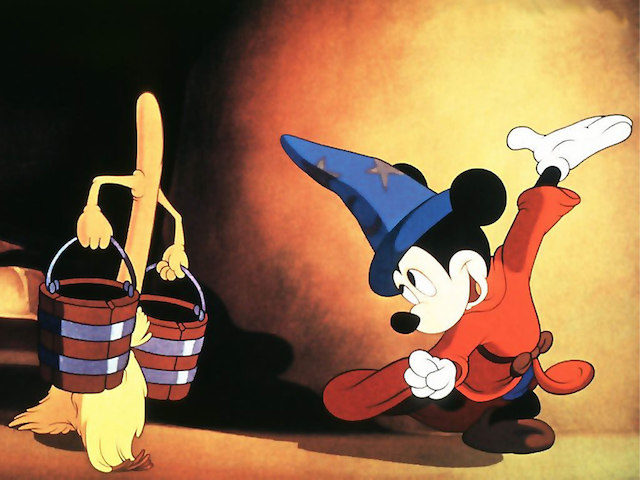
Disney «"Fantasy"» Loved by many for its music and animation, the 1940 film features a lengthy evolutionary sequence showing the origin of life from dinosaurs that's still fascinating to watch. However, in the 1940s, the idea of evolution was still a touchy subject for many people who preferred faith to science, and Disney could get away with a lot.
The original plan was for the evolutionary sequence to continue. It would extend beyond dinosaurs, through mammalian evolution, and finally to human evolution, the creation of fire, and all that good Darwinian stuff. However, none of this made it into the final version of the film. The early evolutionary sequences were left intact because it's just a musical, and no one explicitly mentions science. But the human elements were cut out for fear of offending fundamentalists who would protest the film.
It wasn't just blind fear that stopped Walt Disney. According to animator John Hubley, Disney was threatened. These fundamentalists, who would have wielded considerable political and business influence at the time, made sure Disney knew they didn't want people associated with evolution. Disney was already concerned that the film would struggle to gain recognition, so he gave in to their threats and halted development.
2. In Zootopia, they removed the scene where they force people to wear shock collars.
«Zootopia» is a funny animated film about a world full of anthropomorphic animals performing all sorts of mundane tasks that people do in the real world. The story follows a character named Judy, a police officer, and a rabbit. Hilarity ensues. But the original plan for this film was much darker.
Originally, Nick Wilde was supposed to be the main character, with Judy appearing later. Nick and all the raptors in Zootopia were supposed to wear shock collars that suppressed their predatory instincts. Whenever a predator displayed a negative instinct, they would be beaten. There's a scene, never fully animated, in which Nick and Judy witness a taming party where a small bear is forced to wear a taming collar to be accepted into Zootopia.
The producers eventually decided it was too dark and the characters were unlikable, so they tweaked the story, but early concept art still exists.
1. Kangaroo Jack was filmed as an R-rated movie.
«Kangaroo Jack» It's by no means the most famous movie in history, but the 2003 PG-rated buddy comedy has a solid 8% rating on Rotten Tomatoes, so even if you haven't seen it, you can try to imagine what it might be like.
In the film, two friends try to chase a kangaroo that accidentally runs off with mob money, something that probably happens all the time in Australia. However, the film was once very different from what we believe in the final version. Star Jerry O'Connell once confirmed that the film was originally rated R and even included full-frontal nudity. It was supposed to be a crime comedy like Midnight Run about low-level mobsters. And then the studio intervened.
Apparently, test audiences were under the impression that the silly kangaroo in a jacket used in the promotional material meant it would be a family comedy for kids. Needless to say, they weren't impressed. Instead of changing the film's marketing, the studio retooled it as a family comedy. And judging by the critical reviews, it didn't work.