








Movies often depict all sorts of dangers on screen, whether it's gunfire, explosions, zombies, or even evil leprechauns making terrible puns. However, filming these movies should be fairly safe. You don't expect to be injured or even killed on the set.
Unfortunately, it happens. Whether due to carelessness, incompetence, or simply a lack of concern, some film productions have proven downright dangerous, even deadly.
10. Across the border
We have to start at the very beginning, with the earliest known death to occur during filming in the US, and in fact we're dealing with not one fatality, but two.
It happened back in 1914, before Hollywood became the central hub of American filmmaking. The Colorado Motion Picture Company was filming a Western called«Across the Border"» , using the section of the Arkansas River in Cañon City, Colorado, as a substitute for the Rio Grande. Their leading lady was Grace Forman, professionally known as Grace McHugh. .
At one point, McHugh was about to cross the river on horseback, but her horse stumbled, and she fell into the water and was immediately carried downstream. A brave cameraman named Owen Carter jumped to her aid, but despite being a strong swimmer and the river only a few feet deep, the current was so strong that it swept them both to their deaths. Only days later were their bodies discovered, miles from where they disappeared.
9. Conqueror
Epic «"Conqueror"» The 1956 film is remembered for two reasons. First, because it depicts one of, if not the, most famous mistakes in Hollywood history—John Wayne playing the 13th-century Mongol warlord Genghis Khan. Second, far more serious and controversial—the film was partially shot in the Escalante Desert of Utah, downwind from a nuclear test site. The cast and crew were exposed to nuclear fallout, which could have adversely affected their health and even led to the deaths of some.
John Wayne himself died of cancer. So did the film's leading lady, Susan Hayward, and director Dick Powell. According to a 1980 report, 91 of the 220 cast and crew members developed cancer, 46 of whom died from it. This is due toConqueror ?
This is where the controversy arises, because there's no consensus. Some argue that the cancer rate was in line with the national average. John Wayne, in particular, wasn't particularly surprising, as he smoked several packs a day. But other medical experts believe that only about 30 cases would be expected out of a group of 220 people. Then there are all the native Paiutes who worked as extras and weren't counted in the total, as well as special cases like actor Pedro Armendáriz, who committed suicide after learning he had terminal cancer and therefore wasn't counted either.
Production«"The Conqueror"» highlighted a much more serious issue, namely the issue of downwinders—entire communities who lived downwind from nuclear test sites and were exposed to dangerous radioactive fallout and its impact on their health—an issue that remains far from resolved.
8. Noah's Ark
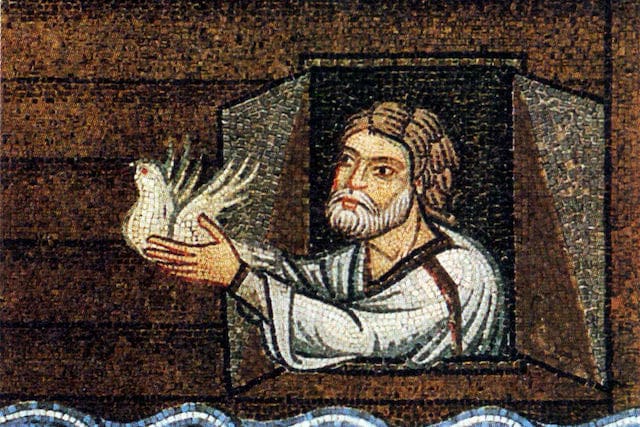
In 1928, when the film industry was just beginning to transition from the silent era to "talkies," WarnerBros. wanted to succeed with a partial talkie, that is, a silent film that included several scenes with sound. They chose an epic disaster film that was a modern retelling of the story of Noah's Ark, called, as you might have guessed, Noah's Ark . As director, the studio hired a young and inexperienced director named Michael Curtiz, who was still a decade and a half away from winning an Oscar for Best Director for the film "Casablanca"« .
Curtis understood the task before him. Make it epic! Don't be afraid to go wild! As the film's poster stated, it was to be "a spectacle for the ages.".
As you might expect, in a film called«Noah's Ark» There would be a Great Flood scene. Because the studio wanted something big, Curtis dismissed suggestions to use miniatures and instead decided to make it as authentic as possible. Therefore, to film the flood scene, which was intended to be the film's climax, the director used dozens of extras and a reported 600,000 gallons of water to simulate the biblical catastrophe.
Predictably, the film crew had little control over the overwhelming flow of water. Three extras are said to have drowned during the scene, another had to have his leg amputated, and dozens more suffered broken bones and other injuries. However, this may be Hollywood legend, as the true scale of the loss of life has never been properly documented. However, one thing was certain.«Noah's Ark »Hollywood has introduced new stunt safety regulations to ensure that a scene like this never happens again.
7. Rust
This is the latest entry on this list, showing that while safety standards in film production have improved, they are still far from perfect. On October 21, 2021, during the filming of the movie "«Rust"» Actor Alec Baldwin used the revolver as a prop, except it contained a live round and went off, hitting cinematographer Halina Hutchins, who died in hospital later that day.
The New Mexico Bureau of Occupational Safety and Health fined the production company the maximum $137,000 for several safety violations, including ignoring two firearm misfires that occurred before the fatal shooting. Meanwhile, the official police report included testimony from several crew members who claimed to have witnessed instances of negligence involving guns on set.
Because this is a recent event, some investigations and numerous lawsuits arising from the tragedy are still ongoing as authorities try to determine who is at fault for the accident.
6. Midnight Rider: The Gregg Allman Story

One common thread you'll notice in most of these stories is that almost no one is punished. Studios and production companies pay civil lawsuits, but nothing more. That changed in 2015, when director Randall Miller became the first American filmmaker in history to actually go to prison for a film-related death.
His sentence was related to his involvement in the unfinished 2014 biographical drama "«Midnight Rider: The Gregg Allman Story »" starring William Hurt. On February 20, 2014, some of the cast and crew were testing the camera on a railroad trestle overlooking the Altamaha River. They thought it was abandoned, but it wasn't, and as a freight train came around the corner, the crew had less than a minute to get out of the way. It essentially turned into a scene from «Stay with me» , but not everyone made it in time. Twenty-seven-year-old camera assistant Sarah Jones was struck and killed by the train, and dozens of others were injured. The subsequent investigation frequently shifted blame, as it became unclear who knew the railway was still in use and who had obtained the proper permits to use it for filming. Ultimately, director Randall Miller pleaded guilty to manslaughter and was sentenced to two years in prison plus eight years of probation.
5. Fitzcarraldo
Let's say you decide to make a film inspired by a real-life 19th-century event in which a wealthy, eccentric industrialist decided to transport a steamboat across the isthmus by dismantling it and dragging it overland from one river to another in the Peruvian jungle. Do you A) use a model and perhaps shoot in a studio because it's much easier and safer, or do you B) head to the Peruvian jungle and insist on using a real steamboat? If you're Werner Herzog, the answer is B, but that's only the beginning of the production challenges for his 1982 epic, "«"Fitzcarraldo.".
First, Herzog's ship weighed 320 tons, nearly 11 times heavier than the actual steamship used a century earlier. The original ship was also divided into more than a dozen pieces to make it easier to transport, but the director insisted on keeping his ship intact because it looked better on camera. To accomplish this feat, Herzog hired over a thousand local extras as laborers.
Given the large number of people involved in production and the fact that much of it took place in the remote Peruvian jungle, some deaths due to disease were inevitable. But some of the other "accidents" included a raid by the Amahuacan people, in which one man was wounded in the neck by an arrow and his wife in the stomach, two plane crashes, a canoe that sank, and, most horrifyingly, a self-amputation, when a snake bit a logger and he was forced to cut off his own leg with a chainsaw.
4. Crow
Perhaps the most famous death to occur during filming was the accidental death of Brandon Lee on the set of the 1994 dark fantasy film«Crow"» . After all, while death on a film set does happen from time to time, the death of a film's protagonist is a much rarer event.
On March 31, 1993, while filming a scene, Brandon Lee walked into the room and was shot by another actor with what was supposed to be a blank. To everyone's horror, Lee immediately lost consciousness with the .44 Magnum bullet lodged in his abdomen and died in the hospital a few hours later.
His death was caused by careless handling of a firearm. The gun used to fire the fatal shot was used in several scenes, sometimes with dummy cartridges and sometimes with blanks. A dummy cartridge looks exactly like a real one, except it contains no gunpowder or primer, making it inert. Because it looks more realistic, it's often used in close-ups, whereas a blank cartridge is the opposite—it contains gunpowder and a primer, but no bullet. This gives you the flash and explosion without the projectile.
In an effort to save money, the film crew made their own mock-up cartridges from real bullets, but they weren't very successful. They removed the gunpowder but left the primer inside. Then, during filming, the primer detonated with enough force to force the bullet into the barrel. Finally, during the fatal scene, the gun was loaded with blanks, which had the same power as the real cartridge, and the two together acted like one very real and very deadly shot.
3. Roar
Movie«Roar» was supposed to be a fun adventure comedy with a well-intentioned message about preserving African wildlife. However, the funniest part of the film, albeit unintentionally, was the title card at the beginning, which proudly proclaimed that "no animals were harmed in the production of this film.".
It was true, but it didn't say anything about people, although... and for good reason.«Roar» is sometimes called "the most dangerous movie ever made." Estimates of how many people were injured on set are all over the place, but they seem to include at least 70 cast and crew members, and possibly more than 100. And keep in mind, these are referring to different people, not different injuries. Many on set suffered multiple injuries, sometimes on the same day of filming, and the film was deliberately shot with non-union talent to circumvent those pesky safety regulations.
What exactly made this film so dangerous? Well, that's easy—it involved over a hundred wild animals, mostly big cats, and very few people capable of keeping them in check. Miraculously, no one died during production, so the numbers didn't go any higher, but the cornucopia of injuries ran the gamut from one extreme to the other. Some suffered only minor scratches or bites, while actress Melanie Griffith required reconstructive surgery after a lioness damaged her face, and cinematographer Jan de Bont received 120 stitches in his head after one of the big cats partially scalped him.
2. Such men are dangerous.
A 1930 film in our day«"Such men are dangerous."» It's almost forgotten. There are a few memorable fun facts about it—it was directed by Kenneth Hawks, brother of the famed classic Hollywood director Howard Hawks, and it starred a pre-Dracula Bela Lugosi. Another not-so-fun fact is that even today it remains the worst plane crash in film history.
On January 2, 1930, three planes carrying eleven men took off from San Pedro to film a flight scene off the coast of Southern California. Only one plane, carrying the pilot and stuntman Fred Osborne, returned. The other two were damaged in a midair collision, killing all ten people on board, including director Kenneth Hawks, an assistant director, four cameramen, two pilots, and two prop men.
Only five bodies were found, and the exact cause of the crash remains a mystery.
1. The Twilight Zone movie«
It's hard to imagine a more dangerous film than one in which five people, including the director, were charged with multiple counts of manslaughter.
In the early 1980s, producers Steven Spielberg and John Landis wanted to make a film version of the mind-blowing sci-fi horror series "«The Twilight Zone» . It was an anthology consisting of four separate parts, each directed by a different director.
Directed by John Landis, the segment featured actor Vic Morrow as a bitter racist who blamed Jews, Blacks, and Asians for all his woes. He was then transported to various time periods, including Nazi-occupied France, rural Alabama, and the Vietnam War, where he was mistaken for each of the minorities he despised, allowing him to experience their suffering firsthand.
Tragedy struck during filming of the Vietnam War scenes, when Morrow and two child actors, Renee Shin Chen and Myka Dinh Le, were supposed to escape from a pursuing helicopter. However, due to all the pyrotechnics, the pilot lost control and crashed into the rotor blades, killing the three actors instantly in one of the most horrific ways imaginable.
Landis, along with an assistant producer, a pyrotechnician, a production manager, and a pilot, were charged with manslaughter, though they were all ultimately found "not guilty.".