








Despite all the wonders of the modern world, there's something to be said about things created in the distant past that still amaze us. With modern technology, we often smugly consider ourselves far more advanced than our ancestors. But then we encounter something truly astounding from the ancient world, and all you can do is stand in awe of how such a thing came to be. And indeed, some of these relics of ancient history are far more fascinating than you might imagine.
10. Antikythera Mechanism
Computers weren't ubiquitous in our world until the 1990s. Home computers began appearing in the late 1970s, but they were still very rare and very basic. Computers for military and government use appeared as early as the 1940s. And then there was Antikythera Mechanism , a 2,000-year-old bronze artifact located near a Greek island that appears to be a very simple type of computer.
Made of brass gears and dials in a watch-like case, the people who discovered it initially had no idea what it could be. The clockwork technology used in it wouldn't be used again until around the 16th century. After careful study, a Princeton science historian determined that the device was used to predict the positions of planets and stars based on the month. So, essentially, it's a sophisticated map of the sky. If you enter a date, the device will show you where the sun, moon, and planets were located in the sky. Essentially, it's a rudimentary computer that helps you quickly and efficiently calculate astronomical coordinates.
Once the date was entered into the device, precisely crafted mathematical gears could calculate the angle of the sun's intersection with the sky and use the resulting gear ratios to display everything else. This included the positions of the known planets, the phases of the moon, a full lunar calendar, a tool for predicting eclipses, constellations, and even a countdown for regular sporting events.
9. Baghdad Battery
Discovered at Hujut Rabu, outside Baghdad, the artifact that became known as Baghdad Battery , It has an asphalt plug, an iron rod in the center, and a copper cylinder around it. If you filled the jar with vinegar, it would produce a charge of 1.1 volts. Hence the name, the Baghdad Battery. And in a very primitive form, it's a version of what we still use as batteries today. But what's remarkable is that it was made two thousand years ago.
At the time of its discovery, there were no instructions or written references to the battery anywhere near it. Over the years, there has been some speculation about its nature, and while it's not generally believed to have been intended to power electrical devices, it could have been used for basic electroplating. Furthermore, it's entirely possible it may have been part of some kind of religious ceremony, as touching it would likely have caused a tingling sensation.
8. Nan Madol
Many remarkable ancient cities have been built in the past, but Nan Madol, located in Micronesia, is unique in the world. It is the only ancient city ever discovered built on a coral reef. Today, no one lives in the ancient city, and locals believe it is a place haunted by spirits. The people who lived and ruled here for over a thousand years were known as the Sadlers. What they built was something of an engineering marvel.
Nan Madol Covering an area of over 200 acres, it comprises 92 artificial islands, built between the 13th and 17th centuries. Black lava was taken from the far side of the island and used to build the city. Some segments were up to 20 feet long and were stacked like logs to construct the outer walls. How the massive stones were transported remains a mystery, although some have hazarded the suggestion that magic was involved. Considering that some of the cornerstones in one building weigh nearly 50 tons, it's not hard to understand why some locals would make such a guess.
The route to where the stones were taken leads through dense jungle. The island's population likely numbered around 30,000, making the undertaking a significant one. Considering that an estimated 750,000 metric tons of stone were used to build the city, this becomes even more impressive. To put into perspective how difficult it must have been, the locals had no metal. This means they had no pulleys or levers to move these stones.
7. Gabon reactor
One of the most exciting discoveries in history is one that few have ever heard of. Located in Gabon, a part of West Africa, is home to the remains of natural nuclear reactor . In other words, nature itself created the conditions for nuclear fission to occur almost exactly as it does in a man-made nuclear reactor. And this happened about two billion years ago, long before any life existed that could have dreamed of creating such a thing.
The reactor in Gabon was capable of producing around 100 kilowatts of electricity. Far from what actual nuclear reactors can produce, but still quite impressive for something that happened by chance in the wild.
So how does nature form its own nuclear reactor? Uranium is naturally found in this region and mined for use in artificial reactors. The conditions for uranium fission were ideal, and it continued to function for over a million years. The waste it produced was even safely stored underground for the past two billion years.
Today, uranium-235 is the most stable fissile source of nuclear energy and accounts for a very small fraction of all uranium in the world. However, two billion years ago, it was present in much higher concentrations, allowing this reaction to occur naturally. All that was really required was to arrange them in the correct geometric pattern. Combined with some moderator to slow down the neutrons—usually water, which is what likely occurred in these natural reactors—and some element to absorb the neutrons, the fission reaction could easily occur.
6. Costa Rican spheres
Many people in the modern world are puzzled by ancient relics because none of them come with instructions, making it difficult to understand what some people are doing. Few relics fit this description better than giant stone spheres , scattered throughout Costa Rica.
The massive carved rocks, the largest of which weighs 16 tons and has a diameter of eight feet, were largely unknown until fruit companies began clearing the area for banana farming. 300 balls have been discovered, and no one knows what they are used for.
The spheres date back to approximately 600–1000 AD, before the Spanish arrived in the area. Their purpose will likely be forever lost to history, and the best researchers can come up with is debunking people's claims about their purpose, since no one really knows.
5. Scythian bongs
Between the 9th century BC and approximately the 4th century AD, if you traveled through the Central Eurasian steppes, you might have encountered a Scythian population. These nomadic tribes roamed the region and were known as impressive warriors, among the first to practice mounted warfare. And they also clearly enjoyed a good high.
Archaeologists have discovered 2,400-year-old artifacts on Russian territory. solid gold bongs , which were used by the Scythians. The bong still contains traces of cannabis and opium. This is consistent with historical accounts of Scythian warriors, who were known to smoke and make tea from herbs, which were said to have some effect on their state of mind.
4. Terracotta Army
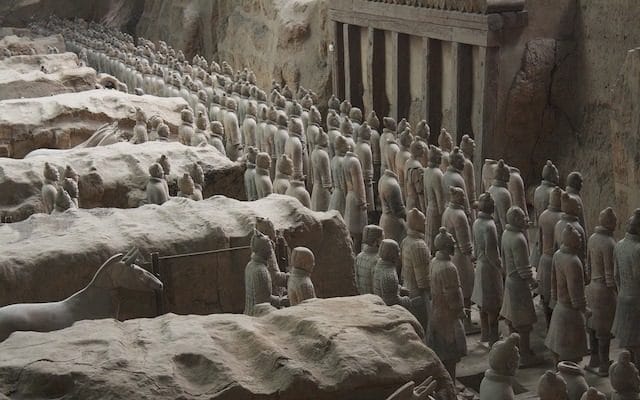
Story Terracotta Army The Terracotta Army is quite well known. Created for China's first emperor over 2,000 years ago, the 7,000 soldiers with their horses and chariots represent one of the most remarkable pieces of archaeological art. But what's less well known about the Terracotta Army is the breathtaking amount of detail used in its creation.
If you've only heard about the army in passing or seen a couple of pictures, you might not notice some of the most interesting details. For example, all 7,000 soldiers are unique. Some archaeologists believe that each one is carved to represent a real soldier from the imperial army. They are not identical, as might initially appear. They have different hairstyles, different clothing, and different decorations on their uniforms. Most importantly, if you look close enough, you'll see that even their ears are different. Some artisans went to great lengths to ensure even the smallest details were present to help distinguish one of these statues from another.
3. Dino Mummy
These days, discovering dinosaur fossils is nothing out of the ordinary. However, the nodosaur remains discovered in the Millennium Mine in Alberta back in 2011 stand out for something unique. Unlike typical fossils, which are typically just stony bones embedded in real rock, this nodosaur remarkably well preserved. Essentially mummified, the animal's skin remained intact.
Nodosaurus, a species of ankylosaur, was 18 feet long and weighed 3,000 pounds. Researchers believe it likely died near water before swimming out to sea, then sank into the silt at the bottom, where it was preserved. The result is not just the skeleton we're accustomed to, but also preserved armored plates and scales. The creature's complete body, after its discovery, makes it look more like a dormant monster than a long-dead fossil.
Not only does this give paleontologists a better understanding of dinosaur armor, some of the remains even have color pigmentation, which can help reconstruct what these animals really looked like. Until now, every time you saw a dinosaur recreation, the coloration was simply based on assumptions.
2. Coprolite Lloyds Bank
While you probably shouldn't Google it, you can take for granted that there were very few excrements of historical significance. That is, when people defecate, it rarely becomes newsworthy; it's certainly not a matter of historical record. A notable exception is Lloyds Bank coprolite .
The Lloyds Bank coprolite, dating to the 9th century, is a fossilized sample of Viking feces. Measuring eight by two inches, it was found beneath the site where Lloyds Bank was building a new location back in 1972. The find was significant both because of its size and because fossilized human waste is actually quite rare.
The composition of the fossil shows that the Vikings who left it there ate a diet rich in meat, cereal grains, and a small amount of pollen. It also contained a huge number of intestinal parasites. Beyond its grossness, this is an unprecedented window into the life of a Viking of that time. Not only because of the diet, but also because of the general discomfort this person must have experienced with all the parasites swarming in their intestines.
Surprisingly, the coprolite was valued at approximately $39,000.
1. Pyramid of Djoser

The Great Pyramid of Giza gets all the attention from people interested in ancient Egypt, but there is another pyramid worth exploring, and that is the Pyramid of Giza. Djoser . The Pyramid of Djoser, dating back to 2630 BC, is actually the oldest pyramid in all of Egypt. It is widely believed that this pyramid was the first and most successful, which, in turn, led to a proliferation of other pyramids. None of them would have existed without the success of the Pyramid of Djoser.
Given that the engineering feat of building pyramids for people at the time still amazes us today, it's significant that this was the first attempt that was clearly successful. The architect responsible for building the pyramid was a man known as Imhotep, a name you likely recognize from pop culture. He was a mummy in films about the Mummy . He also became the Egyptian god of wisdom and medicine. They not only shared the same name, but this man was deified after his death and became part of their pantheon.
The Pyramid of Djoser is much smaller than the Great Pyramid of Giza, but it started a trend and as a result occupies an important place in history.