








For millennia, humans were thought to be the only mammals that practiced agriculture—that is, cultivating the soil and growing crops or other food. That all changed in 2022, when a peer-reviewed study revealed that southeastern pygmy gophers not only dig extensive underground tunnel systems, which speed up the regeneration of partially consumed roots, but also use their excrement to further fertilize the soil. "If agriculture is crop management, that's what they do," Francis Putz, a biologist at the University of Florida who led the study, told National Geographic at the time. His co-author argued that gophers are not pesky invaders, but invaluable "agricultural partners" that shape and enrich ecosystems.
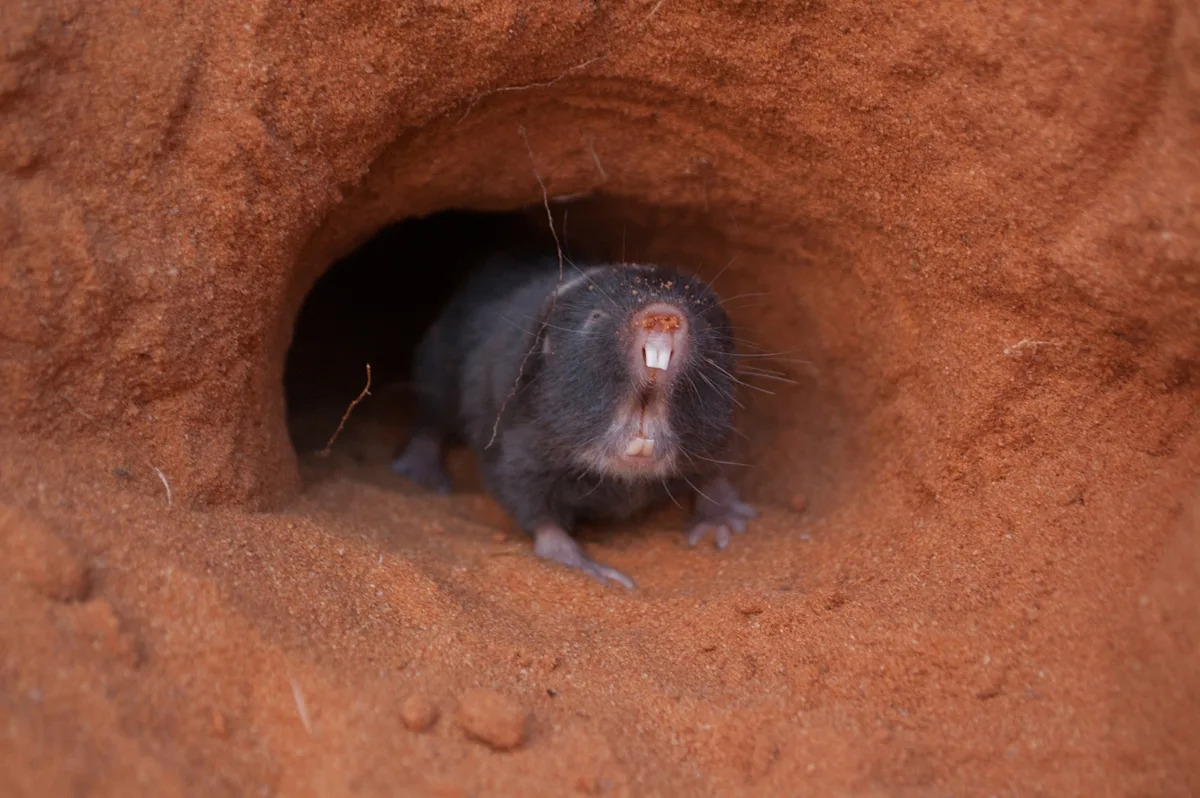
Now a new team of field researchers argues that the evidence for farming behavior may be even stronger among another group of mammals: moles, a family of subterranean rodents found only on African soil.
Blind mole-rats are already known for their remarkable biological properties, including cancer-fighting and aging-slowing properties, and researchers hope this will help discover new avenues for extending human lifespan. The biology of naked mole-rats—smaller and distantly related evolutionary relatives of the South African blind mole-rats—has attracted particular attention. However, the underground behavior of blind mole-rats has received far less attention.
According to Kyle Finn, a zoologist at the Kalahari Research Centre and a research fellow at Linnaeus University, evidence of farmers cultivating geophytes—plants that store nutrients underground in bulbs and tubers—has been documented in at least half a dozen scientific papers, though often as a footnote rather than a primary focus of research. "Scientists sometimes obsess over farmers and the fountain of youth," says Finn, "but the vast underground worlds these animals create are remarkable in their own right." In some cases, farmers have even been shown to construct tunnels that spiral 360 degrees around a nutrient-rich tuber to enjoy it from all angles.
Research shows that instead of simply aerating and fertilizing the soil, as gophers do, moles vigorously fill their burrows with soil to accelerate plant regeneration. Among their favorite plants are the tubers and bulbs of wild ginger, fleshy cucumbers, and sweet potatoes.
«"Many areas south of the Sahara appear desert-like at first glance," says Finn, "because all the activity takes place underground.".
Unconventional agriculture in a world without light
African mole rats have lived less than a foot beneath human feet since the dawn of our species, but only in the last two decades have scientists begun to understand what goes on in their subterranean world.
In 2009, zoologists gained their first complete understanding of the rodents' complex underground shelters when Czech researcher Radim Šumber and his team used radio tracking to monitor the moles' movements and then spent over a month excavating their habitats. The scale of the self-sufficient complex they discovered was astonishing.
Nearly two miles of tunnels snaked between family nests, food storage chambers filled with collected plants, and designated toilet areas. Most tunnels were only a few inches underground, but some deeper ones—colloquially known as "highways"—enabled efficient movement between key locations. Given the limited number of spaces wide enough to turn around, the diggers also mastered the art of running backwards, moving like subway cars.
(Using publicly available data and Schumber's raw field notes, cartographer Oliver Uberti created the first-of-its-kind map of these subterranean communities. You can see it here or in my new book, Hidden Animal Nations.)
Like other researchers, Finn says he stumbled upon evidence of mole farming largely by accident while studying other behavioral patterns within their underground networks.
During field studies of naked mole rats' ultradian rhythms, which involve up to five periods of activity per day in place of the long sleep-wake cycle of most mammals, Finn says he and his colleagues regularly found wild plants that directly intersected with naked mole rat burrows and were eaten and reclaimed multiple times.
Plants are regenerating in a tunnel dug by a digger. Dr. Kyle Finn.
As Finn notes, cultivating geophytes doesn't appear to be the moles' only food source. If they find a plant small enough to consume in one sitting, they usually do so. But moles also know the precise locations of their current and buried tunnels, which they navigate using the Earth's magnetic field as a compass. If the plant is large enough, they'll take a bite or two, fill the tunnel with soil to stimulate regeneration, and then return later to enjoy it again. Over the course of their evolutionary history, the success of this technique—likely initially unintentional—may have become an evolutionarily ingrained trait, observed even among mole species without a large family structure.
Additional fieldwork by Schumber and colleagues revealed the first evidence of farming in a solitary, rather than social, mole species, Heliophobius argenteocinereus, which also "partially consumes the tuber on site and then fills the remaining tuber cavity with soil, allowing the geophyte to continue growing.".
It's unclear how long moles have been farming, but research suggests these rodents have inhabited southern Africa since at least the Pleistocene, which began approximately 2 million years ago. Their evolutionary ancestors appeared even earlier. For comparison, fossil evidence suggests that southeastern pygmy ground squirrels appeared around 1.3 million years ago, while Homo sapiens only began farming just over 10,000 years ago.
In other words, Finn believes naked mole rats may have been the first mammals to practice agriculture in Africa—or anywhere else.
Is this really "agriculture"?
When contacted for comment on these findings, Putz, the author of the 2022 pygmy ground squirrel study, was delighted to learn about the African farmers' activities. He said the characterization of their behavior as "agricultural" was "absolutely accurate.".
«"There's bound to be controversy over this term," Putz said, noting that the Florida Farm Bureau responded to his groundbreaking research by declaring that agriculture only exists when the plants cultivated are "useful to humans." This narrow definition struck him as both arbitrary and self-serving.
When I last spoke with Putz, he was conducting fieldwork in Australia, where many Aboriginal peoples have a rich history of using creative cultivation methods. Instead of planting seeds in rigid rows, he said, they carefully remove plants that compete with their favorite food. Early European colonists categorically refused to recognize this practice as "farming," as it was so radically different from the traditional methods they were accustomed to. "To naive outsiders, they appeared to be hunter-gatherers—simply because the landscapes from which they foraged remained wild.".
Ryan Huling is a freelance writer based in Sierra Madre, California. He writes about animals, food, and technology, and is the author of "Hidden Animal Nations.".