






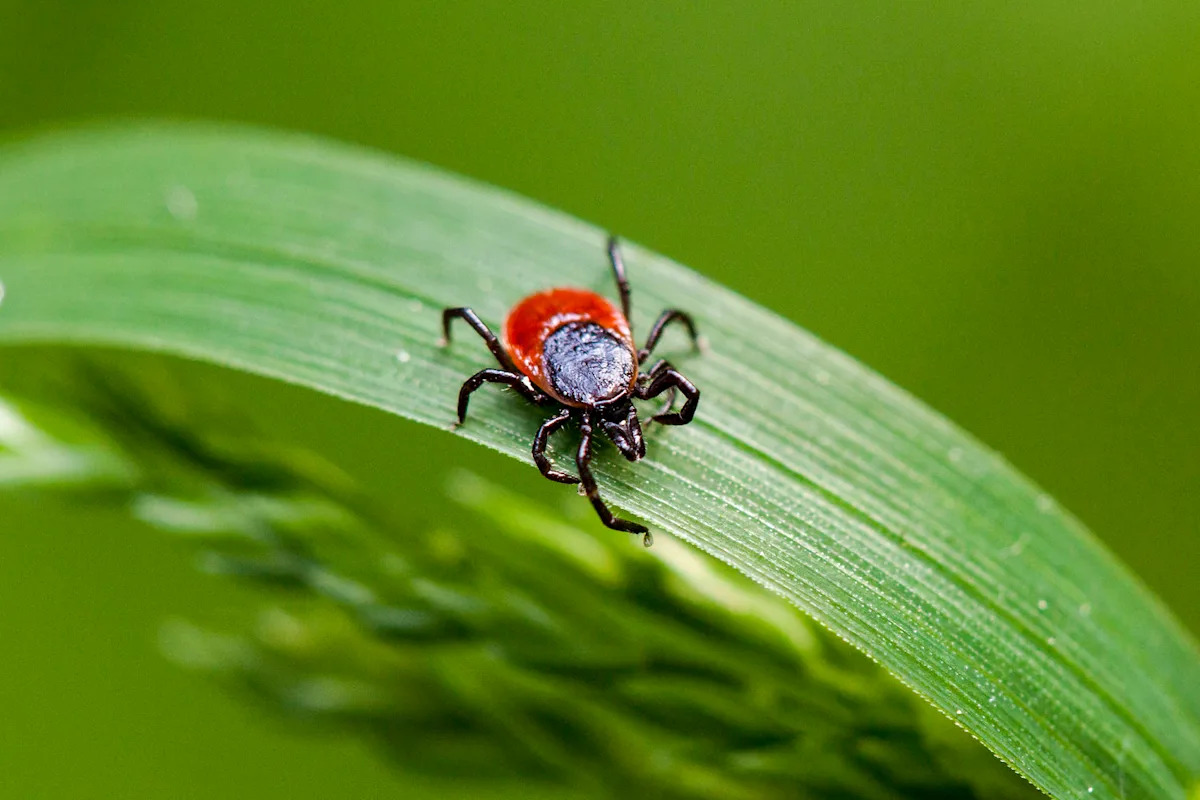
A new type of Lyme disease has been discovered in New York State.
Almost all cases of tick-borne illness in the United States are caused by the corkscrew-shaped bacteria Borrelia burgdorferi. However, B. burgdorferi is actually one of two species of bacteria that cause Lyme disease in the United States. The other species, Borrelia mayonii, is much less common. So far, it has only been found in Minnesota and Wisconsin. Both types of bacteria are spread by ticks.
A case of Lyme disease, caused by Borrelia mayonii, was identified in upstate New York last July, according to a report from the Centers for Disease Control and Prevention released Thursday.
The new case was confirmed in an adult living in Herkimer County, which stretches from the outskirts of Utica to the Adirondack Mountains. According to the report, the individual had no recent travel history.
The state Department of Health found several ticks in the man's wooded area, which tested positive for the bacteria. However, a much larger search, involving over 1,500 ticks from 24 New York counties, did not re-detect the bacteria.
It is not known exactly how the bacteria arrived in Herkimer County.
«"While this discovery was unexpected, we know that the diversity of ticks and the diseases they carry can change geographically over time," a New York State Department of Health spokesperson said in an email.
Douglas Norris, a professor of molecular microbiology and immunology at the Johns Hopkins Bloomberg School of Public Health in Baltimore, said the bacteria have likely been present in New York City ticks for a couple of years, although their distribution appears to be limited to a very small area.
Same disease, different symptoms.
Researchers know much less about B. mayonii than about B. burgdorferi. There have been far fewer cases of B. mayonii infection studied, and the bacterium itself was discovered by researchers at the Mayo Clinic in Rochester, Minnesota, only in 2016—35 years after B. burgdorferi. Both species can cause severe illness.
Both infections can begin with fever and headache, but Lyme disease, caused by Borrelia mayonii, more often results in nausea and vomiting.
According to Norris, people infected with less common tick species may not have the characteristic target-shaped rash around the bite site. Instead, they may have a more generalized rash that appears as tiny red spots anywhere on the body, not just at the bite site.
«"People are also more likely to have neurological symptoms," said Dr. Bobbi Pritt, a pathologist at the Mayo Clinic. Pritt was one of the scientists who discovered the B. mayonii bacteria. "There may be other, more common symptoms that we haven't seen yet.".
The Health Department declined to disclose the symptoms experienced by a New York City resident who contracted the B. mayonii bacteria last year.
Rising number of Lyme disease cases
In recent years, the incidence of Lyme disease has risen sharply in the northeastern United States. According to the Department of Health, between 2020 and 2024, the incidence of Lyme disease in New York State increased by nearly 450%, from approximately 37 cases per 100,000 people in 2020 to nearly 165 cases per 100,000 people in 2024.
While more cases of B. mayonii are likely to appear in the Northeast region, Pritt said, these infections are expected to remain rare.
«"I think Borrelia burgdorferi will remain the most common form of Lyme disease in the United States, because we know that Borrelia mayonii is not the primary cause of Lyme disease," she said.
Even in the Midwest, where B. mayonii has previously been identified, it causes only a minority of Lyme disease cases. According to the Minnesota Department of Health, B. mayonii accounts for only about two of the nearly 3,000 Lyme disease cases diagnosed in Minnesota each year.
According to the Department of Health, only 0.21 TP3T of nymphs, or young ticks, collected across New York State were carriers of B. mayonii, compared to approximately 11 TP3T of adult ticks. B. burgdorferi, on the other hand, infects about a quarter of nymphs in the Northeast and half of all adult ticks.
Ticks must remain on a person's body for 24 to 48 hours before they can transmit infectious bacteria, so stealth is crucial. For this reason, it's typically the nymphs, which are about the size of a poppy seed, that transmit Lyme disease, Norris said.
«"People usually notice the big ticks, but these little ones aren't so easy," Norris said.
Climate change is expanding the range of Lyme disease.
Climate change is altering the distribution of tick-borne diseases, though Norris says it's unlikely to be the cause of the B. mayonni tick's arrival in New York City.
«"Unfortunately, he hit the sweet spot," he said.
Experts don't know how the bacteria got there, but Norris said it's possible an infected tick could have been carried by a bird migrating to New York from Minnesota or Wisconsin.
New York City and the broader northeastern United States have ideal weather conditions for ticks that cause Lyme disease to reproduce to the point where they can infect humans. This so-called "hot spot" is shifting north due to climate change, into Maine and southern Canada, leading to a more widespread Lyme disease outbreak and a sharp increase in cases in places like New York City, where Lyme disease has been circulating for decades.
Pritt said that to prevent tick bites, people should stay in the middle of trails while hiking to avoid contact with tall grass, which can harbor ticks. When possible, wear long sleeves and tuck pants into socks to prevent ticks from attaching to the skin, she said. Pritt also recommends using insect repellent containing DEET or lemon eucalyptus oil. It's also helpful to check yourself and your pets for ticks about every hour while in tick-infested areas. Showering and thoroughly checking for ticks upon returning home are also helpful.
«"We don't want people to be afraid to be outside," she said. "But ticks can carry a variety of diseases, including parasitic and viral ones, so the most important thing is for people to protect themselves from tick bites.".
This article was originally published on NBCNews.com.