






When you make a purchase through links in our articles, Future and its distribution partners may earn a commission.
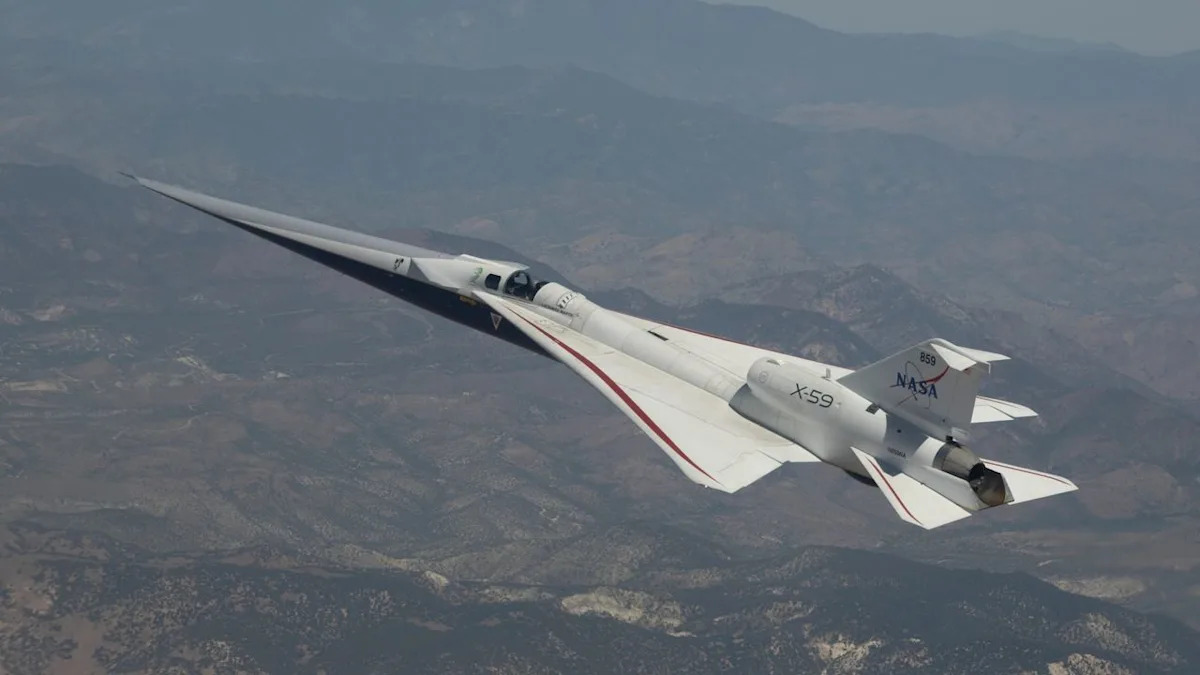
Will the X-59 finally break the sound barrier? | Photo: NASA/Jim Ross
NASA's X-59 fighter jet is on the verge of finally breaking the sound barrier.
The X-59 is a supersonic aircraft designed with a radically elongated geometry to reduce the volume of sonic booms created when breaking the sound barrier. NASA's goal in developing the X-59 is to advance the development of "silent" supersonic technologies that could lead to aircraft designs that minimize the impact of sonic booms on the ground, potentially lifting existing restrictions on supersonic flight.
Following its first test flight in October 2025 and 14 test flights since March 2026, the X-59 is finally ready to conduct its first supersonic flight this month, NASA announced. According to the agency, the aircraft will reach speeds of Mach 1.4 (925 miles per hour or 1,489 kilometers per hour) at an altitude of approximately 55,000 feet (16.7 kilometers). "The first supersonic flight of this unique aircraft awaits us," said Katie Bam, NASA's Low Sonic Boom Flight Demonstrator project manager. "Completing the first flight under mission conditions is especially significant—this is the moment when we begin validating the aircraft in the environment for which it was designed," Bam said in a statement.
NASA recently completed several key milestones in the X-59 test program ahead of its first attempt at supersonic flight. Just a month ago, the aircraft retracted its landing gear for the first time, revealing what it would look like in flight.
NASA's silent X-59 supersonic research aircraft flies over the Armstrong Flight Research Center in Edwards, California. | Photo: NASA/Jim Ross
The X-59 recently reached speeds of Mach 0.95, or approximately 627 mph (1,009 km/h), and completed its first two test flights in a single day. Engineers and technicians working on the program now have a much better understanding of the aircraft and its unique systems.
NASA's X-59 supersonic research aircraft flies silently over the Rogers Dry Lake near the Armstrong Flight Research Center in Edwards, California, Tuesday, May 12, 2026. | Photo: NASA/Jim Ross
One of the X-59's most unique features is its so-called eXternal Vision System (XVS). Due to the X-59's elongated nose, pilots wouldn't be able to see through the front windshield—if they even had one.
The X-59 design completely eliminates the front windshield, instead using a series of cameras that transmit images to an augmented reality display. With the XVS, X-59 pilots see what's in front of the aircraft, completely eliminating the nose cone from the frame.
An image of the X-59's XVS system inside the cockpit. The XVS system provides pilots with augmented reality, compensating for the aircraft's lack of a forward windshield. | Source: NASA
The X-59 is currently undergoing Phase 1 testing of NASA's program, designed to evaluate the aircraft's initial low-speed performance and verify its airworthiness. NASA is also testing instrumentation to determine the nature of the shock waves generated by the X-59.
One of NASA's F-15B research fighters performs a calibration flight of the shock wave probe developed for the X-59 test campaign over Edwards, California, Aug. 6, 2024. | Photo: NASA/Steve Freeman
Following the first supersonic flight of the upcoming tests, NASA will begin the second phase of the X-59 test campaign around the end of 2026.
This milestone will be key to achieving NASA's overall goal for the mission: reducing the impact of the sonic boom felt on the ground beneath an aircraft as it flies over terrain faster than the speed of sound.
Since 1973, supersonic flight over land within a certain distance of the United States has been prohibited due to the deafening sonic booms' destructive effects on people on the ground. NASA hopes that the technologies developed for the X-59 will lift restrictions on supersonic flight over the continental United States, paving the way for the resumption of commercial supersonic flight.
«"Looking forward to these upcoming flights, we're ready to push the boundaries of what's possible even further, boldly approaching the mission milestone this aircraft was designed to achieve," NASA said in a statement. "Flying supersonic and achieving these milestones isn't just progress; it's the embodiment of decades of perseverance, innovation, and teamwork. Every step brings us closer to Phase II and the future of commercial supersonic aviation.".
Beyond NASA, several private companies, including Colorado-based Boom Supersonic, are developing aircraft capable of quieter supersonic flight. Boom Supersonic completed its first successful supersonic flight last year, becoming the first civilian aircraft to achieve supersonic speeds over the continental United States.
Commercial supersonic flights would significantly reduce travel times and could be a great help for disaster relief, medical transportation, and more.