








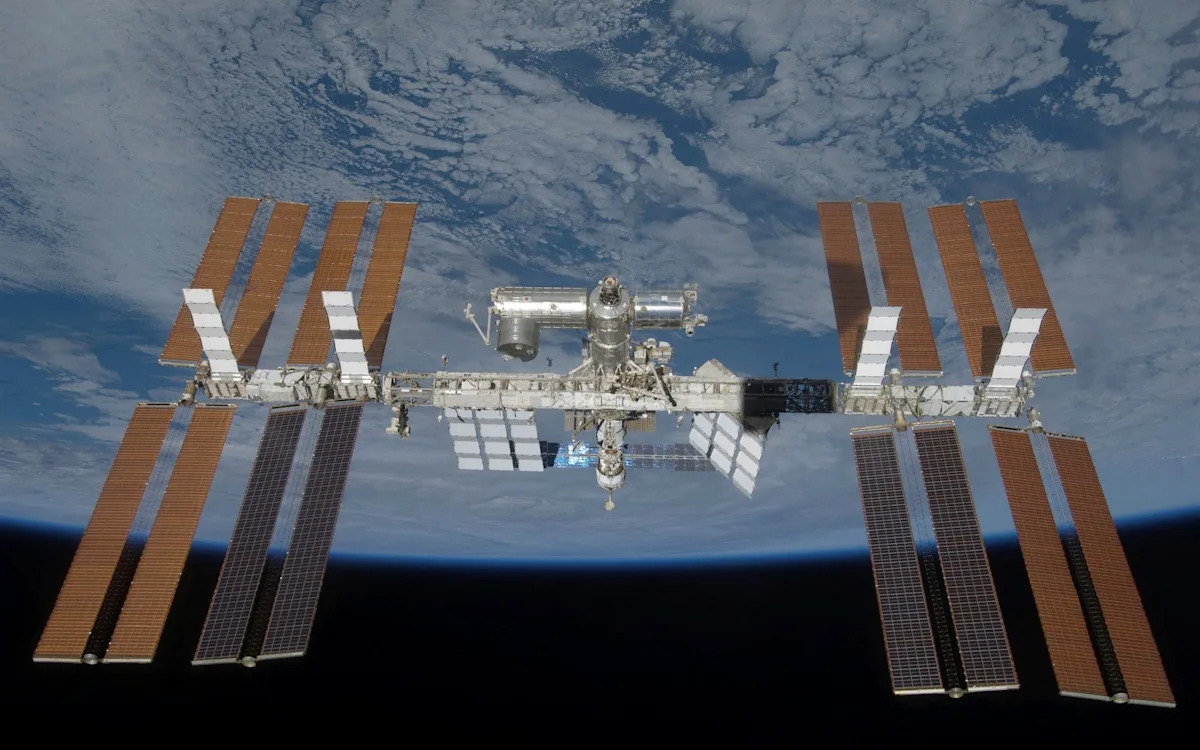
An air leak aboard the International Space Station (ISS) forced astronauts to take refuge in their lifeboats on Friday afternoon, fearing they would need to be evacuated.
Since 2019, NASA and the Russian space agency Roscosmos have been attempting to seal microscopic structural cracks in the transfer tunnel leading to Russia's Zvezda space module.
At its peak, the leak was escaping more than two pounds of air per day, but in recent months the astronauts believed they had the problem under control.
However, in May, Russian cosmonauts unloading cargo from the Progress 95 spacecraft noticed a slow drop in pressure in the Zvezda module and discovered that the leak had resumed.
NASA astronauts Jack Hathaway and Jessica Meir, Russian cosmonaut Andrei Fedyayev, and ESA astronaut Sophie Adenok — Steve Nesius/REUTERS
NASA ordered five ISS crew members to take shelter inside the docked SpaceX Crew Dragon "Freedom" spacecraft on Friday while the remaining two Russian cosmonauts attempted to conduct another assessment and repair.
At approximately 3:30 pm BST, mission control informed NASA astronaut Jessica Meir that the Russian crew had decided to "take measurements only" of the leaks, and therefore "safe haven configuration" - or order to take cover — is cancelled.
«"We're ready to exit safe haven mode," the astronauts were told in Houston. "During today's operations, they wanted to exercise extra caution and take additional precautions to ensure the crew transitioned to safe haven mode," a NASA spokesperson later said.
The "safe haven" configuration is an emergency safety procedure in which crew members take refuge in their docked spacecraft, using them as "lifeboats" from which to immediately evacuate to Earth in the event of a catastrophic failure on the space station.
Astronauts close hatches connecting various modules of the space station, isolating the vulnerable area to prevent sudden depressurization.
Crew members move into their docked vehicles and configure the spacecraft's internal systems for autonomous operation, such as activating life support systems and establishing communications with ground stations.
The astronauts strap themselves into their seats, ready for immediate evacuation.
The hatches were opened and the astronauts returned to the space station shortly after 4:00 pm BST.
Jessica Meir of NASA - NASA, SWNS
Bethany Stevens of NASA's communications office said: "The Zvezda service module transfer tunnel has been suffering from cracks and leaks for some time, and Roscosmos has been working hard to fix these problems.".
«"The cracks have always been a concern, and NASA is monitoring them closely.".
«"Due to new leaks, Roscosmos has decided to conduct more extensive repairs on Friday, June 5. Out of an abundance of caution, NASA has ordered all four SpaceX Crew-12 crew members and NASA astronaut Chris Williams to take up a high-safety position in the Dragon spacecraft during the repairs.".
Ms. Stevens said Russian repair work was currently suspended.
«"As a result, NASA has instructed the Dragon crew to complete safe harbor procedures and return to scheduled operations aboard the International Space Station," she added.
«"We look forward to collaborating with Roscosmos on a joint approach to addressing the leak problem.".
0606 Information leak from the International Space Station
In addition to Ms Meir and Mr Williams, the ISS crew includes Sergei Kud-Sverchkov, Sergei Mikayev and Andrey Fedyayev from Roscosmos, Jack Hathaway from NASA and Sophie Adeneau from the European Space Agency.
There have been several alarming incidents in recent years where astronauts aboard the station have had to scramble to their shelters, but so far none have resulted in an evacuation.
In 2024, the decommissioned Russian satellite Resurs-P1 unexpectedly broke apart into more than 100 pieces of space debris, and the nine astronauts aboard the ISS were ordered to seek shelter in a safe location.
The crew split into several docked capsules, including a Boeing Starliner, SpaceX Crew Dragon, and Soyuz, and waited for about an hour while ground teams assessed the debris cloud's trajectory before receiving clearance to resume flight.
Emergencies on the International Space Station
In 2021, a Russian anti-satellite missile test created a cloud of over 1,500 trackable debris particles. The crew was forced to remain in SpaceX Soyuz and Indoor Dragon capsules for the first few passes through the cloud before it was declared safe.
In 2015, an old Soviet weather satellite was discovered too late for the crew to move away, and it was again forced to retreat to a safe location until the danger passed. Similar retreats due to space debris occurred in 2012 and 2009.
NASA previously stated that the air leak did not pose a danger to the crew, but the astronauts encountered difficulties in fixing it despite numerous checks and the use of sealants.
Roscosmos dealt with the situation by keeping the module hatch closed to the rest of the station and maintaining a lower pressure inside, performing small pressurizations when necessary.
However, this raises questions about the future of the ageing plant, which was scheduled to be decommissioned in 2030 but recently had its lifespan extended until at least 2032.
Try The Telegraph today for full free access. Discover their award-winning website and essential news app, plus helpful tools and expert guides on finance, health, and leisure.