








When you make a purchase through links in our articles, Future and its distribution partners may earn a commission.
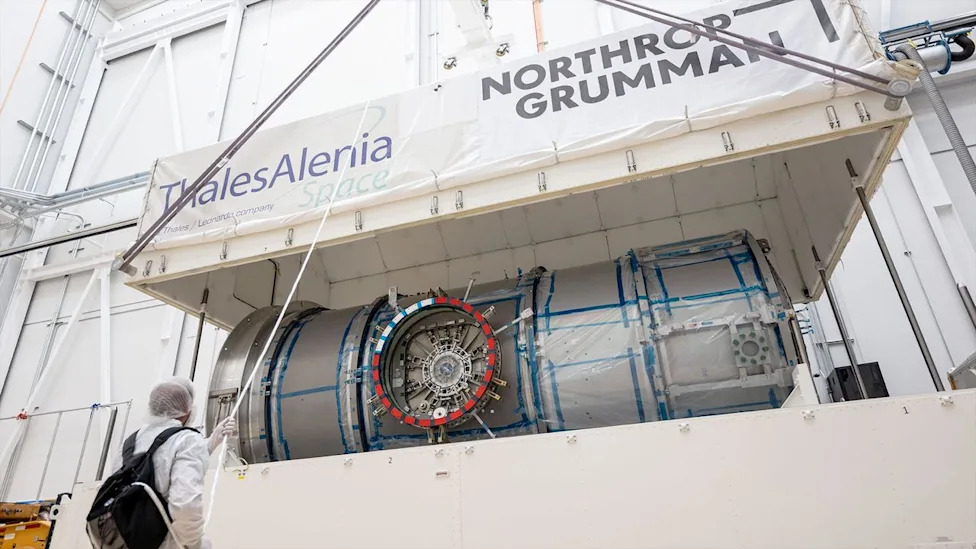
Photo: NASA/Josh Valcarcel
Not every canceled NASA program gets a glowing post-crash treatment, but one such project is finding new life by providing components to help the space agency reach its lunar base goals faster.
Northrop Grumman is repurposing hardware and technology from the Habitation and Logistics Outpost (HALO) space station module for use in a new series of Lunar Infrastructure Demo (LID) missions. HALO was originally designed as a habitat for the canceled Gateway lunar station, but was threatened with cancellation when the agency restructured the Artemis program architecture earlier this year.
Rather than abandon the unfinished module entirely, Northrop Grumman is adapting HALO's electrical and mechanical components to support the development of technologies for a lunar base capable of surviving the frigid, weeks-long night at the Moon's south pole and supporting long-term habitation by astronauts.
One of the reasons NASA canceled the Gateway project was the need for urgency. As the Artemis program's concept developed and astronauts returned to the lunar surface, China's plans to land the first taikonauts on the Moon gradually took shape. These ambitions, along with the ongoing development of China's lunar program, have ushered in a new space race, in which the US and NASA intend to maintain their leading positions.
In March, NASA Administrator Jared Isaacman announced a reorganization of the Artemis program designed to provide a more phased approach to developing the technologies needed for a next-generation human lunar landing and to accomplish that landing as quickly as possible.
According to the current schedule, the first astronaut landing on the Moon, the Artemis IV mission, is planned for late 2028. However, before then, NASA is planning about two dozen unmanned missions to the Moon to lay the groundwork for the infrastructure needed to return astronauts. Rather than let the HALO spacecraft gather dust in storage, Northrop is redoubling its efforts in this direction.
«"To help NASA move faster… HALO's energy, data, and mechanical interfaces will enable NASA to act quickly and begin collecting real-world data on lunar surface characteristics sooner," the company said in a press release on August 4.
Northrop Grumman's Lunar Infrastructure Demonstration Projects (LID-1, LID-2, and LID-3) will leverage technologies developed through the HALO project to rapidly advance lunar surface power, heat, autonomy, communications, and payload hosting services that can withstand the lunar night and scale up to permanent infrastructure near the lunar south pole. | Source: Northrop Grumman
Northrop announced three LID missions aimed at "reusing technologies developed through the HALO project to rapidly improve power, thermal, autonomy, communications, and payload systems on the lunar surface." This will help NASA gather data to better protect robotics and crews during long-duration missions near the lunar south pole, where the agency plans to establish its lunar base as part of the Artemis program. Neither the company nor NASA has specified target dates for these missions.
NASA is specifically exploring the Moon's south pole due to the abundance of water ice discovered by scientists in this region. If properly managed, these ice deposits could be used for a variety of purposes, enabling sustainable life on the lunar surface—the ultimate goal of the Artemis program—including drinking water, radiation shielding, and rocket fuel.
NASA believes that overcoming the technological barrier of "in-situ resource utilization" (ISRU), or the ability to rely on locally available materials for survival, is the gold standard of spaceflight, opening the door to long-term human space exploration. For example, producing propellant off Earth would significantly increase the range of any given space mission, as nearly 95% of a rocket's mass at launch consists of propellant. Thus, the ability to refuel in space, eliminating the need to launch into orbit with a full tank, would enable satellites and crewed spacecraft to travel much further into the solar system than current launch systems allow.
While the Artemis program itself is aimed at establishing a permanent human presence on the Moon, NASA also views it as a testing ground for technologies that could one day support astronaut flights to Mars. However, concerns exist about the national security and economic implications of China beating the United States to the Moon, making speed a top priority for those responsible for the country's return to the Moon.
«"As America enters the next chapter of human space exploration, our lunar infrastructure demonstration projects will help transform the Moon into a place where astronauts can stay, work, and make discoveries that benefit humanity," said David Schiller, Northrop Grumman's vice president of civil space and science development, in a statement. "Our flight-ready, robust HALO technologies enable NASA to move faster, building robust infrastructure capable of withstanding the lunar night and laying a solid foundation for a future lunar base.".