








Scientists have long established a connection between dinosaurs and the various birds we see around us today. Archaeological exhibits confirming this fact are housed in museums around the world. However, if there is living proof of this lineage, it is one of the ugliest birds on planet Earth – the shoebill, also known as Balaeniceps rex. Shoebills are typically large birds (though not particularly fleshy) with plumage that combines blue-gray, dark gray, and slate hues. With their unusual beak, doe-like eyes, and long, thin legs, shoebills look like comic book characters. Here are 10 amazing facts about the shoebill.
1. The beak, resembling a Dutch wooden shoe, gave rise to the name "shoebill".

Over the years, the shoebill has been given many names, including "whale-headed," "whale-headed stork," "boat-billed," and "marsh bird," to name a few. However, its current name comes from the distinctive shape of its beak, which resembles a Dutch wooden clog. (source)
2. Shoebills are more closely related to pelicans than to storks.

Since their discovery, scientists have long attempted to classify shoebills into a specific family. According to one view, the shoebill's vocal organs are similar to those of herons in the Pelecaniformes family, which also includes pelicans and ibises. However, due to structural differences, some scientists place the shoebill in the Ciconiiformes family. However, recent studies examining the structure of shoebill eggs and DNA have shown that it is more closely related to pelicans. (source)
3. Shoebills, native to Africa, live in swamps and marshes.
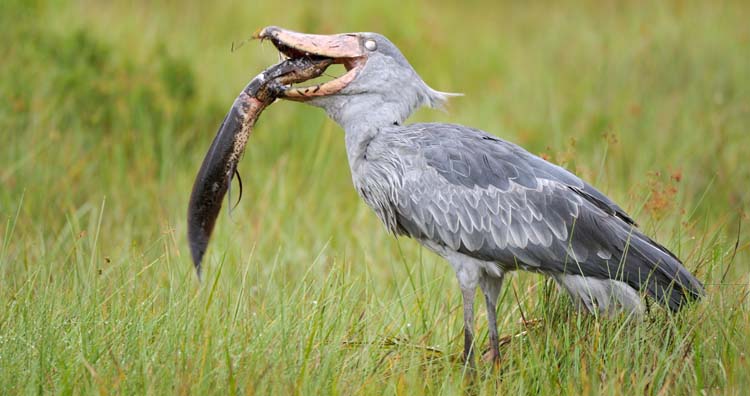
Shoebills inhabit freshwater swamps and marshes. Native to Africa, they are found in South Sudan, Uganda, Rwanda, Congo, Zambia, and Tanzania. They can be found in large numbers in the West Nile region of Sudan. Outside of their natural habitat, shoebills are occasionally seen in some zoos, such as the San Diego Zoo Safari Park, Prague Zoo, and the Dallas World Aquarium. (source)
4. Long, thin legs give the shoebill its characteristic morphology.

As its name suggests, the shoebill is a bird of unusual appearance. It has long, spindly legs the same color (blue-gray) as its feathers. Shoebills are tall birds, ranging in height from 110 to 140 cm (43–55 in), with some specimens reaching 152 cm (60 in). Their tarsus length ranges from 8.5 to 10 inches, and their large feet help them stand steadily on aquatic vegetation while hunting. A typical adult weighs between 4 and 7 kg (9.8 and 15.5 lb), with males being heavier than females. (source)
5. Shoebills have the third largest beak in the bird kingdom, strong enough to kill even baby crocodiles.
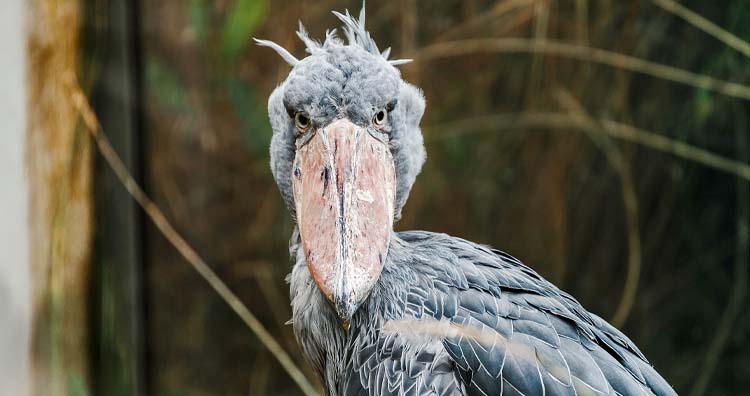
The unique feature of this bird, which gives it its name, is its enormous, convex bill. Measuring 7.4 to 9.4 inches in length, it is considered the third largest bill after pelicans and storks. The bill is exceptionally strong, and thanks to the curved hook at the end, it can kill prey with a single blow. The shoebill's bill allows it to easily consume lungfish, catfish, snakes, and even baby crocodiles. The bill also helps clear out vegetation, which is often swallowed by the fish. (source)
6. With a flapping rate of only 150 beats per minute, they have the lowest rate of any living bird.

Shoebills have an astonishing wingspan—from 7 feet 7 inches to 8 feet 6 inches. This is five times their body size. Shoebills use their wings for balance while standing, protection from predators, and flight. This is where they set another record. They have the lowest wingbeat rate of any flying bird—150 wingbeats per minute. They more than compensate for this by tilting their heads and necks back to improve aerodynamics and enable them to fly longer. (source)
7. Shoebills are usually quiet, but often make loud sounds similar to a machine gun.
Shoebills are relatively quiet birds, capable of remaining silent for days at a time, save for the flapping of their wings. However, when they do make a sound, it is extremely loud. This is especially noticeable during the mating season, when the male attempts to attract a female during courtship. Repeated bursts of sound are created by clapping the upper and lower parts of the bill, reminiscent of a machine gun or a breeding drum. During nesting, chicks and adults use bill clapping to communicate with each other. Chicks have been recorded making a sound similar to human hiccups when begging for food. (source)
8. Shoebills can stand motionless in the water for hours, waiting for their prey.
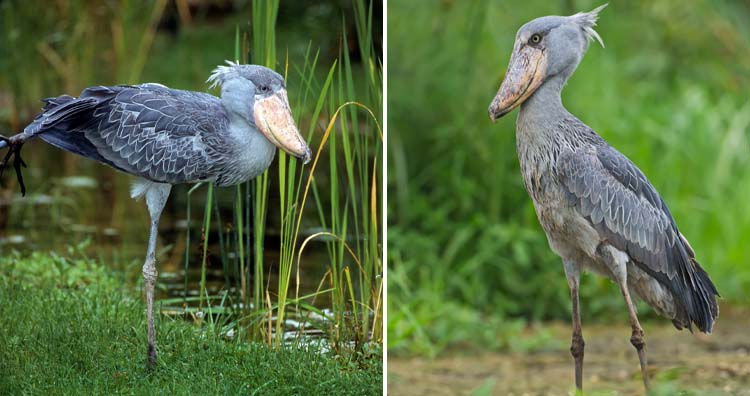
In addition to long periods of silent hunting, shoebills can also stand perfectly still (like a statue) for hours on end, waiting for prey. This technique is commonly known as "stand and wait." When prey is spotted, the shoebill quickly "falls" on it. However, this limits the frequency of the shoebill's attacks. It must regain its balance before attacking again. Up to 10 minutes can pass between attacks. (source)
9. Turbid waters with low oxygen levels are favorite feeding grounds for shoebills.

Shoebills prefer aquatic environments for hunting, particularly turbid, low-oxygen waters. This forces the fish to surface frequently to breathe, making hunting easier for the bird. When hunting, shoebills prefer to maintain a distance (about 20 m) from each other, giving each other ample space to hunt. Shoebills exhibit an unusual attachment to hippos. This is primarily due to the hippos pushing the fish to the surface when they enter the water. (source)
10. It has been established that shoebills live up to 35 years.

Shoebills live long and fulfilling lives, with recorded lives of up to 35 years. Their lives begin in a nest built by their parents, but they are then forced to abandon the nest at the tender age of just three months. After fledging, shoebill chicks are forced to forage for food on their own, guided by their parents. Despite their ferocity and aggressiveness, shoebills are endangered. According to the IUCN Red List, the current shoebill population is estimated at between 3,300 and 5,300 individuals. Their numbers are steadily declining due to human threats and frequent habitat loss. International and local organizations in Sudan, Zambia, Tanzania, and Uganda constantly monitor the population of this unique bird and take measures to combat poaching. (source)