








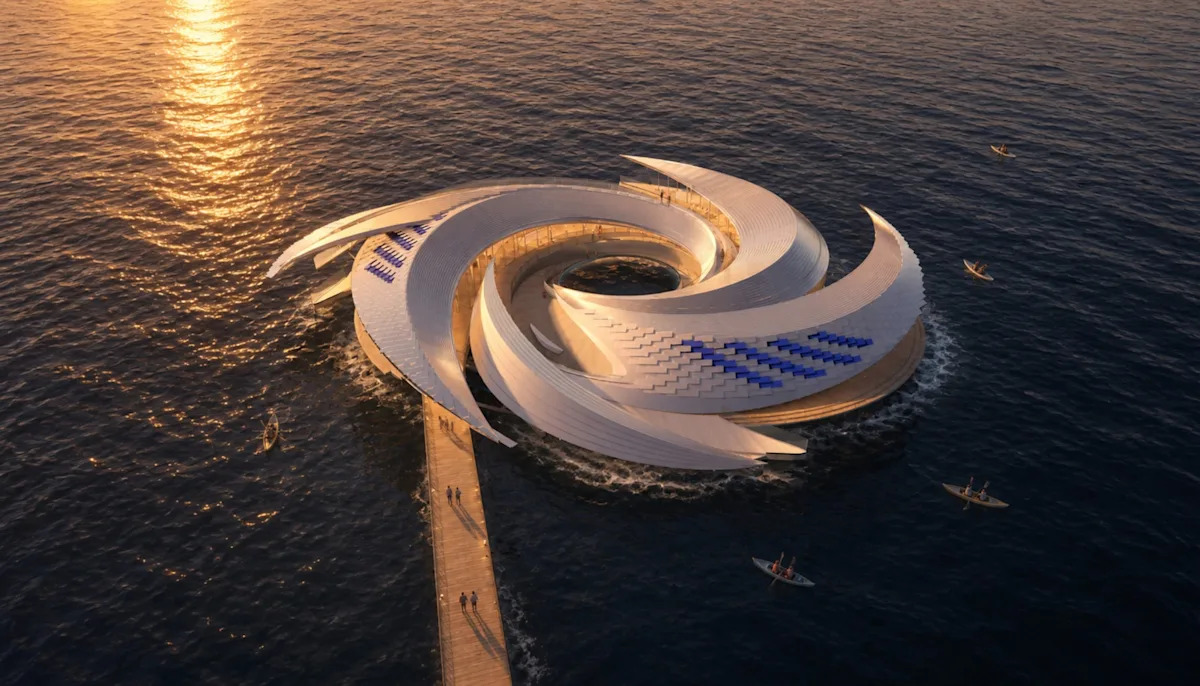
A proposed spiral-shaped floating parliament building made from recycled marine waste has been named a finalist in the Oceanic Parliament competition, a new competition run by Young Architects Competitions (YAC), a global design initiative aimed at raising awareness of ocean pollution.
The project, titled "Ocean Vortex," was conceived by architect Yufeng Tu as part of a competition to create an "architectural manifesto" symbolizing the protection of marine ecosystems. According to the competition website, the initiative aims to draw attention to the "massive plastic islands" in the Pacific Ocean, described as "an ecological disaster beyond all comprehension.".
Tu, who studied architecture at the University of California, Berkeley, and now works in Tokyo for the architecture firm Nikken Sekkei, said the project was inspired by the forces that shape the ocean itself.
«"The spiral form was inspired by the movement of ocean currents and eddies, embodying the dynamic power of water in an architectural gesture," he said. Newsweek . «At the same time, the vortex was meant to carry a warning: the pollution that people dump into the ocean will eventually suck us into the same vortex that we ourselves create.».
Aerial rendering of Ocean Vortex, the proposed floating parliament building.
This concept is based on a growing understanding of the scale of marine pollution. According to estimates by the non-profit organization The Ocean Cleanup, the Great Pacific Garbage Patch (GPGP), the largest accumulation of plastic in the ocean, covers an area of approximately 1.6 million square kilometers—roughly twice the size of Texas or three times the size of France—and contains approximately 1.8 trillion pieces of plastic weighing tens of thousands of tons.
Plastic waste continues to enter the oceans at a significant rate: an estimated 1.15 to 2.41 million tons enter the seas annually from rivers alone. Microplastics—tiny fragments less than 5 millimeters in size—currently dominate marine plastic pollution and, according to research, are found throughout the ocean water column.
As the Océans Connectés platform explains, these materials accumulate in ocean gyres – vast swirling currents – creating concentrated debris vortices that can persist for decades and pose a serious threat to marine ecosystems.
A rendering of the Ocean Vortex project, which uses recycled plastic barrels and other marine debris as a floating support system.
Transforming waste into structure
For Tu, who has worked for various international architecture firms including MAD, UNStudio, and Solomon Cordwell Buenz in San Francisco, the architectural solution was to directly incorporate the problem into the building's material system.
«The project was conceived as a response to marine pollution, so recycled marine waste was not seen as a symbolic secondary detail, but as part of the architectural logic,» he said. Newsweek . "Conceptually, the building proposes to transform ocean waste into a public structure dedicated to global dialogue and environmental responsibility.".
A rendering showing people on a pedestrian walkway in the Ocean Vortex area.
The Ocean Vortex project is a floating public structure whose continuous spiral form links parliamentary chambers, exhibition spaces, and public routes into a unified system. The vortex's geometry, reflecting ocean currents that trap waste in large eddies, also serves as a symbolic reminder of humanity's impact on the environment.
The design uses recycled plastic barrels and other marine debris as floating supports, with the waste itself serving as floating elements, "emphasizing the idea that discarded materials can be recycled into public infrastructure," he said. This approach reflects a broader trend in sustainable architecture, where discarded materials are reused as structural elements rather than simply as a visual motif.
A graphic detailing the design of Ocean Vortex, a floating public structure whose continuous spiral form integrates parliamentary chambers, exhibition spaces and public routes into a single system.
Rethinking Civil Architecture
Beyond its environmental focus, Ocean Vortex also reimagines the function of public buildings themselves.
«"Ocean Vortex's hallmark is its combination of symbolic clarity and ecological efficiency," Tu said. "It reimagines civil architecture as adaptive, fluid, and intimately connected to ecological systems, rather than as a fixed, monumental surface.".
He added that the project combines renewable energy generated by solar panels on the roof, public access and exhibition spaces alongside parliamentary functions, offering a new model in which governance and environmental awareness coexist, and «future public buildings can be more open, sustainable and environmentally responsible,» Tu noted.
The building is designed not only as a decision-making space, but also as a public platform for education on marine pollution, reflecting the competition's goal of creating a mobile structure that will travel between coastal towns to raise awareness of the issue.
Side view rendering of the Ocean Vortex building.
Safe embedded content will be displayed here.
A growing movement in sustainable floating architecture
Service URL:
Do you have an architecture or design story you'd like to share? Email us at s.kim@newsweek.com and your story could be featured in Newsweek.
Related articles
-
The interior of an iconic brutalist building with a "magic key" is the home of a millennial couple.
-
Construction has begun in China on a cube-shaped building that will "transform itself.".
-
The Rise of the Gap Year: Young Americans Leave the Workforce.
Start your unlimited trial of Newsweek.