








A rare confluence of two solar flares is expected to spark a spectacle of the northern lights further south than usual, astronomers say.
Dazzling auroras could be seen across much of the US and Europe as two solar storms "eat" each other, according to NASA.
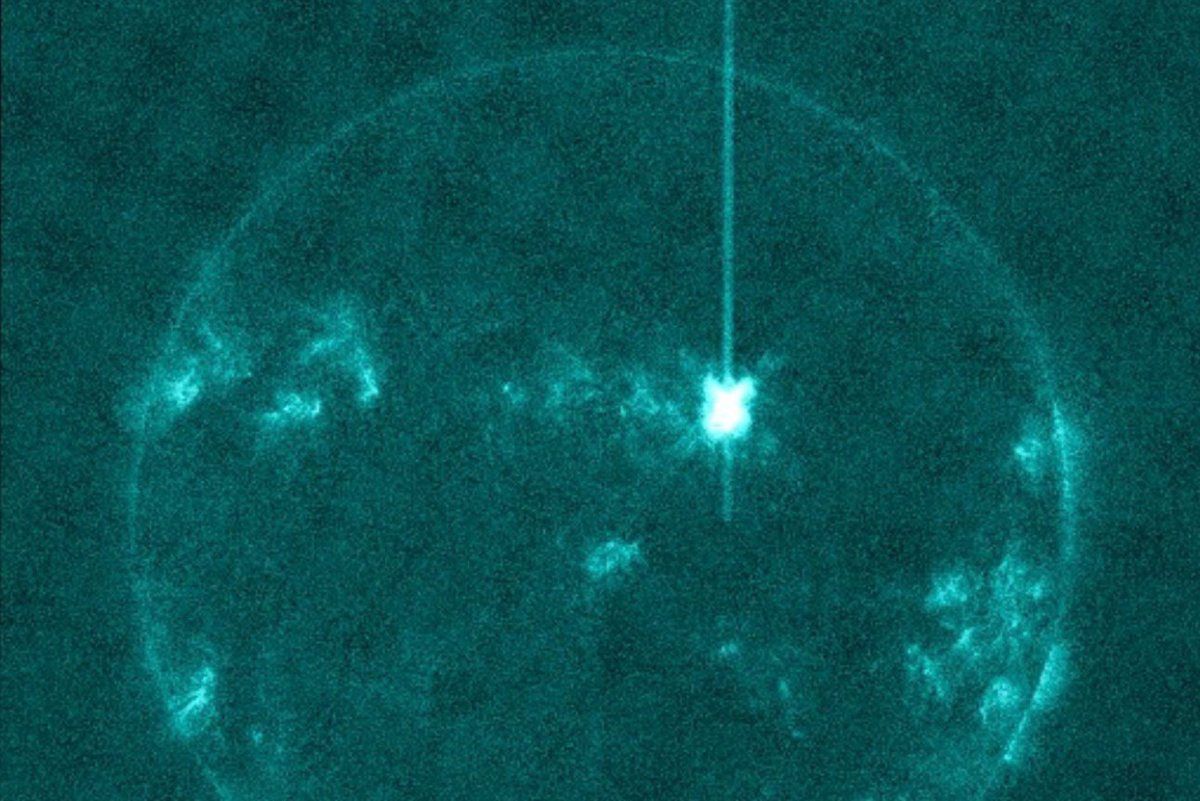
On June 2, an unstable region on the Sun's surface called sunspot 4455 produced a powerful X-class flare. This was followed by numerous coronal mass ejections (CMEs)—streams of charged particles traveling at approximately 2,000 kilometers per second that can disturb the Earth's magnetic field, trigger radio interference, and produce bright auroras.
According to a model from the US National Oceanic and Atmospheric Administration, an X-class solar flare and a coronal mass ejection captured in space combine to form a "cannibalistic" eruption.
When the coronal mass ejection arrives on Friday, it will likely trigger a strong or even very strong magnetic storm around Earth, the agency said.
«"There is a fairly high degree of confidence that coronal mass ejections will reach Earth," the agency stated. "However, the intensity is more uncertain due to the complex circumstances surrounding these coronal mass ejections.".
A powerful X-class flare produced by sunspot 4455 (NASA Solar Dynamics Observatory).
As charged particles interact with gases in the upper atmosphere, including oxygen and nitrogen, they gain increasing energy, creating a dazzling display of the northern lights. Experts predict that on Friday, these lights will be visible as far south as central England and Wales.
In the United States, they say they can be seen in Iowa, Ohio, Pennsylvania, Massachusetts, Rhode Island and New Hampshire.
This likely won't be the last such eruption from anti-Hale sunspot 4455, whose magnetic polarity is opposite to that typically observed on the Sun. One in ten sunspots is known to have such a reversed magnetic configuration, which can make these regions particularly unstable and prone to powerful charged particle emissions.
The Sun has produced a record number of X-class flares in recent years, entering the peak phase of its 11-year activity cycle beginning in 2024.
It is currently experiencing a poorly understood "war zone" phase, where instability is thought to lead to an increase in sunspots, the opposite of the Hale effect.