








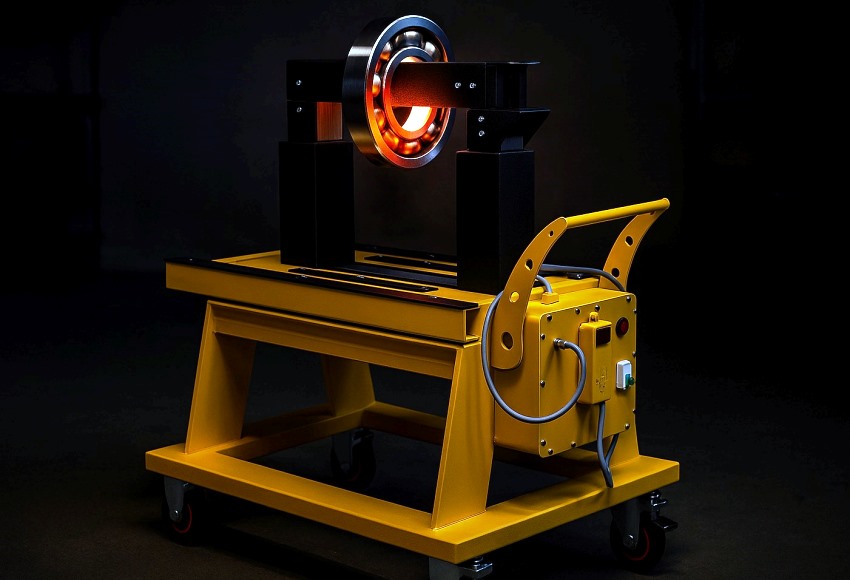
Heating a bearing on a shaft is one of the most important steps. Heating temporarily expands the bearing seat, allowing for easy, damage-free installation. However, even the slightest temperature deviation can ruin the entire installation—overheating destroys the hardening, deforms the raceways, and causes microcracks in the steel. The consequences may not be immediately apparent, but they will lead to premature wear, overheating of the component, vibration, and structural failure.
Overheating is not uncommon, especially with manual control or using outdated methods (stoves, blowtorches, oil baths). Switching to modern induction heaters reduces this risk, but only if used correctly.
Temperature standards: what values are safe?
Each bearing type has its own permissible temperature ranges. These ranges depend on the design features and materials used:
- Conventional steel bearings: optimal heating - from 90 to 120 °C. Maximum — 130–150 °C, only for a short time.
- Bearings with seals or built-in grease: no more 90 °C, otherwise the plastic softens and the lubricant loses its properties.
- Large-sized bearings with an internal diameter of more than 300 mm: can be heated up to 150 °C, but with enhanced temperature control.
- Thin ring ball and roller bearings: their overheating is especially dangerous - deformation is possible.
It is important to remember that overheating by 20–30 °C above the norm leads to loss of hardening, which makes the bearing inoperative.
To avoid errors, it is necessary to strictly follow the recommendations of the bearing and heater manufacturers, taking into account both the geometry and the internal design features.
Temperature control: sensors and automation
The most effective way to prevent overheating is to use electronic temperature control:
- Thermal sensors (contact or infrared) Record the current temperature in real time. They are installed directly on or near the bearing.
- Automatic limiters The heating is turned off as soon as the set temperature is reached. This completely eliminates human error.
- Signaling systems warn the operator about deviations: overheating, sensor breakage, too fast heating.
- Soft start function« In modern heater models, this allows you to avoid temperature jumps at the beginning of heating.
For reliable and safe installation, we recommend using induction heaters from SAPCO. The company offers a wide range of equipment, temperature sensors, and accessories designed specifically for working with bearings in production facilities and repair areas.
In some cases, using two sensors is advisable—one measuring the ring surface, the other the inner layer. This allows for monitoring uniformity of heating and promptly stopping the process.
Typical errors when heating bearings
Even with automated systems in place, errors can occur if the basic operating principles are not followed:
- Lack of temperature control — the most common mistake. The bearing overheats while the operator is busy with other tasks.
- Incorrect placement of the sensor - if it is not installed in the maximum heating zone, the data will be false.
- Installing multiple bearings on one core without calculation — leads to uneven heating.
- Application of non-induction heating methods (gas burners, electric stoves) without temperature control - the risk is practically guaranteed.
- Heating time exceeded even at normal temperatures, it can cause overheating of the internal layers of metal.
- Ignoring the manufacturer's instructions — temperature tolerances are not universal, and each bearing requires an individual approach.
It's especially important to ensure uniform heating. Temperature differences in different areas of the ring can cause ovality or microdeformations.
Consequences of overheating: from loss of tempering to accidents
Overheating a bearing isn't just a matter of extra degrees. It's a breakdown of the material from the inside. Here's what it leads to:
- Loss of hardening of rolling raceways — when the temperature exceeds 150 °C, the steel loses hardness and the bearing wears out quickly.
- Deformation of the landing surface — the ring may expand unevenly and not fit onto the shaft according to tolerance.
- Destruction of plastic elements - separators, seals lose shape or melt.
- Grease bubbling — when temperatures exceed 100–120 °C, most lubricants begin to burn out or lose viscosity.
- Increased vibrations after installation due to distortion, which quickly destroys other elements of the unit.
- Equipment failure — premature failure of the bearing leads to damage to the shaft, housing and can stop the line.
Some of the effects may not appear until weeks or months later, making them particularly insidious.
Proper temperature control during bearing heating is an investment in the reliability of the entire machine. Using high-quality equipment, precise sensors, and adhering to process regulations helps avoid costly downtime, repairs, and accidents. This reduces costs and improves safety.