








Over the centuries, humans have developed a variety of complex dating rules and behavior patterns, depending on culture. Similarly, there are many different courtship rituals among birds. Some are impressive and graceful, while others are downright awkward. Some birds use homosexual encounters to attract females, while others simply win the hearts of women with their moonwalk. Here, we've collected the stories of ten birds with unusual courtship rituals.
1. Great bustards
During courtship, female Great Bustards inspect the male's posterior. This is why male Great Bustards feed on poisonous beetles to cleanse their intestines and look healthy and attractive.
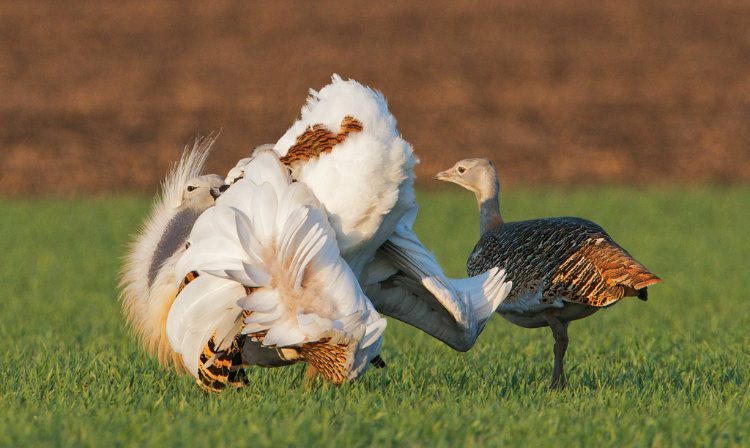
The Great Bustard is a bird in the bustard family, native to southern and central Europe and throughout Asia. They mate at leks. Males gather at the lek and take turns courting females. To impress, they puff up two bare patches of skin on their necks. They also contort their bodies to reveal the bright white feathers on their chests and hindquarters. However, the female is actually looking at the male's cloaca. The cloaca is a versatile opening that serves reproductive, urinary, and intestinal functions. The female checks the cloaca for any signs of nematodes or tapeworms, as well as for bacterial diarrhea. She determines the male's health by assessing the cleanliness of his rear end. Females also peck this area repeatedly to ensure it is clean.
For males, maintaining a clean gut is paramount to attracting females during mating season. Therefore, they feed on poisonous blister beetles. The poison contained in these beetles displaces parasites and bacteria. Both males and females consume these poisonous beetles, but male bustards consume significantly more beetles than females. This diet also increases sexual arousal in males. (source)
2. Superb Lyrebird
The male lyrebird performs four different songs, each accompanied by a unique dance designed to impress the female.
The majestic lyrebird is an Australian songbird, one of the largest in the world. It is known for its intricate tail and superb mimicry. The male lyrebird is also renowned for its courtship dance and song. During the breeding season, the female visits several males to observe their songs and dances, and then chooses a mate. Thus, the male lyrebird spends years honing his skills before reaching maturity.
During the breeding season, the male lyrebird attempts to attract a female with his tail feather. Upon spotting her, he performs a series of sounds and dances. Male lyrebirds sing four different types of songs, each accompanied by a unique set of dance movements. It has been observed that even after years of practice, lyrebirds can make mistakes in their dances. This suggests that dancing is a complex task for birds, just as it is for us humans. (1,2)
3. Flamingo
During mating season, flamingos use "makeup" to appear pinker and therefore more attractive. They also perform a complex group dance until a female chooses a mate.
Flamingos are highly social animals, living in huge colonies, often numbering thousands of birds. During the breeding season, they split into groups of dozens to hundreds of individuals and perform complex group dances. When a female is ready to mate, she departs from the dancing group, and the male of her choice follows closely behind.
Plumage color likely influences mate choice. The brighter the pink of a flamingo's plumage, the greater its chances of finding a mate. To enhance the color of their plumage, flamingos use oil produced by glands near their tails. They apply this oil to their feathers with their beaks, an action often referred to as "makeup.". (1,2,3)
4. Raff
Male ruffs engage in homosexual mating to attract females. When females visit the mating grounds, some males, disguised as females, sneak up and quickly mount the aroused females, while other males perform complex mating rituals to attract members of the opposite sex.
The sparrow is a long-necked, pot-bellied bird with a distinctive breeding plumage consisting of a large collar of decorative feathers. The bird's name derives from this beautiful plumage. During the breeding season, males perform courtship displays at the lek. The display is directed primarily at other males, not females.
There are three types of Little Stint males: territorial males, satellite males, and a very rare third type, the "feder," with plumage similar to that of the female. Territorial males maintain a mating territory and actively court females. Satellite males do not establish a territory but enter the lek and attempt to surreptitiously mate with any female visiting the area. The third type of male, the feder, engages in homosexual mating with independent or satellite males who attract a female to the lek. Once females begin visiting the lek, the feder, with plumage similar to that of the female, readily approaches them and mates. (source)
5. Red-capped Manakin
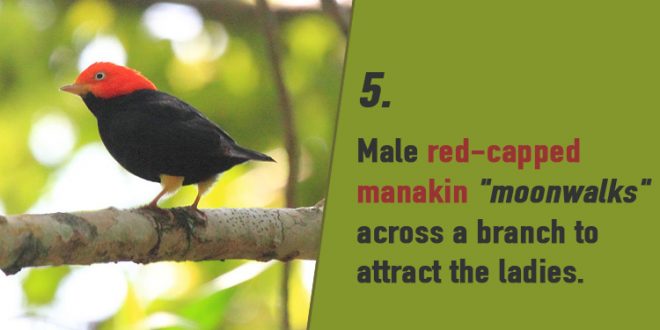
The male red-capped manakin uses a "moonwalk" to move along a branch to attract females.
The word "moonwalk" immediately conjures up images of Michael Jackson moonwalking on stage. Another creature that uses the moonwalk to impress females is the red-capped manakin. The male red-capped manakin uses it as a courtship technique. He quickly steps backward along a branch, similar to a fast moonwalk, to attract the attention of a female. (1,2)
6. Bowerbirds
Male bowerbirds use interior decoration to attract females, creating shrine-like structures out of grass and branches and then decorating them with colorful items.

Humpbacked humpbacks are known for their unique mating behavior. The male of this species builds a structure called a "hut." He then collects colorful objects and carefully arranges them around the hut. The objects can be blue, white, black, or other colors. This decoration is done to attract the attention of the female.
During courtship, the female visits the bower. The male bowerbird dances for the female and sometimes offers her decorative objects to win her favor. (1,2)
7. Great Crested Grebes
Great crested grebes perform an aquatic ballet before diving into the deep and offering each other algae to cement their bond.
The ballet of great crested grebes is one of the most beautiful mating dances among birds. Their mating season begins in the spring. During this time, males, swimming across the lake, give a mating call. After receiving a response, they dive and surface next to the one who responded. They rise out of the water almost on their bellies and remain in this position for a few moments, thus announcing their intentions.
If the other gerbera spreads its wings and spreads its cheek comb, a partnership has been established. The next stage will be their aquatic ballet, with the male and female facing each other, shaking their heads from side to side. Finally, both will dive deep and surface with algae in their beaks. They will rush toward each other, chest to chest, and display their algae, shaking their heads from side to side. (1,2)
8. Club-winged manakin
To attract females, this bird creates its own acoustic violin by flapping its wings more than 100 times per second.
The club-winged manakin has a remarkable feature. It has modified wing feathers that allow the bird to create a "song" with its wings. To produce sound, the club-winged manakin rubs its ribbed, club-shaped feathers against each other. This creates a series of buzzing and clicking sounds. During courtship, the male club-winged manakin raises his wings over his back and shakes them back and forth at a rate of over 100 beats per second. This creates a loud, violin-like sound that attracts a female. (1,2)
9. Sage grouse
Male black grouse gather at the mating ground, spread their tail feathers and open the air sac on their chest to attract females.
The greater grouse is an endangered bird native to North America. It is well known for its unusual mating rituals. In the spring, male grouse gather at a traditional display site called a lek. Dozens of males strut and spread their pointed tail feathers. Then they burst the yellow air sacs on their chests, producing a "whoop" sound that can be heard two miles away. The mating display begins at dawn and lasts three to four hours. A single male can mate with up to 20 females in a single morning. (source)
10. Wilson's Bird of Paradise
A male Wilson's bird-of-paradise tidies up a patch of forest floor to make his brightly colored feathers stand out and attract females.
Wilson's bird-of-paradise is one of the most vibrant and colorful birds. Its lush feathers and plumage create a vibrant courtship dance. Males clear a patch of tropical forest to create a "display yard." Wearing a richly decorated, bright red cape with a turquoise cap, the male performs a vibrant and complex dance, accompanied by singing and calling. The female perches on a perch directly above the male and watches his performance. (1,2)