








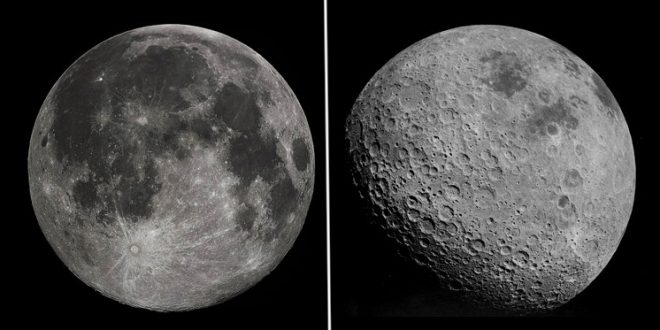
The Moon is our only natural satellite. Together with the Sun, it made life possible on our planet. It gives us light at night, causes the tides in our great oceans, and helped our ancestors keep track of time. It has gained significance in many religions and is considered sacred by many. It has influenced art, literature, and science. More importantly, it has generated enormous interest among scientists and astronomers, who have sent numerous probes, and then humans, to explore its many secrets. For those of you who are similarly fascinated by the Moon, here are a few facts about it that we're sure you'll enjoy.
1. The Moon is larger than Pluto.

The Moon is actually quite a large satellite compared to the size of Earth. In fact, it is the second-largest satellite in our solar system relative to the size of its planet, the first being Pluto's Charon. Its diameter is 3,474.2 kilometers (2,158.7 miles), a quarter of Earth's diameter and larger than the diameter of the dwarf planet Pluto, which is 2,317.8 kilometers (1,440.2 miles). The reason Earth and the Moon are considered a planet-satellite system rather than a binary system is because their center of mass is located 1,700 kilometers (1,100 miles) below Earth's surface. (1, 2)
2. The average density of the Moon is higher than the density of the Sun.

The Moon's average density is 3.346 grams per cubic centimeter, compared to the Sun's density of 1.408 grams per cubic centimeter. In fact, it is the second-densest moon in the Solar System after Jupiter's moon Io, which has an average density of 3.528 grams per cubic centimeter. For comparison, Earth's average density is 5.52 grams per cubic centimeter. Astronomers believe the Moon formed when a Mars-sized rock collided with Earth, ejecting debris into space, which was then collected in orbit. Its density is lower than Earth's because it ejected primarily the mantle and crust, not the core. (1, 2)
3. It is impossible to see the far side of the Moon from Earth.
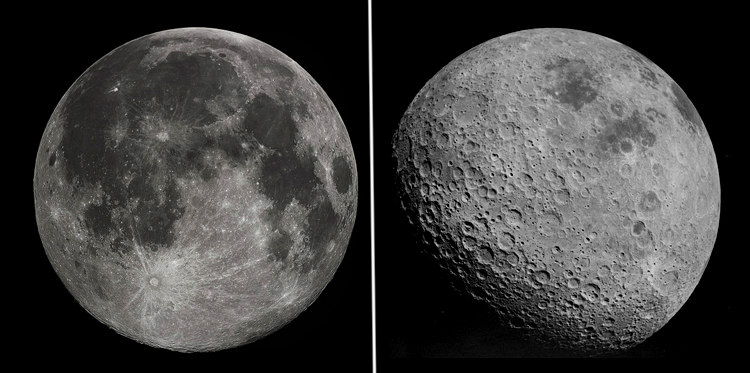
Due to tidal forces acting on Earth, the Moon's rotation slows so much that only one side faces us. This phenomenon is known as tidal locking, and the side we don't see is called the "far side" or "dark side" of the Moon, although it isn't always dark. We see about 59 percent of the Moon's surface facing us, although smaller areas of the far side are difficult to observe due to low viewing angles.
Unlike the near side of the Moon, the far side is more densely cratered. The far side was first photographed on October 7, 1959, by the Soviet probe Luna 3, and subsequently by many other Soviet probes, resulting in the creation of the Atlas. Many astronomers consider the far side a good location for radio telescopes, as it is unaffected by radio emissions from Earth. (source)
4. If the Moon disappeared, a day on Earth would only last six hours. This is because the Moon slows down the Earth's rotation.

The Moon and Earth have a very symbiotic relationship with each other. The Moon's gravity controls the height of the ocean tides, and if it were to disappear, the tides would be approximately three times lower than they are now. Without the Moon, the Earth's axial tilt would gradually change from 23.5 degrees to a much greater tilt or disappear entirely. This would negatively impact the seasons, leading to their absence or extreme seasons. A more immediate consequence of the Moon's disappearance would be how dark the nights would become. Days would last only six to twelve hours because the Earth's rotation would eventually accelerate, resulting in a year with up to a thousand days. (source)
5. The dark areas we see on the Moon are actually solidified lava from ancient volcanic eruptions. They are called "lunar seas ».

Ancient astronomers, who considered the dark areas to be seas, called them "« Marys »" (singular of "« sea »), which translated from Latin means «seas». Mary's Covering approximately 16 percent of the Moon's nearside surface, mare basalts are formed by ancient volcanic eruptions. Several theories exist to explain why mare basalts are more common on the nearside than on the farside. Some believe that Earth's gravitational pull may have contributed to more volcanic eruptions on the nearside. A 2011 study published by planetary scientists Eric Ashfaugh and Martin Jutzi suggests that several million years after the Moon's formation, a second, smaller satellite collided with the Moon and slammed into its surface, thickening it. Later, other impacts on the Moon's surface fractured this crust, leading to the formation of volcanoes. (source)
6. The Moon does appear larger when it is close to the horizon, but this is just an optical illusion known as the "moon illusion," first described in the 4th century BC.

The Moon's larger size near the horizon was originally thought to be due to a magnification effect caused by Earth's atmosphere. However, it is actually 1.5 percent smaller near the horizon than high in the sky. One theory explaining this illusion, known as the "apparent distance hypothesis," suggests that we estimate the size of an object based on a continuous sequence of bodies between the observer and the object. Therefore, since the sizes of these intermediate bodies decrease with distance, we expect the size of the object to also decrease.
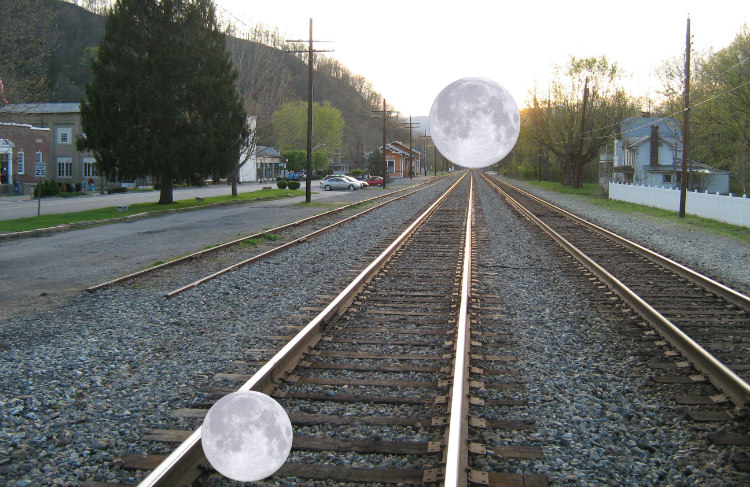
A similar theory, the "relative size hypothesis," suggests that we tend to judge the size of an object based on the size of its surroundings. If the surrounding objects are small, the object appears larger, and vice versa. To test this illusion, hold a small object, 1.4 inches in size, at arm's length close to the Moon when it's high in the sky and also when it's close to the horizon. You won't notice any change in its size. (source)
7. Moon dust penetrates even materials like Kevlar and is extremely harmful to humans, causing what's known as "lunar hay fever.".

Unlike terrestrial dust, lunar dust formed in a complete vacuum, meaning there is no erosion to smooth the rough surface of the dust on the Moon. Dust particles have complex shapes and are coated with a thin layer of highly reactive minerals, such as iron. This dust is just as hazardous to the lungs, if not more so, than industrial mineral dust or dust from volcanic eruptions. Therefore, special care must be taken when handling spacesuits after returning from space.
According to Larry Taylor, director of the Planetary Geosciences Institute at the University of Tennessee, the dust is so abrasive that it can cut through three layers of Kevlar-like material on the boots of one of the Apollo 17 astronauts. At night, the dust accumulates a lot of static electricity from the solar wind, and during the day, ultraviolet rays destroy the electrons. (1, 2)
8. During a lunar eclipse, when the Moon enters the Earth's shadow, its surface temperature can drop by about 500 degrees Fahrenheit (260 degrees Celsius) in less than 90 minutes.

The Moon experiences extreme temperature fluctuations. One lunar day is equivalent to 27 Earth days, and surface temperatures can rise to 253.4 degrees Fahrenheit (123 degrees Celsius) during the day and drop to -243.4 degrees Fahrenheit (-153 degrees Celsius) at night. Since the Moon lacks an atmosphere, unlike Earth, there is no temperature regulation, and the variations are very dramatic. Its axial tilt is much smaller than Earth's, meaning there are areas, such as craters at the north and south poles, where extremely low temperatures are recorded, such as -412.6 degrees Fahrenheit (-247 degrees Celsius) and -396.4 degrees Fahrenheit (-238 degrees Celsius), respectively. These are the coldest temperatures ever recorded in the solar system. (1, 2)
9. Every year, the Moon moves 3.8 centimeters away from the Earth. In 500 million years, there will be no more total eclipses.
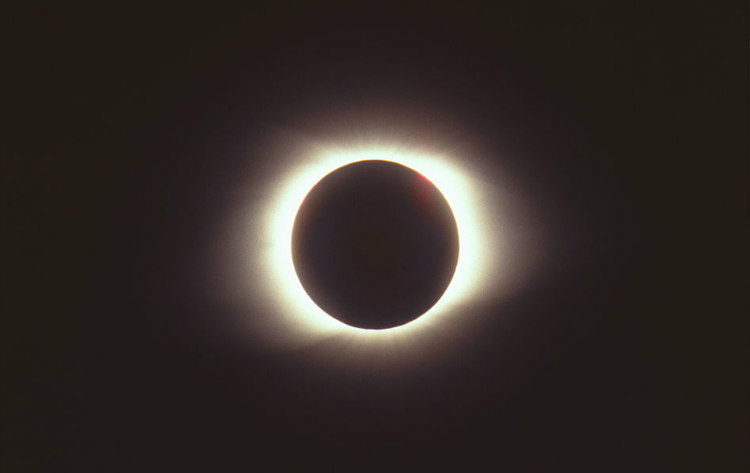
The reason we can observe solar eclipses is because the distance from the Sun to Earth is 400 times greater than the distance from the Moon, and the Sun's diameter is 400 times greater than the Moon's diameter. This allows the Moon to completely block the Sun during total solar eclipses. However, as the Moon gradually moves away from Earth, this ratio will also change, moving it further and further away from us. If the Moon continues moving at its current speed, it will take 500 million years for total eclipses to disappear. However, this is unlikely, as the speed decreases with increasing distance. (1, 2)
10. There is a tiny art museum on the Moon that features six works of art, including a painting of a penis, by Andy Warhol.
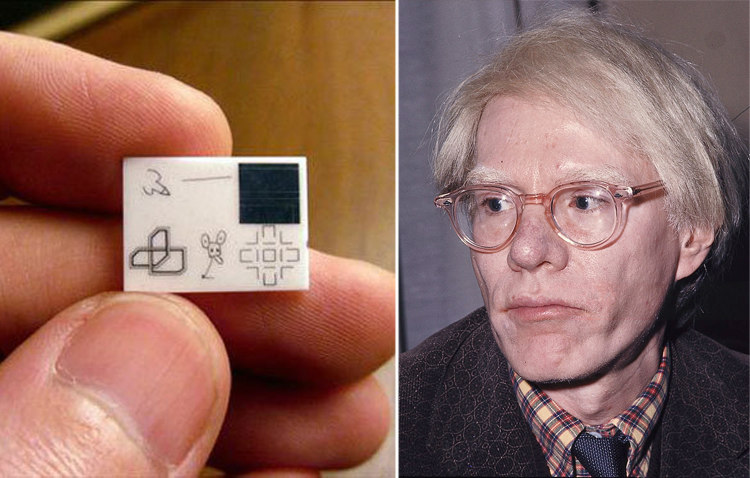
«"Moon Museum" is a three-quarter-inch by half-inch ceramic plaque featuring works by six 1960s artists: Andy Warhol, David Novros, Robert Rauschenberg, Forrest Myers, Claes Oldenburg, and John Chamberlain. It is believed to have been secretly placed in the Apollo Lunar Module, currently on the Moon, and is considered the first "space art object," though not the only one. Technicians often hid personal items in the gold blankets of other Apollo landers, which are now permanently stationed on the Moon. (source)