






NEED TO KNOW
-
On June 8 and 9, Venus and Jupiter will form a rare conjunction, appearing unusually close to each other in the evening sky.
-
Mercury may also be visible below this pair, although it will be harder to notice due to its low position.
-
The best time to observe this celestial phenomenon is with the naked eye shortly after sunset in locations with a clear western horizon.
Space sparkles!
June in the Northern Hemisphere sees the shortest nights of the year, but the sky still puts on a beautiful spectacle after sunset.
This month, Venus and Jupiter—the two brightest planets visible from Earth and considered "great benefics" in astrology—will conjoin low in the western sky after sunset, creating one of June's most enchanting moments for skywatchers.
Venus, for example, is especially attractive now, shining as a bright "evening star", while
Jupiter shimmers nearby, then gradually sinks lower into the twilight.
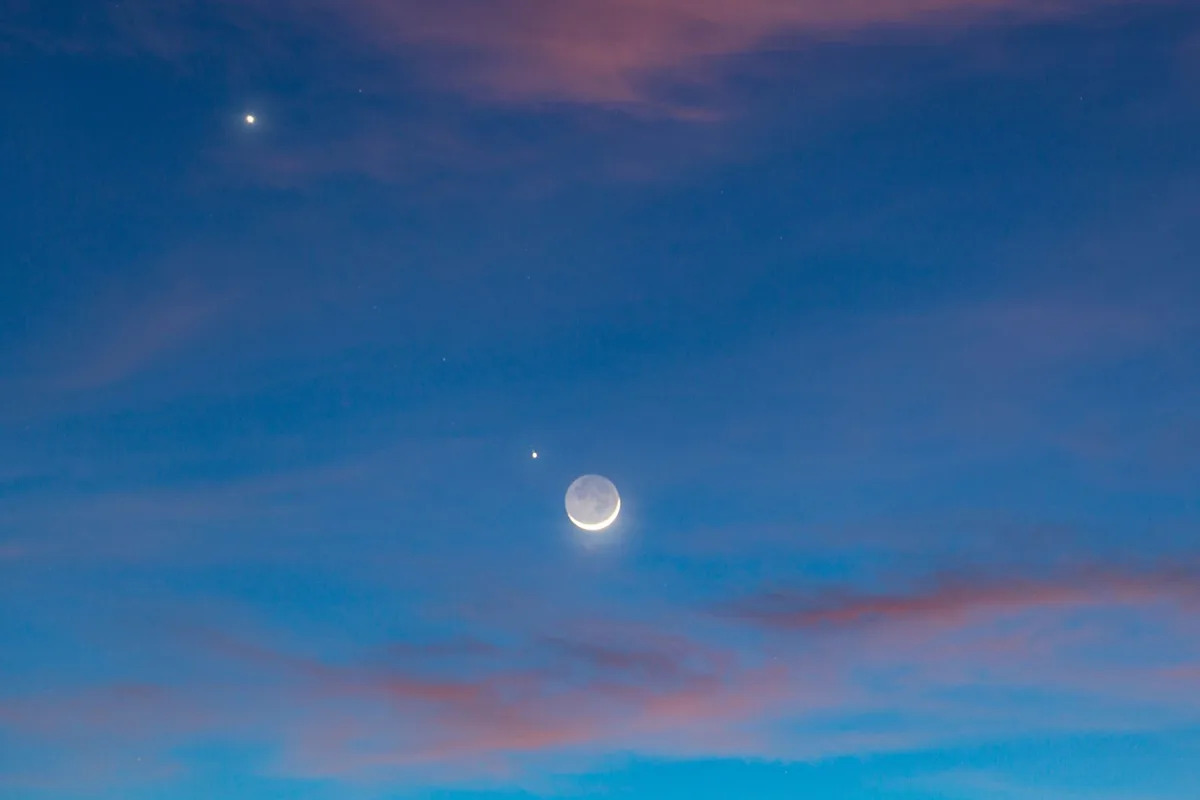
Between Monday, June 8, and Tuesday, June 9, the two planets will be especially close to each other, creating a favorable conjunction that can be observed without binoculars or a telescope.
Mercury will also be present on the celestial scene for part of the month, making the evening sky appear unusually active.
Astrologically speaking, all three of these planets are currently transiting the sign of Cancer, where Mercury will eventually go retrograde.
In the meantime, read on to find out everything you need to know about this remarkable event.
When will it be possible to see Venus and Jupiter?
Venus and Saturn. Photo: Petar Petrov / Impact Press Group / NurPhoto via Getty
Venus and Jupiter will be visible after sunset in early June, with the best time for viewing coming shortly after sunset and the sky begins to darken.
Around Monday, June 8, and Tuesday, June 9, the planets will be at their closest distance from each other, with Venus and Jupiter separated by about 1.5 to 1.6 degrees in the sky, according to EarthSky.
They can still be seen near each other on surrounding nights - especially between June 9 and 11 - weather permitting.
However, the viewing window will be short, as both planets are low in the evening sky. This means skywatchers have about an hour between sunset and the moment Venus and Jupiter drop below the horizon, so it's best to go outside soon after sunset rather than wait until the sky is completely dark.
Where will Venus and Jupiter be visible?
After sunset, look low, to the west!
Venus and Jupiter will be visible close to the horizon, so buildings, trees, hills, or cityscapes could easily obscure the view. Ideally, the best viewing opportunities will be on a beach, an open field, or a location with a wide, unobstructed view of the western horizon.
Venus will be the brighter of the two celestial bodies, appearing as a dazzling white point of light. Jupiter, on the other hand, will be visible nearby, slightly dimmer, but still bright enough to stand out in the twilight.
Mercury may also be visible below this pair to observers with a very clear western horizon, although it will be harder to spot because it is lower in the brighter part of the sky.
How to see Venus and Jupiter?
The Moon and Jupiter. Photo: Cheng Xin/Getty
Start going outside (or looking up) about 30-45 minutes after sunset, when the sun has completely set below the horizon.
Look west and scan the horizon low to find the brightest "star," which turns out to be none other than dazzling Venus. Jupiter will be nearby, but will appear slightly less bright.
But between Monday, June 8, and Tuesday, June 9, the two regions will be unusually close to each other.
The best part? You don't need a telescope. In fact, this conjunction is best observed with the naked eye because the planets are bright and close to the horizon.
Binoculars can help if you're trying to find Mercury below Venus and Jupiter, but try not to use any equipment until after sunset.
Read the original article on People.