








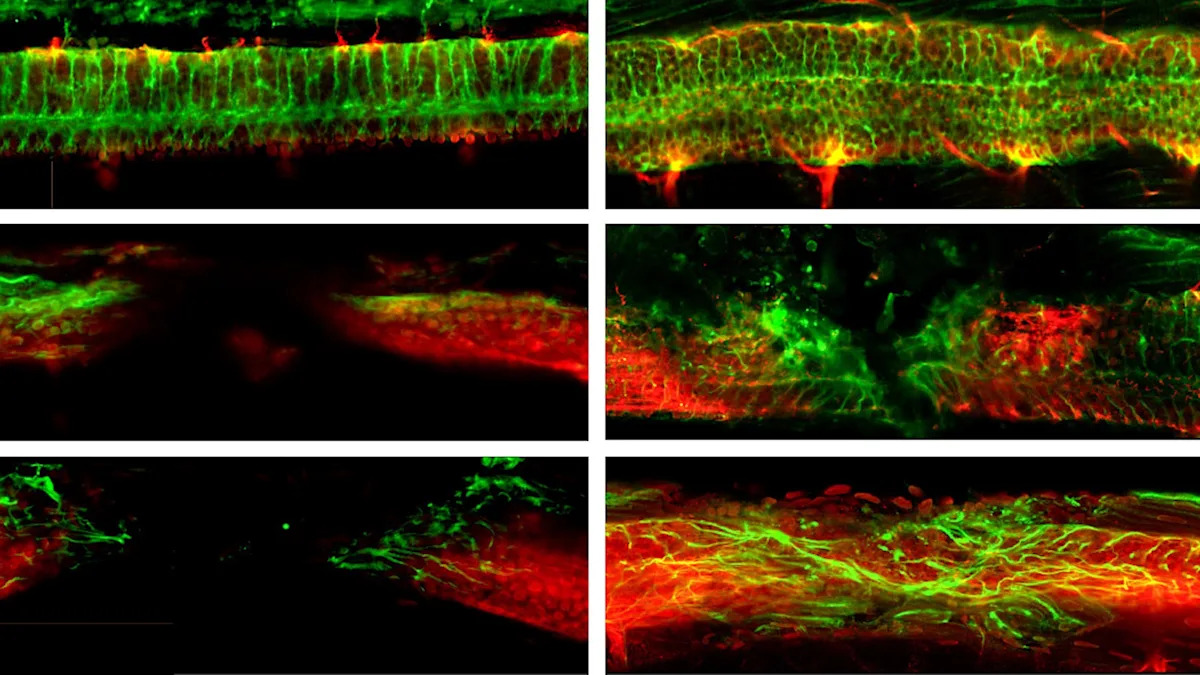
Despite significant advances in medicine, spinal cord injuries remain among the most challenging physical injuries to treat. Scarring often prevents nerve fiber regeneration, and nerve cells typically cannot regenerate on their own. A possible solution? A series of injectable nanorobots containing stem cells that can aid nerve cell regeneration. A detailed description of these tiny robots is provided in a study recently published in the journal Nature Materials .
To create new tools, a team from ETH Zurich, Switzerland, developed microscopic devices that combine living neural progenitor cells (NPCs)—specialized stem cells developed to treat spinal disorders—with custom-designed nanoparticles. These nanoparticles have two layers: one is sensitive to magnetic fields, and the other converts them into electrical signals.
«"We place a reservoir in the center where we trap the cells. Then we introduce nanoparticles and wait for the two components to bind," says a statement from Salvador Pane i Vidal, a co-author of the study and a robotics specialist at the Zurich Institute of Technology.
Each nanorobot is approximately six micrometers wide, making them smaller than a red blood cell. However, the procedure requires a huge number of robots. Animal trials require millions of nanorobots. Even with such large numbers, initial experimental results are encouraging. In tests on mice with spinal cord injuries, nerve cells stimulated by microrobots began to reconnect at the site of injury within 28 days. By the end of the experiment, the mice showed significant improvements in movement, gait, coordination, and exploratory behavior.
Significant additional research is needed before these nanorobots are ready for widespread use, but the team hopes to one day begin testing similar devices on humans. Before then, they need to determine the most effective magnetic fields and the duration of their exposure to patients. Meanwhile, the developed design could also be used to treat regenerative diseases of organs and wounds.
«"The reproducible and scalable production of microrobots using our lab-on-a-chip system demonstrates that the platform's potential applications extend beyond fundamental research," added Pane and Vidal.