






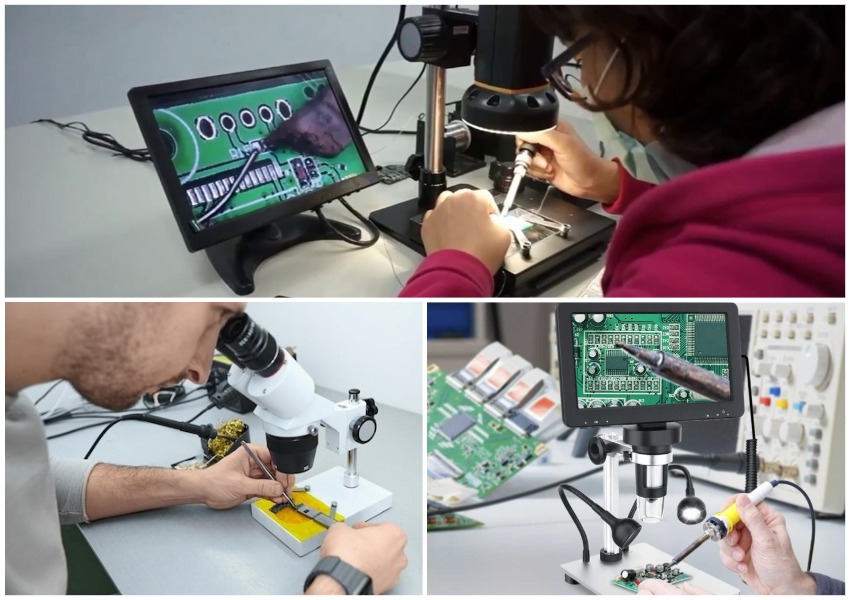
Soldering microchips and miniature components requires high precision, and a high-quality microscope is essential. However, choosing the right model can be challenging: there are numerous devices on the market with varying specifications, and not all are equally useful. What should you consider when buying a digital soldering microscope? Which parameters are truly important, and which are just hype? In this article, we'll explore key selection criteria and help you choose the optimal equipment for comfortable and efficient work.
When selecting a digital electron microscope for soldering, it is important to consider several key characteristics determined by the specifics of these devices:
- Working distance.
One of the most important parameters is the working distance. Most USB microscopes on the market have a short working distance—just a few centimeters. Their housings are typically plastic, making them vulnerable to flux fumes and accidental touches with the soldering iron. Ultra-compact models with a built-in display, although offering a slightly greater working distance (about 6–8 cm at the required magnification), also wear out relatively quickly. A working distance of 12 to 16.5 cm with a magnification of 8–20x is considered optimal, providing comfortable soldering. - Increase.
For soldering, magnification of 8x, 10x, or 20x is generally sufficient, depending on the component size. For defect detection and diagnostics, magnification up to 45x–50x may be needed, less commonly up to 90x–100x, and very rarely up to 150x–200x. It's especially convenient if the microscope has a smooth zoom function. It's important to remember that the "1000x" marketing claims for inexpensive models don't correspond to the actual optical magnification—they're simply digitally stretching the image, which results in a loss of clarity. - Tripod.
It's crucial that the microscope stand is stable and its components are free of play. Many USB and compact models suffer from image shifting when focusing and image shake, which can be tiring for the eyes. Microscopes with metal stands, metal focusing mechanisms, and a base measuring 20–27 cm are preferred. - Camera.
The camera should have minimal display lag. Sometimes, even at 30 frames per second, lag is still noticeable, which can be disruptive during soldering. Ideally, 60 frames per second ensures the smoothest possible image. The camera resolution should be at least Full HD, but the best models support 4K. Autofocus simplifies operation, especially when the height of objects changes frequently. Other useful features include photo and video recording, computer connection, and the ability to take measurements directly on the screen. Keep in mind that HDMI will provide a faster image than USB connection to a PC. - Screen.
Image quality depends not only on the camera but also on the screen. The optimal display size is 7 inches or larger, with a resolution of 1024×600 pixels. Models with Full HD and 4K screens measuring 10–13 inches are also available. Microscopes with HDMI output can be connected to a computer monitor, which improves image quality and reduces the cost of the kit, but reduces portability. - Backlight.
The ideal backlight is a ring-shaped light with a diameter of 7–12 cm and a power of at least 5 watts. It provides uniform illumination without shadows or glare. Additionally, a beam light can be used to create contrasting shadows and highlight surface defects such as grooves, cracks, and unevenness. - Tilt the microscope.
The vertical lens position requires some familiarity with precisely determining the instrument's height. If you've previously used stereo microscopes, you might find a microscope with an adjustable body angle more convenient, which improves spatial perception during soldering.
Recommended models:
Check out the high-quality microscopes from the ARSTEK series:
- ARSTEK MIMIC - digital electron microscope with a screen
- ARSTEK MIMIC BM - digital electron microscope without a screen
- ARSTEK SZ0750 - a stereoscopic microscope with the ability to install a camera
- ARSTEK SZ0745 - stereoscopic binocular microscope