








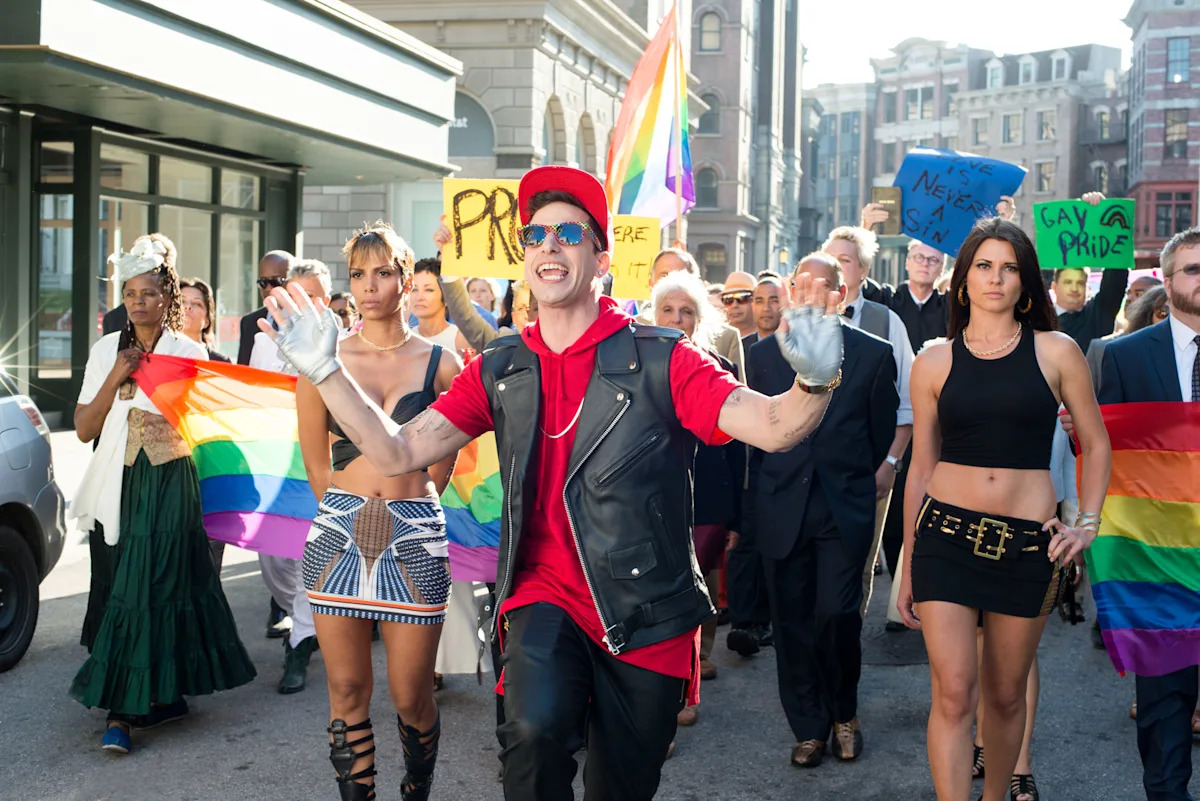
It's been ten years since Conner4Real first burst onto the scene in Popstar: Never Stop, Never Stopping, and a lot has changed.
Created by Saturday Night Live stars and longtime friends Andy Samberg, Akiva Schaffer, and Jorma Taconé (known as prankster rappers The Lonely Island), the project marks the trio's most ambitious effort to date. The story centers on Conner (Samberg), a disillusioned pop megastar who finds himself in a tailspin when his career falters and is forced to reunite with his Beastie Boys-like former best friends, Owen (Tacone) and Lawrence (Schaffer).
Under the guidance of producer and comedy master Judd Apatow, the trio went all out to create a film that combined their comedic talent with the memorable digital shorts that made them SNL stars and performers in their own right. The result was a veritable treasure trove of humor—a film that literally bursts at the seams, despite its meager 87-minute runtime.
Despite this, Popstar failed to capture the hearts of fans upon its 2016 release, recouping less than half its budget at the box office. However, like many beloved comedies, Samberg, Schaffer, and Tacone's film has since matured like a fine wine. Not only has it become beloved by audiences, who now consider it a modern comedy classic, but its memorable jokes have also become part of their everyday vocabulary.
In honor of the anniversary, Samberg, Schaffer, and Taccone take us inside Conner's world to talk pressure, real-life pop stars, zombie penises, and the film's unexpected afterlife.
These interviews have been edited for clarity and brevity.
Andy Samberg (writer, who played Conner4Real): After "Hot Rod," we had more experience. We knew we wanted as much creative control as possible, and working with Judd [Apatow, producer] really helped in that regard. By that point, we'd also released three albums and a bunch of short films for "SNL." Initially, we were thinking, "What kind of film would allow us to make the comedy music we love in a way that feels authentic and makes sense?"«
Akiva Schaffer (director, screenwriter, played Lawrence): The whole film is the culmination of many skills we've honed throughout our careers. It was everything we'd always wanted to do, all at once. The good thing is, you're always happy when you feel like you're where you're supposed to be, but on the other hand, it's a little nerve-wracking because you want everything to turn out well. You think, "Oh my God, this is like putting all my eggs in one basket.".
Jorma Tacone (director, screenwriter, actor who plays Owen): We were really nervous about focusing on the three of us and our friendship. Judd was always really good at guiding us. He'd say, "No, this is what this movie is supposed to be about. It's good. Don't worry.".
Shaffer: We were so thrilled to have someone as talented as Judd. We'd write all week, and we'd have, say, four good new scenes, but we didn't know where they'd take us. The fact that on Friday we could say, "Judd, what do you think of this?" and he'd say, "That's great, keep going," really fueled our creativity.
«"Popstar: Never Stop Rolling" ©Universal/Courtesy of Everett / Everett Collection
Samberg: It was really fascinating to watch [Judd] work. Sometimes the most straightforward suggestion is the right one, especially with comedians. We were always trying to outsmart ourselves, and he'd be like, "No, focus on you and your friendship. That's what interests me. I love that you've known each other your whole lives and are still friends, work together, have fun together, and speak your language.".
Taccone: Honestly, it was almost like encouragement. It simply let us know we were on the right path—and that's priceless.
Samberg: A lot of it was based on our own experience working on SNL, seeing a lot of musicians and their lives. All these pop stars are incredibly talented. Then, when people realize how big their popularity is, they get sucked into this machine, and once you reach a certain level of success, you rely on that machine to stay afloat. There's a lot of that in the film, where people aren't honest with you or don't say no. It can distort your perception of reality, corrupt your spirit, and kill your joy. We were really interested in that, especially in the context of friendship.
Shaffer: Judd encouraged us to not get hung up on the generalities and just start writing scenes that we thought would be funny in a movie like this. We quickly realized that the three of us should be a band, and Andy would be Justin Timberlake, or whoever comes next. We knew that if we made a movie about the three of us, it wouldn't feel contemporary. We wanted to satirize contemporary pop music, and the biggest stars of the time were solo artists.
Taccone: We are naturally divided into two camps: Alvin, Simon and Theodore [laughs] . I'm Theodore, Andy is Alvin, and Akiva is Simon. These are almost clichéd character traits, but they create clear boundaries for how our characters will behave in different situations. A lot of the humor comes from this.
Inspired, the trio began writing songs for Conner4Real as they developed the script, leading to an organic process that resulted in a wealth of music and humor.
Samberg: We started writing songs almost immediately after we decided to try writing a film script, before we even had a script. I think the very first song Akiva and I wrote was "I'm Strange," but it never made it into the film.
Shaffer: When we got tired of writing, we'd go into the studio and try to come up with songs. For example, we came up with "Equal Rights," but we didn't know where to put it. We just knew it was a song some idiot would sing. That allowed us to just throw together all sorts of funny things. When we started putting together the actual story, we had so many things to choose from.
Samberg: We'd go into the studio and brainstorm ideas for Lonely Island songs, but then gradually we'd steer them toward the story we were working on. Some songs weren't even included in the film, like "Fuck Off," but a lot of people really like it.
Shaffer: We had "Mona Lisa" and "Finest Girl," the Bin Laden song, pretty early on. As we were working on it, we realized we didn't want [Conner] just rapping. All the big rappers at the time were singing and rapping at the same time, so we were like, "He needs to sing." I downloaded Auto-Tune because we're not very good singers. For songs like "Mona Lisa" and "Finest Girl," we just sat there and figured it out. We'd never made songs that sounded like that before.
Taccone: I wrote the original version [of the catchy verse from "Turn Up The Beef"]. We tried a lot of versions. Three of my original lines made it onto the album; "Turn up the Meds!" is one of them. We always pay special attention to the visual component. You come up with a joke, and hopefully the audio version will be funny, but when it comes to the visual component, you hope it will be even funnier.
Samberg: There were probably four or five songs we were definitely planning to include in the film. We'd play them to friends, and gradually a consensus emerged about which ones everyone liked best. "Finest Girl," "Mona Lisa," "I'm So Humble"... We knew we wanted to include "Incredible Thoughts" in the finale. These were the songs we felt like "singles" that could be used as a basis for separate musical numbers.
Taccone: It was so cool to have practically an entire album written before we started filming. While we were writing the songs, we had a Google Doc that we were all constantly adding to. The script for the movie was probably 155 pages long, but we also had a 300-page supplemental version. It was a veritable bible with all this other stuff, and, seriously, I think we wrote it all down.
Once filming began, Conner's world was turned upside down. His colorful entourage became reality, his songs came to life, and fans filled arenas...
Taccone: There are some incredibly talented improvisers in this movie. If you hire someone who's good at what they do, let them shine—and they will. Even if you haven't interacted with crazy groups of people, you can imagine those 20 fucking people collectively draining his bank account.
Shaffer: Sarah Silverman [who plays Paula, Conner's press secretary] and Tim Meadows [who plays Harry, Conner's manager] were fantastic. I didn't know Tim could convey this wounded soul so convincingly. I felt like we saw a side of him that wasn't there in his other work. He really took this ridiculous comedy to a new level and gave it depth in a completely unexpected way.
Taccone: Tim is like Christopher Walken or Nic Cage in the way he speaks sometimes, almost incorrectly. [laughs] . He joked on set, "The kids love it!" Even though we wrote the line ourselves, it still sounds even weirder when he says it. We were so lucky to be around these people.
Shaffer: We really enjoyed working with James Buckley [who played Sponge] and Eddie Blackmon [who played Eddie]. They were so funny, but they were the ones that got cut the most because of the pacing of the film. Just like "Mona Lisa" is one of my favorite songs, and it's only in the film for 10 seconds.
Taccone: Our friend, DJ Nu-Mark from Jurassic Park 5, is our DJ—a little nod to the Beastie Boys and Mix Master Mike. He came [and did it for us] like a real professional, practically for free, and then in the edit we made it so that he's fucking hunting dolphins "like a moron." He saw the movie and was like, "What the fuck? You made me hunt dolphins? I was doing you a favor!"« [Laughs]. Things like this just make me happy, knowing the backstory.
Shaffer: We were able to rent out the Forum in Los Angeles for 11 days straight because it was new. We realized that all arenas around the world look the same, and no one would notice, so this arena became the embodiment of our entire world tour. It has so many rooms. The production designers decorated them in different styles, so it felt like we were backstage in Europe. We used every corner to create the feeling of many different places.
Samberg: It was about a week and a half straight where I just performed songs all day, over and over again. It was definitely really cool, but by the end I realized, "This is unreal." Even backing up one song takes a lot of energy. At one point, I felt really sick, and I just had to endure it. I had to get an IV—but it was really fun. Akiva and Yorm just rocked it.
Shaffer: Adam Levine was so kind to do a cameo [in the film "I Am So Humble"]. Before filming, he said, "Why doesn't Andy come out in character and introduce Maroon 5 at the Honda Center?" Andy was in hair and makeup for the first time, and Jorm and I had to go on stage in front of 20,000 people and say, "Andy is about to come out in character for the movie we're about to make. Please act like he's the biggest star in the world—and don't yell 'Andy!'" We got incredible footage. It looked perfect because it was real.
Samberg: The Maroon 5 show was absolutely psychedelic… [The live performance footage] was really cool. The dancers, choreography, and graphics were amazing. We had hundreds of extras. It was like a dream come true.
Taccone: You won't be surprised that we came up with the "Donkey Roll" pretty quickly. It was very spontaneous... like, "What about this?" I don't think it's a particularly clever name. It was one of those moments where you're thinking up the silliest dance you can think of, and then Usher's about to do it with you, Michael Bolton's singing along, and Justin Timberlake shows up dressed as a fish. I was just like, "What the hell is going on in our lives?"«
Shaffer: We really loved Morgan Spurlock's One Direction documentary, so Judd asked Sony if they had any crowd footage. They sent us a folder of photos of crowds going crazy, holding signs. All we had to do was use visual effects to replace One Direction with "Conner." All those shots of crowds outside hotel rooms? That's all One Direction footage.
"Popstar: Never Stopping" director Akiva Schaffer, Jorma Tacone, and Andy Samberg on set, 2016 ©Universal/Courtesy of Everett/Everett Collection
Soon, Conner's celebrity fans began making themselves known, while Samberg, Schaffer, and Tacone filmed hours of candid interviews and the film's many memorable jokes piled up...
Samberg: We had about 25 experts who interacted with some of the most famous people in the world. Some of these were people who actually interacted with us, and some were just like, "Wow, is that Judd Apatow? Heck, yeah, I'll be there!"«
Taccone: We've had some incredibly famous people come to see us. I remember sitting across from Mariah Carey, who I've had a crush on since I was 12, and asking, "Would you say you like our music?" Nas is one of the best rappers alive today, and we'd all giggle and say, "Would you say we're an influence?"«
Shaffer: We shot in Los Angeles because we knew we wanted cameos, and we had to work around their schedules. Some people would film during prep, when someone had free time, others would film while we were filming at the Forum. We'd have a full day of shooting, then we'd go shoot Ringo Starr for lunch, and then come back. We had to be very flexible.
Taccone: [Ringo] came about because of Judd. He was like, "How do I talk to Ringo Starr?" There was a huge amount [of footage]… I filmed with Norah Jones and I had Ed Sheeran play Conner4Real songs, but we didn't include that. It was fucking awesome. I still regret it.
Samberg: I don't think I've ever seen this footage; that's how crazy it was. Ed Sheeran, this is terrible. I love you.
Shaffer: [Conner's turtle, Maximus,] is a look borrowed from [Michael Jackson's chimpanzee] Bubbles and pop stars with their weird pets that they're very attached to.
Samberg: This is taken from the headlines of my childhood: When I was a child, I had a turtle that I loved very much.
Taccone: We shot a lot for this movie. How many times did we look at each other and think, "Is this filming over?" We just kept shooting, partly because of the simplicity of the process. For example, we could let Connor access his Snapchat. That made editing much more difficult.
Samberg: Akiva would message me like, "We need Conner to say this," and I'd hide under the table. When we were writing the script, shameless self-talk on social media was a new thing, but now it's become sort of the norm. Today, when you watch Conner tell everyone he just masturbated, you think, "I don't get the joke.".
Taccone: There's a big section in the film about Connor's downfall that we cut, but it was so funny. His girlfriend breaks up with him and has an orgy with Ryan Phillippe and Lily Collins. Natasha Lyonne has sex with [Connor] at a party… but there was a moment in the editing where Akiva and I looked at each other and thought: As soon as I leave, this friendship storyline is over.
Shaffer: Before filming began, we asked our assistant to organize all the jokes we'd written, so by the time we started shooting, we had about 50 jokes from various script drafts that didn't make it into the final version. I always singled out a few of them and tried to use them during filming. The joke about Thirty Seconds to Mars was one of them. It's one of the best jokes in the film, and it easily could have been left out entirely.
Taccone: Judd was very good at hinting at key moments, like a flaccid penis on the limo window.
Samberg: Judd said he wanted a scene in the middle of the film where the three of us are together and everything goes wrong. Akiva and I wrote the limo scene, and it was definitely one of the most talked about and beloved. There were other, even wilder versions. One of them turned it into a Night of the Living Dead-type scene with multiple dicks, where everyone starts having sex and ends with one of them slowly lowering himself through the sunroof. I think we went with the version that audiences were happy with. Sometimes you have to boil it down to one dick.
Taccone: I remember our lawyers saying, "Okay, let's get this straight... Do you want us to ask Oscar-winning director Steven Spielberg if we can use his tripod sound from War of the Worlds?" And we said, "Yes!" Two days later, we got an email back from Spielberg: "Yes, it's fine." You just have to ask!
Samberg: [Connor's makeup ended up looking very similar to what we were hoping for. There were a lot of alternative looks that I thought were really fun. We were just like, "Make me look scary, but also really subtle.".
Shaffer: [On how he set the wolves on Seal] We actually had no connection with him, but we wrote the script for him. I don't know why. We just thought, "That's who it should be." Judd called him and said, "Yeah, Seal's in." It was great.
Taccone: We were all obsessed with The Grudge, but I think Akiva really wanted to use it as inspiration for [the bee joke].
Shaffer: This documentary came out around the same time. We thought, "Oh, this is such an interesting move—to turn off the camera and still hear the words on the screen.".
Taccone: In the DVD extras, we created a version of the ending where the bees return. There's a mother bee, and our bodies merge into one being to defeat her. A lot of work went into the sound design.
«"Popstar: Never Stop Rolling" ©Universal/Courtesy of Everett / Everett Collection
The amount of footage nearly got out of control, which led to an incredibly complex and labor-intensive editing process…
Shaffer: We got to editing and thought, "I can't even watch all this." Between the footage, concert footage, and interviews, we had about 300 hours of footage.
Samberg: We re-edited this film a thousand times… since it was shot in a mockumentary style, there were endless ways to cut it down. We had a huge stockpile of really funny and useful material with great people. Everything was fine. The selection process was much more difficult than with the other film.
Taccone: We've been friends with Phil Lord and Chris Miller since they produced our first film, Awesometown, and they're the most meticulous people I know in filmmaking. We were discussing the first act, and Phil gave us 10 different scene reorderings. We thought, "We've tried every one of them..." Knowing that, we decided, "I think we can do this.".
Shaffer: [On how they knew they had the final cut] Honestly? Probably when they ran out of money.
Upon its release, Popstar flopped at the box office, receiving positive reviews from critics but failing to recoup its budget. However, in the decade since its debut, it has become a beloved film for many fans and a comedy classic with memorable lines.
Shaffer: We were a little sad when the marketing campaign presented the film as a Justin Bieber project. "Never Stop, Never Stopping" is a really funny title, and we didn't turn it down, but they added it. Our title was "Conner4Real." The film also featured two suits very similar to ones Bieber once wore. We always hoped that if he ever saw the film, he wouldn't feel insulted. We were—and remain—fans of his.
Taccone: We've already released enough stuff that has gained cult status. If you maintain a pure tone, you'll find your audience. I knew people would like it. And I'm certainly glad that people do. It's clear we fought for what was important to us.
Shaffer: I was so happy when the film got good reviews. I thought at least we'd done our job. The fact that it didn't make a profit didn't surprise us, but it was still sad. We still work together and do our podcast, but I think if the film had been a hit, Judd would have immediately said, "Okay, let's tinker with this until we come up with an idea for the next film." Things would have turned out differently.
Samberg: On a personal level, this is incredibly important to me. I created this with my two best friends, and ultimately it's about how much we love each other, how important we are to each other, and how much harder it would be to be in this business without each other. We appreciate that we're not alone in this.
Taccone: This is a declaration of love for our friendship. I think I will remember it with even more warmth when I grow old and become a decrepit old man.
Shaffer: The most important thing for me is that people liked it. It's wonderful that people have discovered this over the past 10 years. I'm really proud of that.
Samberg: I'm just as happy that the music remains relevant as the film itself. The fact that it resonates and is still being discussed, 10 years later, is everything we could have dreamed of.
Subscribe to the Indiewire newsletter. For the latest news, follow us on Facebook, Twitter, and Instagram.