








When you make a purchase through links in our articles, Future and its distribution partners may earn a commission.
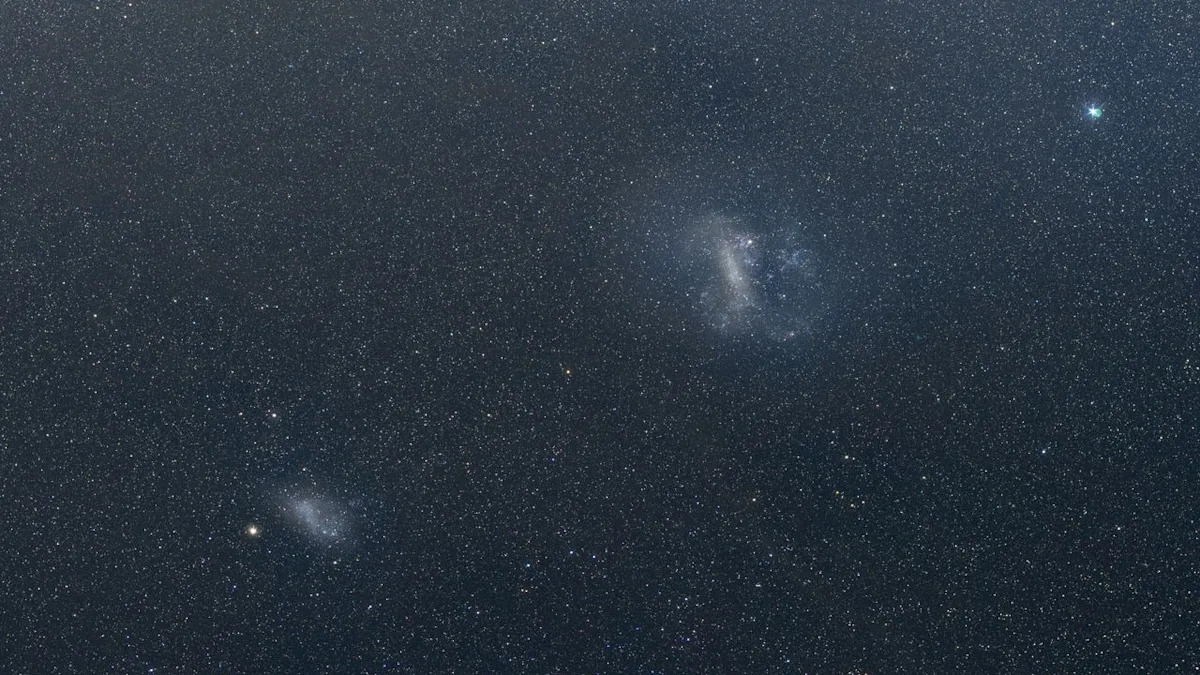
This visible-light mosaic shows the Large Magellanic Cloud (LMC) and the Small Magellanic Cloud (SMC). Separated by approximately 21 degrees, these two galaxies are easily visible from the Southern Hemisphere as faint, glowing spots in the night sky. | Credit: Axel Mellinger, Central Michigan University/NASA Visualization Studio
The Small Magellanic Cloud appears to be being pulled apart by the gravity of its twin galaxy, the Large Magellanic Cloud, which appears to be rotating the stars of its younger sibling.
The Small and Large Magellanic Clouds (abbreviated SMC and LMC) are two dwarf irregular galaxies orbiting close to the Milky Way. The LMC is approximately 163,000 light-years away, while the SMC is even farther away, approximately 200,000 light-years. Both galaxies are being disrupted by the Milky Way's gravity, triggering bursts of star formation within them and ripping out a stream of gas called the Magellanic Stream.
However, new results obtained by the European Southern Observatory's Visible and Infrared Survey Telescope for Astronomy (VISTA) on Mount Paranal in Chile have revealed that the Milky Way is not the only galaxy influencing the Small Magellanic Cloud (SMC). It turns out that its larger sibling, the Large Magellanic Cloud (LMC), is also exerting a destructive influence.
As part of the VISTA Magellanic Cloud Survey (VMC), a four-meter telescope has spent the past 11 years meticulously mapping the motions of millions of individual stars in the Magellanic Clouds. VISTA's near-infrared wavelengths allow it to see through the dust in the Magellanic Clouds, providing sharper images of the stars.
«"When I first saw the results, I was amazed by the quality of the measured stellar motions," said Florian Niederhofer of the Leibniz Institute for Astrophysics Potsdam (AIP) in Germany. "By combining observations conducted over more than a decade, we were able to map the internal kinematics of the Small Magellanic Cloud with a level of detail that is remarkable for ground-based observations.".
In 2022, Niederhofer's team published observations of the Large Magellanic Cloud (LMC), showing how stars moved within the off-center bar of the dwarf galaxy, similar to the galactic bar often found at the center of large spiral galaxies, including the Milky Way. While no significant disturbances occurred there, the results of the measurements in the Small Magellanic Cloud (SMC) came as a surprise.
Previous measurements suggested that the motion of stars in the Small Magellanic Cloud (SMC) indicated the rotation of the dwarf galaxy, but new results suggest this was incorrect. Instead, stars are moving en masse outward from the SMC's core in directions generally aligned along a southeast-northwest axis (as seen from Earth). If extended, this line would point toward the LMC. This is precisely what we would expect if the LMC's gravitational tidal forces were exerting gravitational pull on the closest part of the SMC, stretching it.
The average speed of these stars is 10.6 miles (17 kilometers) per second, and they could travel several thousand light-years in a few hundred million years. This gives an idea of how much the Small Magellanic Cloud has been deformed, perhaps over billions of years. In the past, its structure must have been more compact and well-defined, as opposed to its current amorphous form.
Animation showing the radial motion of stars in the Small Magellanic Cloud. | Credit: ESO/VISTA VMC/AIP/S. Vijayasree
«"These results reveal widespread tidal expansion throughout the Small Magellanic Cloud and challenge long-held assumptions that the Small Magellanic Cloud behaves like a rotating disk," said Sripriya Vijayasri of the AIP, lead author of a research paper describing the findings. "The study shows that the internal motions of stars in the Small Magellanic Cloud are determined not by orderly rotation, but by gravitational perturbations caused by repeated collisions with the Large Magellanic Cloud over billions of years.".
The motions of stars are like a time machine, a legacy of past events imprinted on the way stars move through space. Another example: the VISTA telescope discovered that older red giants in the Small Magellanic Cloud appear to have their own northward motion. These red giants are stars born about two billion years ago, and their motion is the result of some other gravitational interaction that occurred at that time. Considering that astronomers believe this is the first time the Magellanic Clouds are passing close to our galaxy, this mysterious interaction, which occurred two billion years ago, may not even have been related to the Milky Way.
As for the future, the Magellanic Clouds are slowing down as they interact with the Milky Way's halo, and recent simulations have shown that the Magellanic Clouds are destined to merge with the Milky Way in billions of years. Until then, these two dwarf galaxies will remain together, even if the older brother continues to pick on the younger one.
The results of the study were published in the journal Astronomy & Astrophysics.