








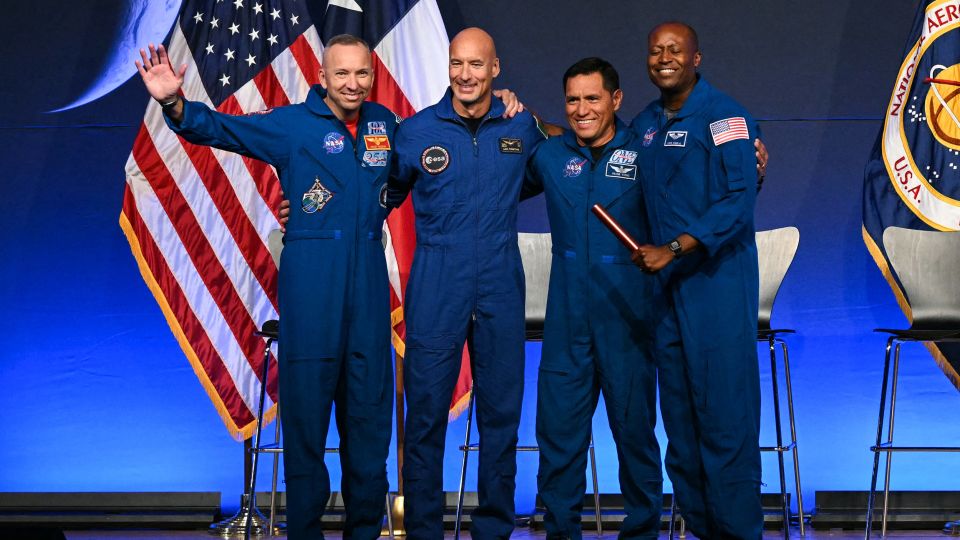
NASA on Tuesday announced the names of the four astronauts who will join the next Artemis mission, a key two-week flight that will test various technologies considered vital to returning astronauts to the lunar surface for the first time in more than 50 years.
The crew, scheduled to launch in late 2027, includes three NASA astronauts—space rookie Andre Douglas, record-holder for the most spaceflights Frank Rubio, and experienced pilot and test pilot Randy Bresnik—as well as Italian astronaut Luca Parmitano of the European Space Agency.
The Artemis III mission is designed to be a preparatory mission for the lunar landing, testing how NASA's Orion spacecraft will dock with the lunar lander. The space agency states that the mission's primary goal is to "reduce risks" before the actual lunar landing, which NASA hopes will occur as early as 2028.
To reach the lunar surface, astronauts would have to perform a similar maneuver while in lunar orbit. But as part of the Artemis III mission, NASA plans to test this maneuver much closer to Earth, remaining in low-Earth orbit (LEO), the closest orbit to our planet and the same region where the International Space Station operates.
The Artemis III crew module is pictured inside the Neil Armstrong Operations and Control Building at NASA's Kennedy Space Center in Florida. — Chandan Khanna/AFP/Getty Images
The Artemis III crew will launch from Florida aboard an Orion capsule, the same type of spacecraft that completed the historic Artemis II moon flyby in April, and will be based in low Earth orbit.
At least one lunar lander will be launched separately—it's unclear whether it will be SpaceX's Starship, Blue Origin's Blue Moon, or one of each. Upon arrival in low Earth orbit, the landers will rendezvous with Orion, allowing astronauts to dock with the spacecraft and possibly board one of the landers.
NASA has suggested it may conduct test flights with both Blue Moon and Starship, although it's unclear how soon both vehicles will be ready. In recent months, the space agency has made a concerted effort to stimulate competition between companies that have held multibillion-dollar contracts for years to supply NASA with crewed lunar landers. Both companies have encountered development difficulties and delays.
This artist's concept image shows SpaceX's Starship human lunar landing system. — SpaceX/NASA An artist's concept image shows Blue Origin's Blue Moon landing system on the lunar surface. — NASA
At a press conference on Tuesday, NASA Administrator Jared Isaacman again suggested that the Artemis III program could include docking with both landers, saying that "Orion will touch and dock with the Blue Origin lander and then again with the SpaceX lander.".
However, the timelines for both SpaceX's Starship project and Blue Origin's Blue Moon project remain uncertain. Blue Origin, in particular, faced a serious problem last month when one of its New Glenn rockets exploded during a scheduled ground test. (New Glenn is the rocket Blue Origin plans to use to launch the Blue Moon lander into space.)
Isaacman also said NASA plans to conduct a key test – a so-called dress rehearsal – of its Space Launch System (SLS) rocket by the end of the year.
Artemis III comes into view.
The Artemis III mission took shape at a uniquely rapid and unexpected pace.
In February, NASA Administrator Jared Isaacman shocked the space industry by announcing the Artemis III mission, which in turn canceled previous plans to land humans on the moon, the first since 1972.
However, Isaacman argued that the transition from a flyby of the moon on the Artemis II mission this year to a lunar landing on the moon on the Artemis III mission is too big a technological leap.
«"We didn't jump straight into the Apollo 11 program," Isaacman said earlier this year. "We had the whole Mercury program, Gemini—many Apollo missions before we finally landed on Earth." NASA's old Artemis plan, he said, "wasn't the path to success.".
NASA on Tuesday released one of the first substantive descriptions of what a mission might look like if it docked simultaneously with Blue Origin's Blue Moon and SpaceX's Starship.
Artemis program manager Jeremy Parsons said Orion will first dock with Blue Moon and then spend about two days docked in orbit, allowing astronauts to board the craft and test its various functions, including life support systems.
According to Parsons, the Orion spacecraft will then separate and dock with SpaceX's Starship for only "about a day." He did not specify whether astronauts would be able to remain inside the SpaceX spacecraft during the mission.
The journey was supposed to end with a splashdown in the Pacific Ocean.
According to the current schedule, Bresnik, Douglas, Rubio, and Parmitano will have approximately a year to prepare for the mission. By comparison, preparations for the Artemis 2 mission took three years, partly due to a number of scheduling delays.
Meet the Artemis III mission astronauts.
The four men making up the Artemis III crew have diverse backgrounds, with a strong emphasis on engineering and test pilot experience. The selection of an all-male crew is also a departure from recent trends at NASA. In recent years, NASA has rarely excluded women from crews.
Randy Bresnik
Bresnik, 58, nicknamed "Comrade," joined NASA in 2004. He flew on the NASA Space Shuttle and the Russian Soyuz capsule in 2009 and 2017, respectively. He has already played a key role in the Artemis program, serving as assistant chief astronaut. In this role, according to NASA, Bresnik "manages the crew's knowledge and expertise in their critical role in the development and testing of all vehicles and aspects of the Artemis mission.".
Bresnik will be the commander of the Artemis III flight squadron.
«"We, as a crew, are honored to be your crew on the Artemis III mission in space, serving as a bridge between the phenomenal Artemis II mission we completed two months ago and the Artemis IV mission that will follow ours, where we will once again be the first to land humans on another celestial body—our neighbor in the night sky, the Moon," Bresnik said.
Bresnik considers Santa Monica, California, his hometown. Before joining NASA, he studied mathematics at The Citadel War College in South Carolina. He also holds a master's degree in aviation systems engineering from the University of Tennessee in Knoxville and graduated from the Air War College in 2008. He trained at the U.S. Naval Test Pilot School—a common path for astronauts—to become an F/A-18 test pilot and participated in Operation Iraqi Freedom.
Andre Douglas
Douglas, 40, joined NASA in 2021. He had never flown a mission before, but was training as a backup for the Artemis II mission, which made history in April by flying four astronauts on a lunar flyby—the first time humans had traveled to the lunar vicinity since the Apollo program ended more than 50 years ago.
As the backup for this mission, Douglas completed all the training that the prime crew—Christina Koch, Reid Wiseman, and Victor Glover of NASA, and Canadian Space Agency astronaut Jeremy Hansen—underwent. This gave him several months of experience piloting NASA's Orion spacecraft.
Douglas was excited about the opportunity to join the Artemis III mission as a specialist for his first spaceflight experience, saying Tuesday, "My brain is working at its limit right now. But my heart—my heart—is so warm.".
Born in Miami, Douglas studied engineering at the U.S. Coast Guard Academy and earned three master's degrees and a doctorate from the University of Michigan and George Washington University. Before joining NASA, Douglas served in the U.S. Coast Guard and conducted research for NASA at the Johns Hopkins University Applied Physics Laboratory.
Frank Rubio
Rubio, 50, also a specialist on the Artemis III mission, joined NASA in 2017 and first spacewalked on the Russian Soyuz spacecraft in 2022, intending to complete a roughly six-month mission to the ISS. However, problems with the Soyuz spacecraft forced Rubio to remain in orbit for more than 370 days, breaking the record for the longest single spaceflight duration by an American astronaut. During this journey, he also famously lost the first tomato grown in orbit.
Rubio, a Miami native, is a military parachute instructor with over 650 parachute jumps under his belt. Before joining NASA, he also served in the Army Air Corps and participated in combat operations in Bosnia, Afghanistan, and Iraq.
He is also a board-certified family physician and military physician. Rubio holds a bachelor's degree in international relations from the United States Military Academy at West Point and a doctorate in medicine from the Uniformed Services University of the Health Sciences.
Luca Parmitano
Parmitano, 49, was selected as an ESA astronaut in May 2009. He has flown into space twice, in 2013 and 2019, completing a total of six spacewalks and becoming the first Italian to command the International Space Station.
Although Parmitano was born in Paterno, Sicily, he considers Catania his home. He holds degrees in political science and experimental flight engineering, as well as a dissertation in international law. He served as a test pilot and colonel in the Italian Air Force.
Parmitano, designated as the Artemis III pilot, is qualified to fly over 20 types of military aircraft and, including helicopters, has piloted over 40 types of aircraft. In 2007, the President of the Italian Republic awarded him the Silver Medal for Valor in Aviation for the successful landing of his AMX military aircraft after a bird strike.
Parmitano was visibly excited during Tuesday's event. "I'm grateful to NASA for allowing me to be part of this incredible group of people, this crew, and for giving me the opportunity to fly—but we wouldn't go anywhere without fuel, and the fuel that keeps everything going is right here," he said, referring to his family.
ESA Director General Josef Aschbacher said the agency was proud that a European astronaut would be at the helm of the mission alongside the NASA commander.
«"Early in his career, he experienced a challenge during a spacewalk," Aschbacher said of Parmitano. "His helmet began filling with water, which by any standard was a dangerous situation. He handled it calmly and clearly and returned safely to duty. That says more about an astronaut than any resume. Luca is precise, focused, and determined. Yes, I'm sure he brings a touch of Italian nonchalance to the cockpit.".
CNN's Katie Hunt, Ashley Strickland and Jacopo Prisco contributed to this report.
NASA's Artemis program is sending humans into deep space for the first time in more than five decades. Subscribe to the Countdown newsletter and get updates from CNN Science on these incredible missions as they unfold.
To receive more CNN news and newsletters, create an account at CNN.com.