








Dimensions as a basis for choice: why size matters
Choosing a bathtub is always a compromise between desired comfort, room size, and budget. Dimensions are the first thing to consider, even before design and color. The wrong size can make using the bathtub uncomfortable, and the room feel cramped and dysfunctional. The standard dimensions we inherited from the Soviet era (150-170 cm long, 70-75 cm wide) were based on the average person's height and the technological capabilities of the time. Today, the market offers much more flexibility: from compact sit-down models 120 cm long to luxurious loungers for two 180-200 cm long and longer. However, while pursuing comfort, it's important to remember physics: a large bathtub takes longer to fill, requires more water, and places greater stress on the flooring. A bathtub that's too small will make relaxing a reality. Therefore, the choice must be approached systematically, taking into account not only the length and width, but also the depth (height of the side), shape, internal volume and, importantly, the material of manufacture, which directly affects the thickness of the walls and, therefore, the usable internal space.

Cast iron bathtubs: heavy classics with clear standards
Cast iron is a material with a long history. Its main advantages include strength, durability (a service life of 50 years or more), excellent sound insulation (water doesn't rattle when poured), and the ability to retain heat for a long time. However, the weight and complexity of cast iron castings limit the range. Manufacturers don't strive to produce hundreds of models, so the size range of cast iron bathtubs is rather limited and predictable. The most common sizes are 150x70 cm and 170x70 cm. These are considered the classic "standard" for typical apartments. The 150x70 cm model is suitable for people of average height (up to 175-180 cm), while 170x70 cm is more comfortable for taller individuals. The depth (height with legs) is typically 50-60 cm, with a useful water depth of about 40 cm. Non-standard options are also available: short bathtubs 120 cm long (for very small bathrooms or summer cottages) and extended ones up to 180 cm. The width rarely exceeds 75 cm, as greater width and thicker cast iron walls do not significantly increase the interior space, and the weight of the structure becomes critical for older floors.
- Installation features: Due to its enormous weight (80-120 kg without water), a strong, level base is required. Additional support is often needed in the center of the long side to prevent sagging and cracks in the enamel. Installation alone is impossible.
- Pros: Indestructible strength, silence, heat capacity, geometric stability, affordability.
- Cons: Enormous weight, limited design and color range (usually white, cream), cold surface upon first touch, difficulty in repair (it is difficult to repair a chip in enamel at home).
- Internal volume: A 150x70 cm bath holds approximately 140-160 liters, 170x70 cm - about 180-200 liters.

Steel bathtubs: a lightweight and economical option
An enameled steel bathtub is the direct opposite of a cast iron bathtub. Its main advantage is its light weight (25-35 kg), which allows it to be installed even on weak floors and done by a single person. Modern models made of high-quality steel 1.5-2 mm thick with several layers of enamel can be quite durable. However, this material has inherent disadvantages: it is very noisy (a ringing sound when filling) and cools quickly. To combat the former, manufacturers apply a noise-absorbing coating (rebowler) to the back of the bathtub body—be sure to check for this when purchasing. The latter is more difficult to combat—only external thermal insulation (foam mats under the bathtub) or the habit of adding hot water will help. The size range of steel bathtubs is similar to that of cast iron, but with a slight variation: standard lengths are 150, 160, 170, 180 cm; Width: 70, 75, sometimes 80 cm. Depth is usually slightly less than that of cast iron bathtubs—40–50 cm. Steel bathtubs often have a rectangular, asymmetrical shape with a widened headboard for greater comfort.
Pay attention to the quality of the enamel. Cheap models may have a thin, unstable coating that quickly develops a network of small cracks (flowering) and yellows. High-quality enamel should be thick, smooth, and free of bubbles and burrs. Another important factor is the rigidity of the frame. Pressing your hand on the edge and center of the base of a cheap bathtub can cause it to flex. Such a bathtub will visibly deform under the weight of water and a person, which will eventually lead to peeling of the enamel. Choose models with reinforcing ribs on the back.
- Popular sizes:
- 150x70 cm is the basic size for small apartments.
- 170x70/75 cm is the most popular and comfortable for most people.
- 180x80 cm is a spacious option for large rooms.
- Installation nuance: A steel bathtub must be installed on adjustable feet and carefully leveled. Any misalignment will result in uneven load distribution and deformation.
- Internal volume: Due to its shallower depth, the capacity is approximately 10-15% less than a cast iron bathtub of the same size. A 170-liter steel bathtub holds approximately 150-160 liters.

Acrylic bathtubs: freedom of shapes and sizes
Acrylic is a material that has revolutionized the world of plumbing. Its flexibility allows for the creation of bathtubs of any shape, even the most extraordinary: oval, round, asymmetrical, corner, with integrated steps and shelves. The range of sizes is virtually unlimited: from miniature sit-down tubs 110-120 cm long to enormous island models measuring 200x100 cm and more. Acrylic bathtubs offer the opportunity to realize unconventional design ideas. The de facto standard for straight bathtubs is 170x75 cm, but corner and asymmetric bathtubs offer much greater variety. Corner bathtubs are most often sized 140x140 cm, 150x150 cm, and 160x160 cm. They save space by fitting perfectly into a corner, yet can still be quite spacious inside. The depth of acrylic bathtubs is usually greater than that of steel and cast iron bathtubs – 50-65 cm, which allows even a tall person to fully immerse themselves in the water.
Acrylic is warm to the touch, quiet, and lightweight (an empty bathtub weighs 25-40 kg). However, its surface is softer than steel and cast iron and can be scratched by abrasive cleaners or hard objects. High-quality acrylic (cast, 4-5 mm thick) offers good scratch resistance and is easily restored—minor damage can be polished. Cheaper models made of extruded acrylic are thinner and require careful handling. Important: an acrylic bathtub should never be placed on its legs. It requires a sturdy frame (usually metal, included) that distributes the load and prevents the base from sagging under the weight. Many models can be built into a niche or decorative podium.

- Features of non-standard sizes:
- Shortened (120-140 cm). Ideal for Khrushchev-era apartments, summer cottages, and under-stairs bathrooms. They often have extra depth to compensate for the length.
- Increased width (80-100 cm). They allow for a comfortable reclining position and are suitable for two people. They require a very sturdy frame and proper floor load calculations.
- Corner asymmetrical. For example, the dimensions are 150 x 120 cm. One edge is longer than the other, which allows the bathtub to fit comfortably into a specific layout and save space.
- Volume: Due to its greater depth and often streamlined shape, the internal volume of an acrylic bathtub with the same external dimensions as a steel bathtub can be 20-30% larger. A 170x75 cm bathtub can hold 200-220 liters.
- Hydromassage systems (jacuzzi). Almost all whirlpool bathtubs today are made of acrylic. Their standard sizes are: corner bathtubs – 150x150 cm, 170x170 cm; straight bathtubs – 180x80 cm, 200x90 cm. It's important to allow space for the technical compartment containing the pump and electronics.
How to measure and choose the right size
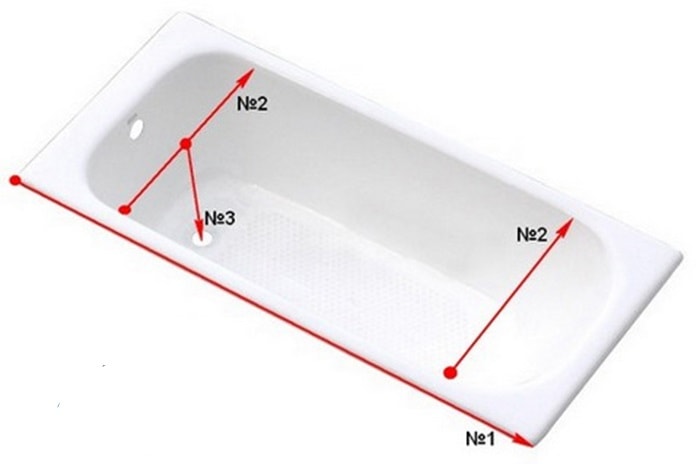
Before heading to the store, arm yourself with a tape measure and a notebook. Measure not only the length and width of the space allotted for the bathtub, but also all the gaps. Consider the thickness of the future wall covering (tiles and adhesive), the thickness of the screen or podium, if planned, the space for utility lines (at least 5-7 cm from the wall to the edge of the bathtub for installing the faucet and trap), and the possibility of bringing the bathtub into the room (doorways, hallways). Draw a simple plan with dimensions. In the store, pay attention not to the external dimensions listed in the catalog, but to the internal length and width. These are the determining factors for comfort. Sit in the bathtub you like right in the showroom (salespeople usually don't mind), and find a comfortable position. Assess whether there is enough space for your height and whether your knees or elbows are touching the walls.
Don't forget about the ergonomics of the surrounding space. After installing the bathtub, there should be at least 70 cm of free passage. If the bathtub is against a wall, there should be at least 10-15 cm of space on the side for access to faucets and cleaning. For corner bathtubs, it's critical to correctly determine the water inlet and drain sides (right or left). This depends on the location of the risers in your apartment. And last but not least, a very important tip: if you choose a non-standard, very large, or heavy (cast iron) bathtub, be sure to consult a specialist about the load-bearing capacity of the floors in your building. It's better to be safe than sorry about cracks in the ceiling of your downstairs neighbors. A properly sized bathtub will become a source of pleasure for years to come, not a daily reminder of a mistake.