








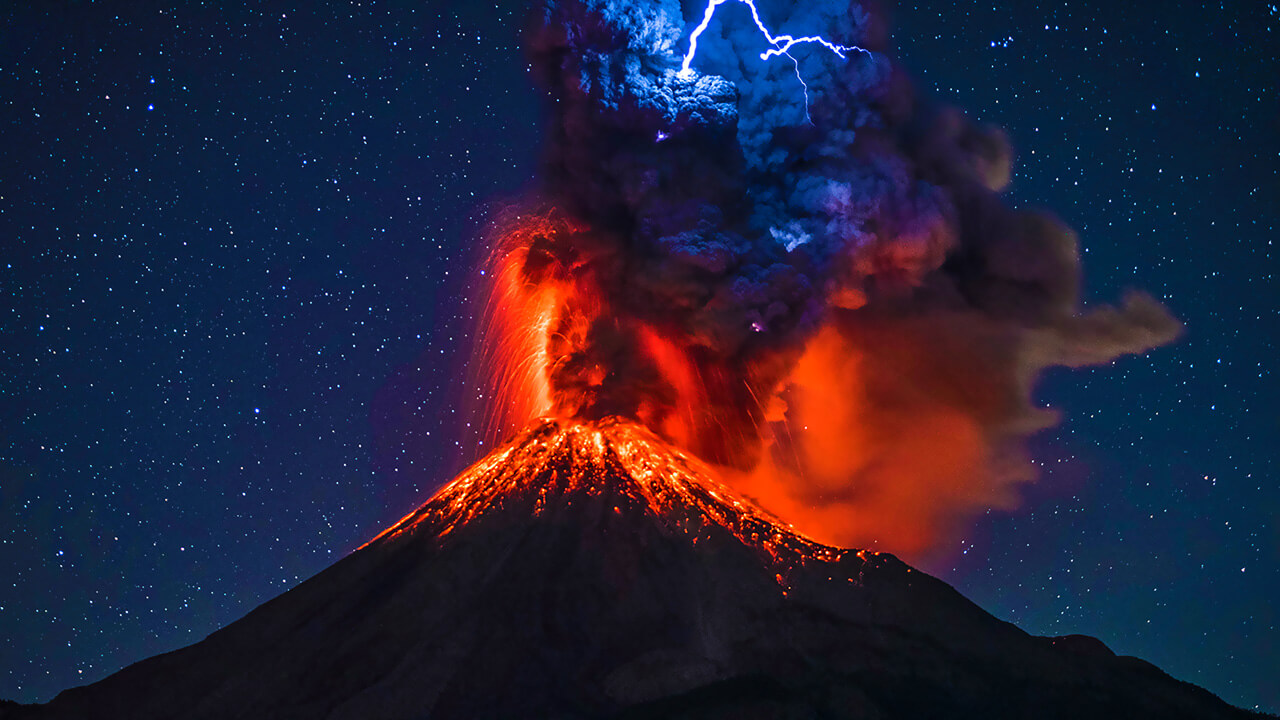
Many predictions of the possible end of the world include the eruption of the Yellowstone supervolcano. But while it's currently overhyped, there are numerous volcanoes on Earth that are ticking time bombs for nearby human settlements.
To ensure your vacation is never marred by clouds of steam, ash, and lava flows, we'll tell you about the ten most dangerous volcanoes on Earth, where you definitely shouldn't take selfies.
10. Galeras, Colombia
This stratovolcano with a large caldera is located west of the city of Pasto and is one of Colombia's most active volcanoes. It has been active for over one million years and shows no signs of fading in the 21st century.
In 1993, nine people died during the Galeras eruption, including six scientists, and in 2010, 9,000 (according to other sources, 8,000) people were evacuated from the area near the volcano.
9. Klyuchevskaya Sopka, Russia
A list of the most dangerous volcanoes on the planet couldn't be complete without a representative from Russia. Klyuchevskaya Sopka is one of the highest volcanoes on Earth, and the highest active volcano on the Eurasian continent. Located on the Kamchatka Peninsula, it is surprisingly covered in pure snow and ice crusts, which can create an interesting contrast with the ash and lava flows during an eruption.
It can spew ash columns reaching 8 kilometers in height. It has erupted periodically, approximately once every five years, since 1737 (this is only the first documented eruption; how many there were before is unknown). The most powerful eruptions occurred in the 19th century.
8. Kilauea, Hawaii
This volcano's name isn't particularly original, meaning "belching" or "spitting out" in Hawaiian. It's believed that the local volcano goddess chose it as her home.
Kilauea is the most active shield volcano on the island, erupting almost continuously from 1983 to 2018, causing widespread destruction, including strong earthquakes and fires.
Since 1912, the Hawaiian volcanic eruption has been monitored by staff at the Hawaiian Volcano Observatory.
7. Merapi, Indonesia
Mount Merapi (meaning "mountain of fire") is one of Indonesia's most active volcanoes, having erupted for centuries. It is located near the center of Java, approximately 32 kilometers north of the city of Yogyakarta.
One of the largest recorded eruptions occurred in 1637 and destroyed several towns and villages in Java.
The greatest risk associated with this volcano is the spread of pyroclastic flows, a mixture of volcanic gases, ash, and rock debris that can travel at speeds of up to 700 km/h. In 2010, 353 people died from such flows.
6. Sakurajima, Japan
This active stratovolcano was a separate island until 1914, but lava flows connected it to the Osumi Peninsula.
The volcano has erupted almost continuously since 1955, posing a serious threat to nearby settlements, the largest of which is the city of Kagoshima (over 600,000 residents).
It is no wonder that due to its danger, Sakurajima was included in the list of Volcanoes of the Decade in 1991.
5. Taal, Philippines
Living like a volcano is no longer a relevant expression for residents of Taal Island, home to one of the world's most dangerous volcanoes. Philippine authorities have decided to ban islanders from returning to the dangerous area and will provide them with homes further away from the volcano.
Taal awoke from its slumber on January 12 of this year, spewing a kilometer-high column of ash. This forced the emergency evacuation of residents of Batangas province. Since the volcano has repeatedly displayed its nasty behavior, authorities decided to protect people from it once and for all.
4. Nyiragongo, Congo
Together with its neighbouring peak, Nyamlagila, Nyiragongo accounts for approximately 40% of all volcanic activity in Africa.
A distinctive feature of this volcano is its incredibly fluid lava, which is due to its low quartz content. Due to its fluidity, the lava can rush down the slopes at speeds of up to 100 kilometers per hour.
3. Colima, Mexico
Mexico's most active volcano consists of two conical peaks, but only one is active.
From time to time (documented since 1576), Colima reminds local residents of its existence by spewing ash, lava, and smoke. On one occasion, it was able to eject a plume of ash and smoke 10 kilometers into the air.
2. Santorini, Greece
From the "young to early" volcanoes, whose main activity occurred relatively recently, we move on to the heavyweight, which was last active around 1645 BC.
The Santorini eruption and the subsequent tsunami are believed to be the cause of the destruction of the Minoan civilization of Crete (though this is not certain). It is also hypothesized that the memory of this catastrophe formed the basis of the legend of Atlantis.
Since then, the Santorini volcano has shown only occasional seismic activity and nothing that looks like an impending eruption. However, volcanologists are constantly monitoring it.
1. Vesuvius, Italy
Which volcano is the most dangerous in the world? The answer to this question depends on your definition of danger. A good indicator is the overall volcanic hazard posed by a volcano. This, in turn, is best described as a combination of the likelihood of an eruption, its size, and the potential damage from the volcano's activity. Supervolcanoes like Yellowstone, if they erupt, would threaten life and property globally.
But within a reasonable timeframe of our existence, the probability of such an explosion is extremely small, and humanity will likely find other ways to harm itself long before a supervolcano does.
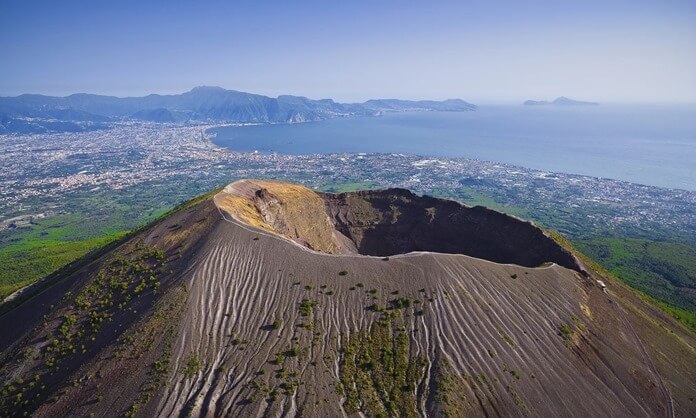
For this reason, the active volcano Vesuvius ranks first in this ranking. Its slopes and the immediate surrounding area are extremely densely populated; even the city of Naples is only about 15 km from the volcano. In the event of a major eruption, more than 3 million people could be at risk of death or, at worst, the loss of all their belongings.
Vesuvius has not erupted since 1944 and may remain dormant for a long time. However, it is hypothesized that it will awaken again sooner or later (within decades to centuries, unlike the indefinite slumber of supervolcanoes). Currently, the Osservatorio Vesuviano in Naples monitors Vesuvius's activity day and night.