








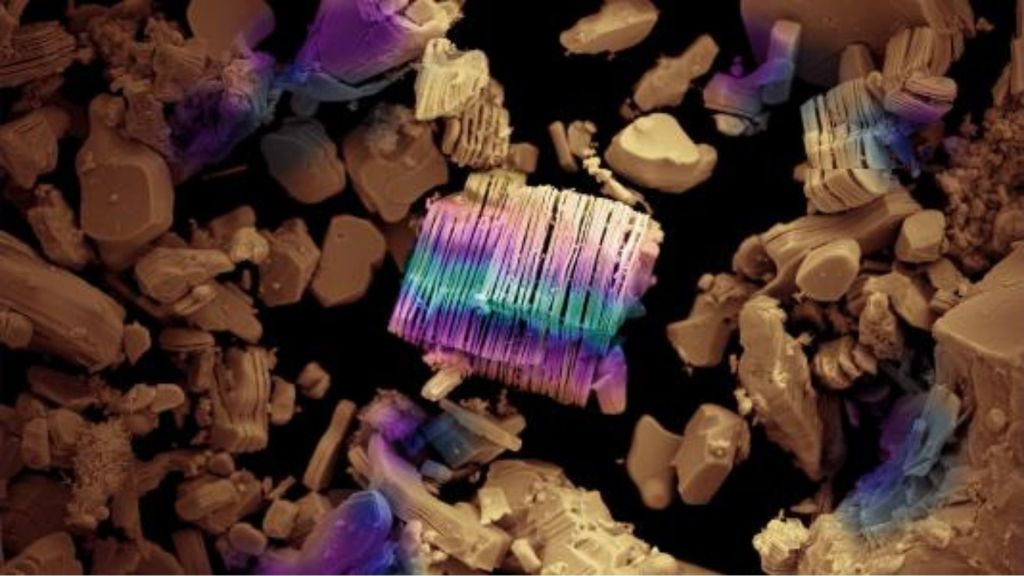
Scientists at the U.S. Department of Energy's Argonne National Laboratory are bringing materials engineering closer to the atomic scale, demonstrating how MXenes can be modified at a near-atomic level to create advanced technologies.
In two recent publications, researchers demonstrated new ways to control the types of atoms in MXenes, their arrangement, and which chemical groups attach to their atom-thin surfaces.
MXenes (pronounced "max-ins") are a family of two-dimensional materials, often just a few atoms thick. They are primarily composed of transition metals such as titanium, vanadium, or molybdenum bonded to carbon and/or nitrogen.
Expansion of the MXene material family.
MXenes initially form layered solids called MAX phases. When researchers chemically remove one type of layer from a MAX phase, the remaining layers can be separated into thin, flat layers of MXene.
«I like to think of MAX phases as a textbook with all the pages glued together, and MXenes as the one page you want to extract,» explained Brian Wyatt, a Maria Goeppert-Mayer Fellow at Argonne National Laboratory.
«"You need to dissolve the glue and carefully remove the page. The glue and the pages are different chemical environments, so the atoms prefer to be near certain layers," he added.
In a study published in the journal Science, scientists from Argonne National Laboratory created 40 different MAX phases, each containing at least two metals, and in some cases up to nine metals, in a single structure.
This achievement nearly doubled the known chemical space that can be used to create MXenes.
When the atomic order is violated
Researchers have discovered that atomic order can be maintained when a material contains up to six different metals. However, when seven or more metals are added, this structure is disrupted, and the atoms become truly disordered.
«"This is where entropy, the natural tendency toward randomness, takes over," Wyatt said. "Nature favors a certain order, but as soon as we add enough different ingredients, it becomes too difficult for the atoms to remain organized," he added.
Using secondary ion mass spectrometry (SIMS), the team measured the structure of the material layer by layer to determine the location of different atoms.
Structural materials for future technologies
«"We like to say they're like design materials," Wyatt said. "If I need something specific, I use these compositions; if I need something different, I use others. There are so many people in the group that we can design based on our needs.".
One promising application is electromagnetic interference shielding, where MXenes can block unwanted signals even in nanometer-thick coatings.
Researchers are also studying them in the context of catalysis, where their open two-dimensional surfaces could reduce the need for expensive materials such as platinum.
«"The ability to tune the properties of MXenes is key to catalysis," Muhoza said.
«"Sometimes specific metals are needed as active sites, but only a small region of the base material is active. MXenes allow these metals to be placed on a two-dimensional structure so that all of them are exposed," he added.
The next challenge is scaling these materials for production and industrial applications. Artificial intelligence and machine learning can help researchers determine which combinations of elements are most feasible to test.