








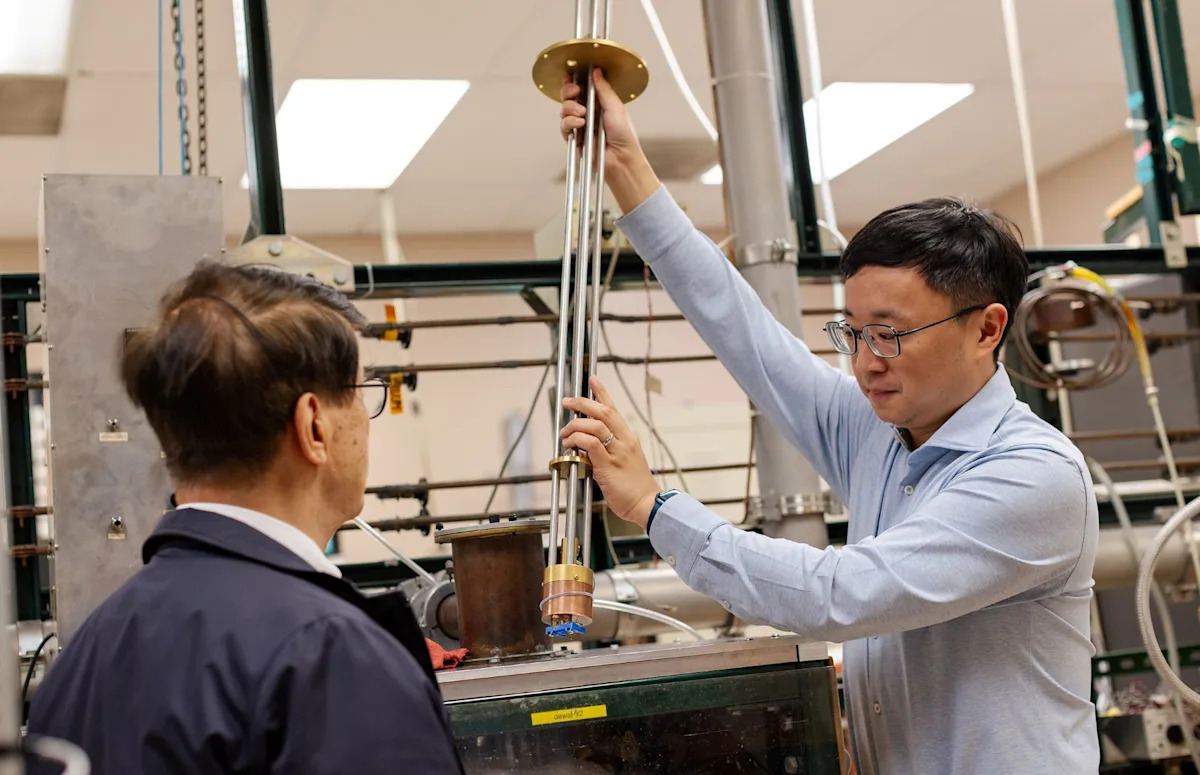
A team of researchers from the University of Houston has announced a new superconductivity record, creating a material that conducts electricity with zero resistance at normal pressure and at a higher temperature than any previous superconductor at atmospheric pressure.
This doesn't mean that room-temperature superconductors already exist. But it does mark a significant step toward technologies that could significantly reduce energy loss.
What's happened?
Researchers from the Texas A&M Center for Superconductivity and the University of Texas's Department of Physics measured the superconducting transition temperature at 151 Kelvin (-122 degrees Celsius). The university stated that this is the closest temperature to room temperature achieved to date and the highest temperature recorded for a superconductor at atmospheric pressure since the first discovery of superconductivity in 1911, according to a ScienceDaily article. .
The study, published in the journal Proceedings of the National Academy of Sciences, broke a record that had stood for over 30 years. The previous highest temperature at atmospheric pressure was 133 K, achieved in 1993 by a mercury-based material based on copper oxide, Hg1223.
Physicists Ching-Wu Chu and Liangzi Deng achieved a new result using a method called "pressure quenching." They first subjected the material to high pressure to enhance its superconducting properties, then cooled it and rapidly released the pressure so that the enhanced state remained stable under normal conditions.
«"Our method shows that this state can be maintained without maintaining pressure," Chu said.
Why is this important?
Superconductors allow electric current to flow without resistance, meaning virtually no energy is lost as heat. This could improve the efficiency of power grids, enhance energy storage, and facilitate the development of faster electronics, advanced MRI systems, and future fusion technologies.
Chu noted that currently, approximately 8% of electricity is lost during grid transmission. Reducing these losses could lead to significant savings, as well as a reduction in environmental pollution associated with unnecessary electricity generation.
Most superconductors only function at extremely low temperatures, requiring expensive cooling systems. Increasing the operating temperature makes these materials much more practical for practical applications and significantly simplifies their study by scientists using standard equipment.
The findings could contribute to the introduction of cleaner and more efficient energy systems and medical technologies into everyday life.
A team from the University of Houston is now helping advance this field of science toward an even more ambitious goal: superconductivity at room temperature and atmospheric pressure. Room temperature is approximately 300 Kelvin, so this record is still about 140 degrees Celsius short of that goal.
Chu and Deng also contributed to a paper outlining six possible ways to increase superconducting temperatures, including the pressure quenching method used for this breakthrough.
Rohit Prasankumar, director of superconductivity research at Intellectual Ventures, said future advances will likely depend on collaboration between physicists, chemists, engineers and materials scientists.
«"This discovery has enormous potential," Chu said. "We believe that with enough people working on it and enough time, we can realize that potential.".
Dan added that materials at atmospheric pressure become "much more accessible to scientists, allowing them to use well-designed equipment.".
Subscribe to TCD's free newsletters to receive helpful tips, actionable advice, and a chance to win $5,000 toward your home improvement. To read more articles like this, change your Google preferences here. .