








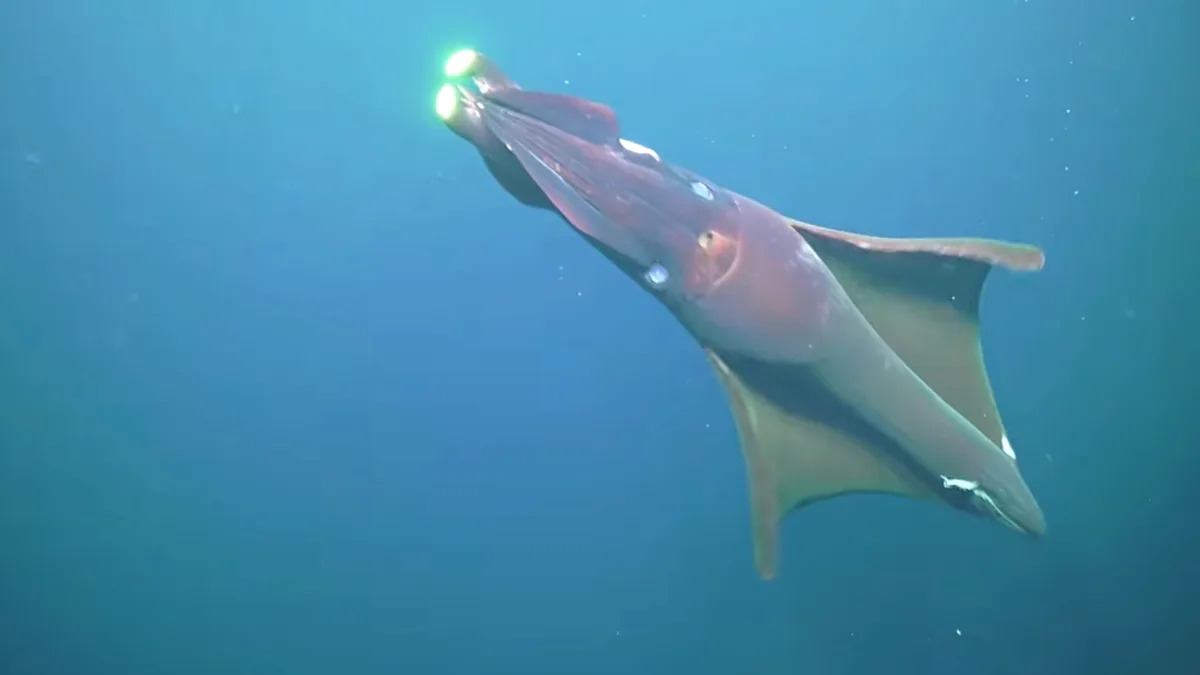
A rare giant squid has been discovered in deep-sea canyons off the coast of Western Australia, with traces of its genetic material found in the water.
According to Smithsonian Magazine, the discovery came about through the identification of 226 species of marine organisms living in an ecosystem located deep below the ocean's surface.
The research team studied underwater canyons off the coast of Ningaloo. Environmental DNA (eDNA) was used to identify animals that had recently visited the area.
During a 2020 expedition aboard the Schmidt Institute of Oceanography's research vessel Falkor, the team collected nearly 200 water samples at five depth levels in two canyons—Cape Range and Clotes—about 2.8 miles below the surface.
They then compared DNA fragments released in mucus, skin, feces, and other tissues with genetic databases. This analysis, published in March in the journal Environmental DNA, confirmed the presence of giant squid in both canyons.
Giant squid are extremely rare. Scientists have documented the presence of giant squid in Western Australian waters only twice. Study co-author Lisa Kirkendale stated in a Curtin University press release that the last time scientists found evidence of their existence was over 25 years ago.
The study also identified species not previously recorded in Western Australian waters, such as the faceless conger eel and sleeper shark.
Researchers said much of the life in the deep ocean remains unexplored.
«"We found a large number of species that don't exactly match any currently recorded finds, which of course doesn't automatically mean they're new to science, but it does provide compelling evidence of a vast amount of deep-sea biodiversity that we're only just beginning to understand," said Georgia Nester, lead author of the study.
The research results showed that different areas of the deep-sea zone are not interchangeable. Each deep zone contained its own unique set of organisms, and the two canyons were also distinct from each other.
Protecting marine life may require more tailored approaches rather than one-size-fits-all strategies. Understanding what already exists is often the first step toward protecting it.
Scientists are increasingly using environmental DNA (eDNA) to complement older methods such as camera traps and nets. This method allows for the detection of rare, fragile, or fast-moving animals that are easily missed by traditional surveys. Even a single water sample can contain evidence of multiple species.
These data can influence future conservation planning, helping decision-makers track ecosystem changes over time and identify areas that may require stronger protection. They also provide scientists with a more effective way to monitor species without disturbing them.
Subscribe to TCD's free newsletters to receive helpful tips, actionable advice, and a chance to win $5,000 toward your home improvement. To see more stories like this, change your Google preferences here.