








WhatsAppRedditShareEmailTweetPin0 Shares
Chances are good that if you're currently using a phone or computer to enjoy this content, you're a Homo sapiens. We're the only human species currently inhabiting Earth, but it wasn't always that way.
Just like you're looking for a new dog at the shelter and can't decide between a pug, a schnauzer, a Doberman, or a greyhound, humans had quite a few choices, too. Our relatives have since gone extinct, though some of their genetic traits remain. But it makes you wonder: how many different species of humans existed back then? Let's go back in time and take a look.
Are we different species?
To begin with, one might wonder whether we are actually a different species from pre-existing humans. At first glance, it seems so. We are not Neanderthals, but at some point we interbred with them, because 2% of all non-African ancestry comes from Neanderthals. Right now, you and everyone you know are part Neanderthal. Melanesians may have up to 6% of Denisovan DNA.
According to some early definitions of species, different species are incapable of reproduction and do not have fertile offspring. But humans are clearly quite fertile, so by this definition, we are no different from ancient humans. However, some organisms reproduce asexually, so this definition of reproduction is in any case too restrictive. The result? We technically don't have a fully established definition of species.
Early humans
It is important to understand from the outset that when studying early human species, there is no consensus in the scientific community about what this means.
At least eight species of early humans can be identified that lived alongside us. However, this number is sometimes significantly expanded, including other species whose existence has not yet been sufficiently confirmed. Furthermore, there are those that are not necessarily human species, but rather represent an intermediate stage between us and our ape-like ancestors. According to some estimates, there are as many as 20 species of humans, not counting us. But even this list lacks some representatives, such as the Denisovans.
To understand all the confusion, consider a species called Homo erectus. Homo erectus is our earliest relative, possessing human-like proportions. Along with Neanderthals, it is perhaps the most frequently depicted "caveman." They had longer legs and shorter arms, suggesting they were adapted to life on the ground rather than in the trees.
Homo erectus existed as far back as 1.89 million years ago and disappeared around 110,000 years ago. Homo sapiens, or us, first appeared between 200,000 and 300,000 years ago. So, we spent a fair amount of time dividing the Earth. But it's possible there was not just one, but several varieties of Homo erectus.
Homo erectus is sometimes subdivided into Homo ergaster and Homo georgicus. Not everyone is certain whether these were the same species or different subspecies. Perhaps they all shared a common feature—a larger skull, meaning a larger brain.
Another remarkable feature of Homo erectus was that they were the first early human species to spread beyond a single continent. Earlier fossil finds had very limited ranges, but Homo erectus fossils have been found in Africa, Asia, and Europe. This ancient human was a wanderer.
As we've already discussed, science has identified at least 20 human species, and some lists even more. Some of them were similar in appearance to humans, while others were clearly more ape-like. But all of them had to be unique enough to be considered separate species before we could definitively separate them. At least for now.
Who knows what the future holds? More fossils could help us better understand how our species and others arose. In the meantime, let's take a look at some of our ancient relatives that no longer exist.
Sahelanthropus

Chances are you've never heard of Sahelanthropus, and not just because the word doesn't sound very pleasant. Sahelanthropus chadensis lived in Africa approximately 6 to 7 million years ago.
If you saw a reconstruction of this early hominin based on fossil remains, you'd probably think it was an ape. However, one important difference is that they walked upright. At least, that's what some scientists believe. Others are less convinced, believing it was simply another ape.
If this species truly walked upright, it may be the oldest human ancestor ever discovered. The debate continues: some believe it could walk upright, others are convinced it walked on all fours like chimpanzees, and perhaps it simply walked upright at times, like modern apes or even your dog, if motivated. Without further evidence, this question will remain a subject of debate.
Neanderthals
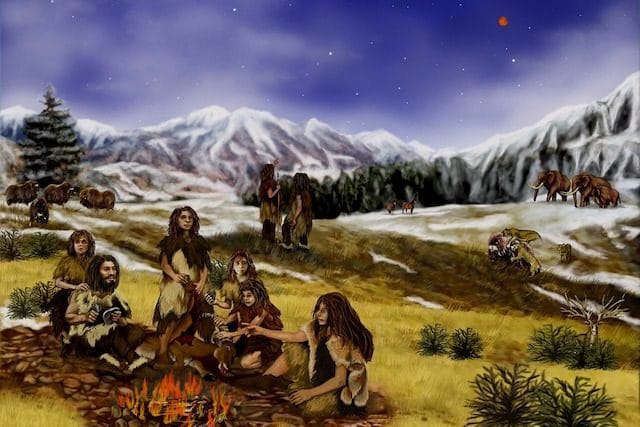
Neanderthals appeared 400,000 years ago. In relative terms, they weren't much older than Homo sapiens. And, like other human species besides us, they became extinct around 40,000 years ago.
Although Sahelanthropus would have been our most distant relatives among humans, Neanderthals were our closest. Physically, they were almost identical to us. And, as genetics shows, we could have shared some special traits and, if we so chose, had small children who were half Homo sapiens and half Neanderthals.
Fossil evidence shows that Neanderthals expanded as far west as Wales and could also be found in the easternmost reaches of Siberia. They were adapted to life in colder climates than many other human species, and their physique was also well-suited for running. This is significant because not all of our ancestors were capable of this. This means that Neanderthals were much better hunters than other species.
While the modern image of cavemen, typically involving Neanderthals, conjures up a dumber version of ourselves, there's ample evidence that Neanderthals were highly intelligent. They may have even altered the landscape they inhabited by burning and clearing vegetation. They even produced their own resin to make hunting weapons.
We know much more about Neanderthals than about some other species, thanks to their habitat. Many fossils were preserved in limestone caves, so we have much more information to study them than with species that lived in warmer, more open climates, where remains and relics are less well preserved.
Neanderthals survived the Ice Age, developed tools, mastered hunting, and even sewing. Their disappearance, like that of any other species, remains a mystery.
Flores Man

Flores Man, also known as Homo floresiensis, was a small human species that existed between 50,000 and 100,000 years ago on the small island of Flores in Southeast Asia. By "small," we mean the female skeletal remains measured 90 centimeters (3 feet 6 inches) in length, earning it the nickname "hobbit." It has been suggested that its small size may be an example of island dwarfism, where species evolve smaller sizes due to limited resources in an island environment.
Since the remains discovered are few, only one nearly complete skeleton and a few fragments of others have survived. The nature of the Flores Man remains a matter of debate. Some suggest it is not a distinct species at all, but merely the remains of several sick individuals mistaken for something else.
Denisovans

Denisovans are another species closely related to modern humans, interbreeding with both Homo sapiens and Neanderthals. They are also a relatively new species, their remains first discovered in 2010.
Based on the evidence we have, a common ancestor known as Homo heidelbergensis left Africa between 300,000 and 400,000 years ago. Those who left split into two groups. One became the Neanderthals, and the other the Denisovans. Those who remained in Africa evolved into Homo sapiens. This is how the three of us are related, and why our ancestors were able to reproduce across three distinct groups.
While Neanderthals got their name from the Neanderthal Valley in Germany, Denisovans are named after a Russian cave once inhabited by a man named Denis. And that's not a joke; there's a real reason.
Denisovans inhabited a wide variety of locations around the world, from the frigid northern reaches of Siberia to the scorching jungles of Southeast Asia. Few Denisovan fossils have been discovered, but we do have their DNA, and it's thanks to this DNA that we've learned much of what we know. This DNA data suggests low genetic variability in the population, meaning they may have initially been small in number. However, as we've already mentioned, their DNA has survived to this day.
While we've already discussed the Melanesians, it's also believed that the Sherpas of the Himalayan Mountains are better able to cope with high altitudes and low oxygen levels than many other modern humans thanks to their Denisovan DNA.
Australopithecus
One of the most famous skeletons ever discovered, belonging to an ancient human relative, is named Lucy. She belongs to the species known as Australopithecus. Australopithecus lived in Africa, and Lucy was found in Ethiopia.
We've discovered the remains of over 300 individuals, so we know a lot about them. We know they could walk upright, but they may also have spent time in trees. Judging by the teeth we've found, their diet consisted primarily of plants, but they may have also eaten harder food, and perhaps even small lizards and similar animals.
Although they had some similarities with Homo Sapiens, they looked more like apes in appearance.
Where did all the others go?

If Homo erectus existed for nearly two million years, where did it go? Where did everyone else go except Homo sapiens? Around 40,000 years ago, only Homo sapiens remained on Earth, and all other human species disappeared. The truth is, we don't have a definitive answer.
It's entirely possible that Homo sapiens exterminated their own kind. We may have gone to war with these other human species and wiped them out. But that's clearly not the only thing that happened, since we share common genetic roots. Therefore, another theory exists: perhaps we simply interbred with some of them, and the result of all of our interbreeding is who we are today.
Other theories more convincingly suggest that climate change became too challenging for other species to survive, and they all went extinct. Or even that our species simply had higher infant survival rates and lower maternal mortality rates, making us better prepared for long-term survival in a changing world.
It's no wonder we have a hard time understanding where everyone went; we don't even know where they came from. We don't even know where we came from. There is evidence of early Homo sapiens appearing in Morocco, Ethiopia, and South Africa. Perhaps we emerged in all of these places at roughly the same time.
We gain all our knowledge from fossils, and they don't always provide the clearest picture. The only thing we know for sure is that we once had relatives, but they're gone.
Other articles that may interest you