








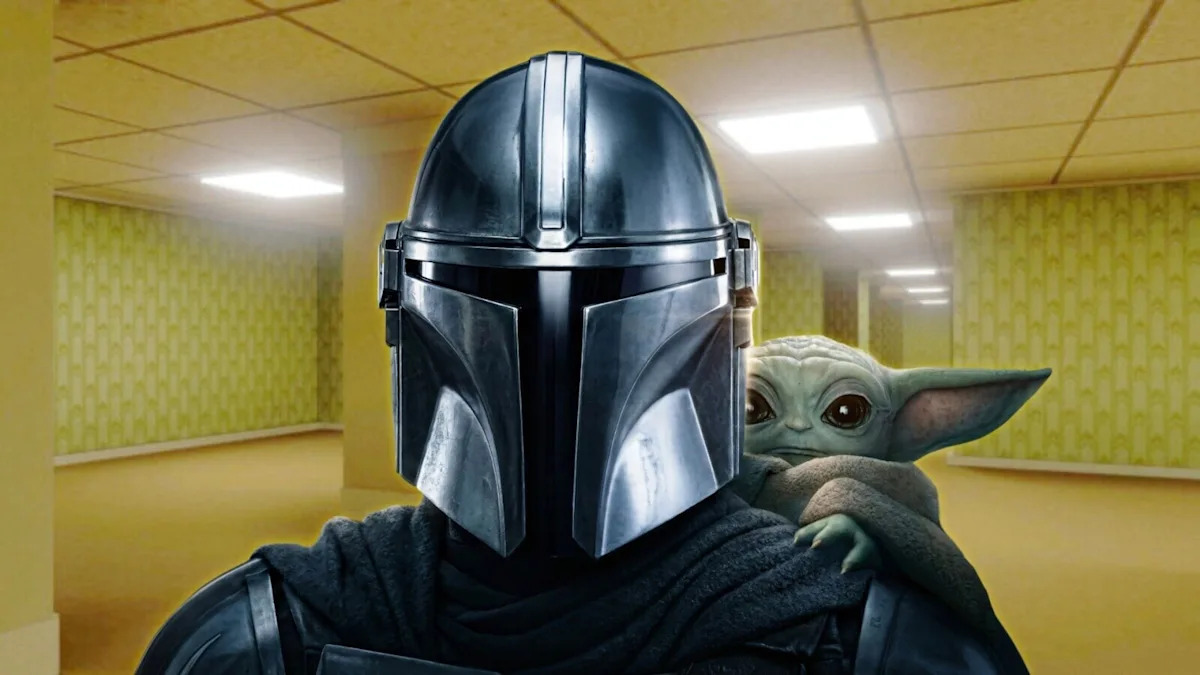
«"Behind the Scenes," a recent horror film based on creepy, endless yellow rooms found on the internet, proved more gripping to audiences than both "The Mandalorian" and "Grogu," Disney's big attempt to bring Star Wars back to theaters.
There's a funny version of this story where we laugh about it. I can already hear some suited Disney executive shouting, "George Lucas built this in a cave. From a box of scraps! Why can't we do it now?"«
But it goes deeper than that, and goes beyond the "small film defeats giant franchise" narrative we've seen many times before. In "Behind the Scenes," "The Mandalorian," and "Grog," we witnessed the collision of two completely different approaches to filmmaking.
On one side is modern Star Wars: huge budgets, endless storytelling, nostalgia management, corporate control, and the constant pressure to maintain one of the biggest entertainment machines on Earth. On the other, Behind the Scenes: a bizarre internet horror concept created by a director who simply wants to tell a story, developing his style on YouTube in the same way George Lucas once fought to make the original Star Wars feel personal, daring, and new.
One side is protecting its franchise, while the other is trying to create something of its own – and apparently, that difference still matters.
«Star Wars began as a strange, soul-stirring project.
People forget that the original Star Wars wasn't meant to be a blockbuster.
George Lucas created this film like a kid tinkering in a garage. He took everything he loved—samurai movies, Flash Gordon TV series, mythology, hot rods, and World War II dogfights—and blended them into one bizarre adventure. The film was shot under severe constraints that directly impacted filmmaking capabilities, including a small budget, limited technology, and limited support from people who barely knew what the film was about.
Perhaps this is what made Star Wars great. Constraints encourage creativity—the cantina feels alive because the filmmakers had to invent an entire galaxy using masks, puppets, costumes, matte paintings, and clever cinematic techniques. The original trilogy succeeded because it had flavor, energy, and individuality.
Modern Star Wars has unlimited resources, and perhaps that's the problem.
Modern Star Wars feels too corporate.
Large franchises eventually become so expensive that they stop taking risks.
A modern Star Wars film must support streaming plans, merchandising, theme parks, attract investors, evoke nostalgia, ensure story continuity, and promote the film globally. This isn't creative freedom, but rather brand management.
Modern Star Wars films are often more focused on reminding audiences of the universe's importance than simply telling a compelling story. This is why films like Behind the Scenes suddenly feel fresh, because rather than defending the legacy, they simply aim to evoke a strong audience reaction and pique their curiosity.
The Internet has given birth to a new generation of filmmakers.
Over the past few years, we've seen a wave of internet horror projects and experimental games break into the mainstream. Markiplier's Iron Lung began as an indie adaptation, built almost entirely on the strength of online fandom and creator culture. Exit 8, based on a surreal game with looping corridors, follows a similar pattern: a simple, unsettling concept that spread online because people couldn't stop talking about it.
There are other examples. Skinamarink quickly gained popularity on TikTok and horror forums before becoming a cinematic hit. Analog horror series like The Mandela Catalog and Local 58 have amassed a huge audience on YouTube thanks to their lo-fi aesthetic and unique atmosphere. Even projects inspired by SCP lore, creepypasta culture, and gaming communities using found footage have begun to attract serious attention from studios.
What they all have in common is that they don't feel like they were created primarily by Hollywood. It's the modern version of "making something in the garage." Today's filmmakers have Blender, Unreal Engine, editing software, YouTube, and an online audience at their disposal, and they don't need Hollywood's permission to start creating.
The question is no longer, «Can you build something?» but rather, «Do you have an idea that people will actually be interested in?».
«Star Wars needs more passion, not less money.
This is not an argument for making Star Wars cheap.
Massive space battles and incredible visual effects are part of the fun, but money is no substitute for vision. The franchise needs filmmakers who strive to create something personal, not to support a gigantic cultural monument.
Audiences still love franchises, but they also want films that feel alive—films that convey genuine care and thought. A small project with a few rough edges can be more captivating than a polished, team-driven blockbuster.
The Rebels are now on YouTube.
The irony is that the creators of Star Wars should understand this better than anyone.
The whole story boils down to these tiny rebels fighting a gigantic empire that confuses size with strength. Now we're seeing internet filmmakers, using editing software and bizarre horror ideas, generating more buzz than one of the biggest entertainment brands on Earth.
This doesn't mean Star Wars is dead. But simply "being part of Star Wars" is no longer enough to automatically dominate culture.
A new generation of filmmakers can first build an audience online—they can upload short films demonstrating the viability of a concept, experiment freely, and create entire worlds based on a single, powerful idea. Then Hollywood takes notice.
If Star Wars wants to feel alive again, perhaps it needs to recapture that spirit, because the Force was never about the size of the Death Star. It was about a child looking to the horizon and believing they could do the impossible.
Get more news from Cracked delivered straight to your inbox. Subscribe to the Cracked newsletter on the Cracked News Letters Signup page.