








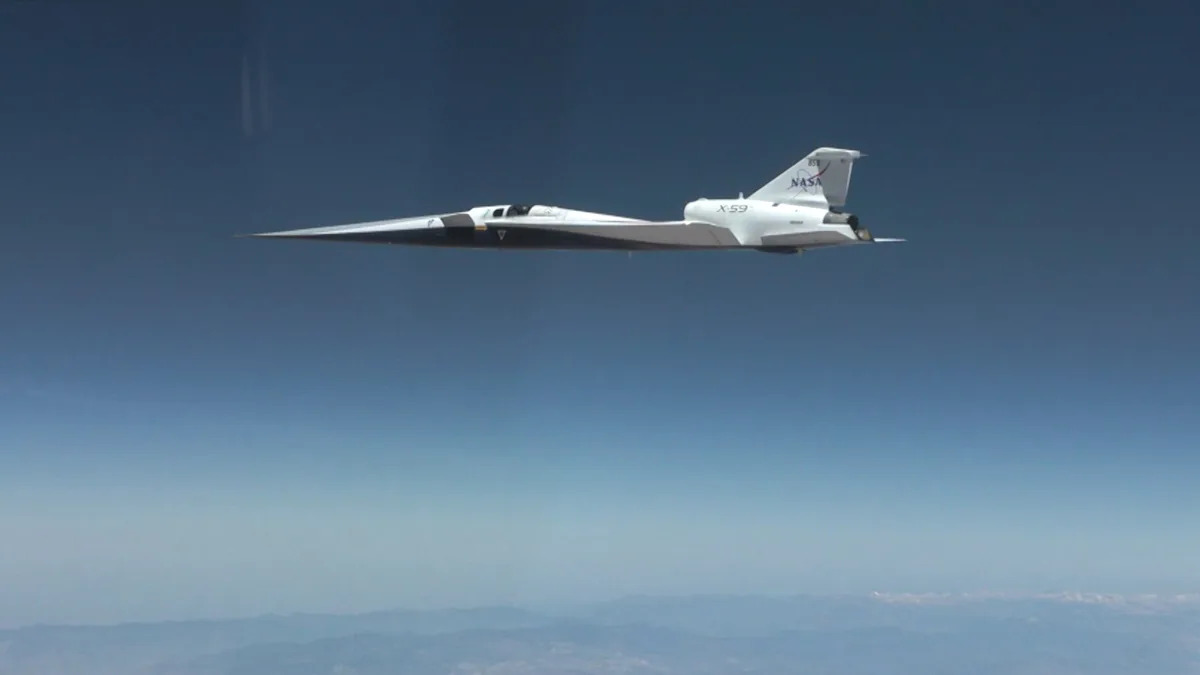
NASA's X-59 experimental aircraft moved one step closer to making supersonic flight silent: on June 5, it made its first supersonic flight, reaching a top speed of 713 mph at 43,400 feet, equivalent to Mach 1.1.
«"Flying at supersonic speeds is a significant milestone for the X-59 team," said Katie Bam, NASA's project manager, in late May, prior to the flight. "Completing the first flight under mission conditions is especially significant—it's the moment we begin validating the aircraft's performance in the environment for which it was designed.".
The 81-minute flight took off from Edwards Air Force Base and was piloted by NASA pilot Jim Less.
Subscribe to Today in Science, a free daily newsletter from Scientific American, and join a community of readers who love science.
The term "supersonic" is rather vague, as the speed of sound depends on the temperature and pressure of the local atmosphere. Mach 1 denotes the local speed of sound, above which movement is considered supersonic; Mach 5 marks the transition to even higher "hypersonic" speeds. When objects travel faster than the speed of sound, the shock waves they create are directed backward and form a cone; if an object flies low enough for this cone to reach the Earth, the result is a loud noise called a sonic boom.
This boom, coupled with the enormous cost, led to the retirement in 2003 of the only supersonic passenger jet, the Concorde, which had been carrying passengers since 1976. The plane had a cruising speed of 1,350 mph and could fly from New York to London in less than three hours under favorable conditions.
For nearly a decade, NASA has been working to create an aircraft capable of flying faster than the speed of sound without producing destructive sonic booms. The craft's long nose is designed to dissipate shock waves, so that flight produces only a "quiet supersonic boom," as the agency described it in a statement in late May—something between distant thunder and the sound of a car door closing 20 feet away.
The result was the X-59, which first flew in October 2025 and has completed more than a dozen flights to date. Now that the X-59 has reached supersonic speed, the test flight program continues, with plans to reach speeds of Mach 1.6 (1,218 mph) and altitudes of 60,000 feet, though the aircraft will also conduct less extreme flights to provide engineers with even more data.
«"These flights not only strengthen our confidence in the X-59's performance, but also mark our progress toward future mission phases that will ultimately help shape the future of supersonic flight," Bam said in late May.
Following the completion of this phase of test flights, NASA will begin a second phase of testing, which will focus on the aircraft's noise and determine whether it will emit the planned "silent supersonic boom" or something more akin to the unacceptable sonic booms of other high-speed aircraft. In the final phase, the testing will move to populated areas, and NASA will survey residents about their impressions of the aircraft's noise.