








Humans are obsessed with longevity. We revere centenarians, yet lie about our own age. We read about diets proven to extend life, yet still eat cheesecake. Sometimes we even freeze our own heads, just in case some future scientist wants to stitch them onto a creepy robot body or something. But try as we might, we've never managed to extend the average human lifespan much beyond 80 years or so, which is such a short period of time in geological terms that if we did, the giant sequoias would probably laugh at us and comment on how cute we are.
Nothing on planet Earth lives longer than the oldest trees, unless you count the 500,000-year-old bacteria scientists discovered in Siberian permafrost, but we'd rather not. There are also several species of cloned plants that can live over 100,000 years, but these are organisms that reproduce asexually and constantly create new copies of themselves, so individual plants aren't as old as the collective organism. Trees reign supreme, and some trees live exceptionally long—long enough to witness the rise and fall of civilizations, though they're almost certainly too overconfident to care.
From legendary sequoias to mysterious yews, let's travel the world to find the oldest trees and discover how they've survived for so long.
This tree is as old as Jesus
Jesus never walked the forests of New Zealand, but if he had, he might have seen a kauri tree sapling growing in the Waipoua Forest in the country's Northland region. Today, this sapling is one of the oldest trees on Earth. According to the New Zealand Department of Conservation, the tree is called "Te Matua Ngahere," meaning "Father of the Forest." Besides being the oldest living kauri tree, it is also the second largest—at 98 feet tall, roughly the same height as the Christ the Redeemer statue in Rio de Janeiro. Its wide trunk has a girth of nearly 54 feet, about 10 feet greater than the girth of a blue whale.
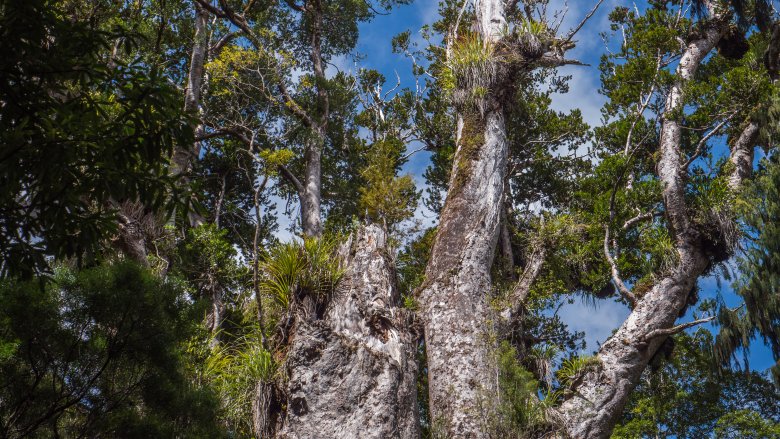
Kauri trees are evergreens known for their large trunks with few branches between the ground and the canopy. This means their wood is valuable because it produces long, straight boards with few knotholes. Historically, kauri wood was used to build houses and boats, and between 1840 and 1920, most of the old trees were felled. However, Te Matua Ngahere was lucky. It was discovered during road construction in 1928, and the people who discovered it made a rare decision. Not chop it down for money, which is what people usually do when they come across big trees. Hooray for people who don't kill everyone Cowrie. Small steps.
This tree is probably a little older than Jesus.
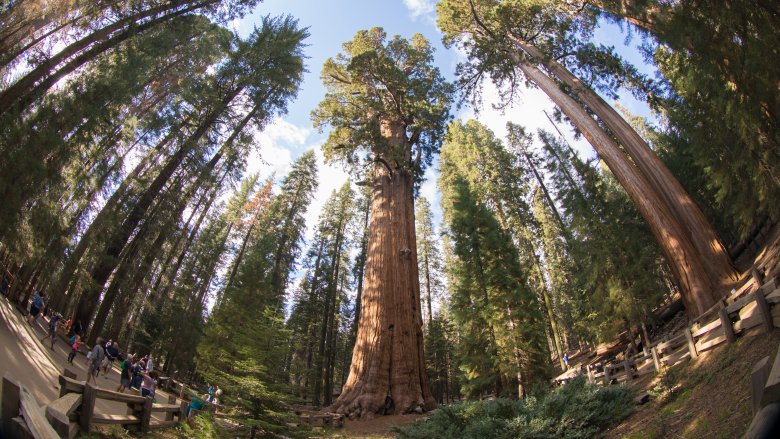
According to Live Science, General Sherman is the largest tree in the world by volume—approximately 52,500 cubic feet, roughly equivalent to the volume of paper currently stored in the New York State Archives. At 275 feet tall, it towers over Sequoia National Park in California, but don't get too impressed just yet. General Sherman is actually more than 100 feet shorter. the tallest tree in the world: Hyperion, a 600-year-old, 380-foot-tall coast redwood located in California's Redwood National Forest. For comparison, Hyperion is approximately 75 feet taller than the Statue of Liberty, from base to tip.
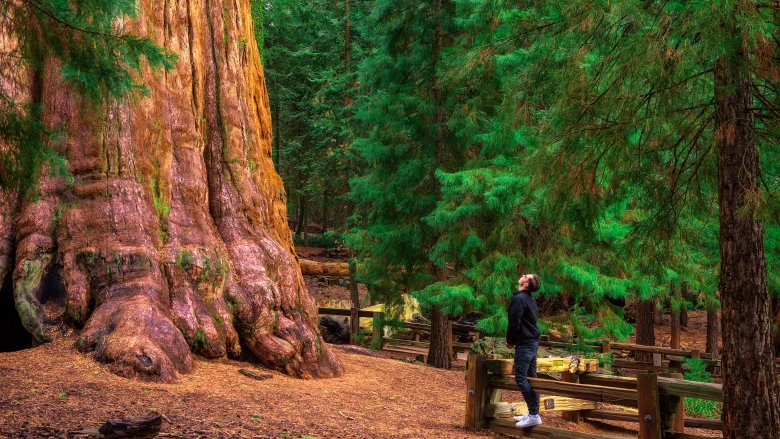
At around 2,200 years old, General Sherman is still growing, so in a thousand years or so, it could actually overtake Hyperion. Meanwhile, it doesn't need height to be impressive, because it has sheer mass. General Sherman's branches alone are so enormous that just one of them is larger than almost all the trees growing east of the Mississippi. And you wouldn't want to be standing under this thing when one of those branches decides to fall—in 2006, a falling branch crushed a brand-new fence and walkway. So, if you do decide to visit General Sherman, it might be wise to look up every now and then, just in case.
We know the exact age of this ancient tree.
For most trees, we can only guess at their age. Sometimes core samples give us fairly close dates, but usually not accurate to the year of planting. This tree is different. Called Jaya Sri Maha Bodhi, it has several claims to fame: it's the oldest tree with a known planting date, and it's also the world's closest living connection to the Buddha, a man who attained enlightenment under a fig tree. Jaya Sri Maha Bodhi is not a fig tree. tree , but it's about as close as you can get. According to Atlas Obscura , it was grown from a cutting of the sacred Bodhi tree, which was given to the Sri Lankan king Devanampiya Tissa in 236 BC.
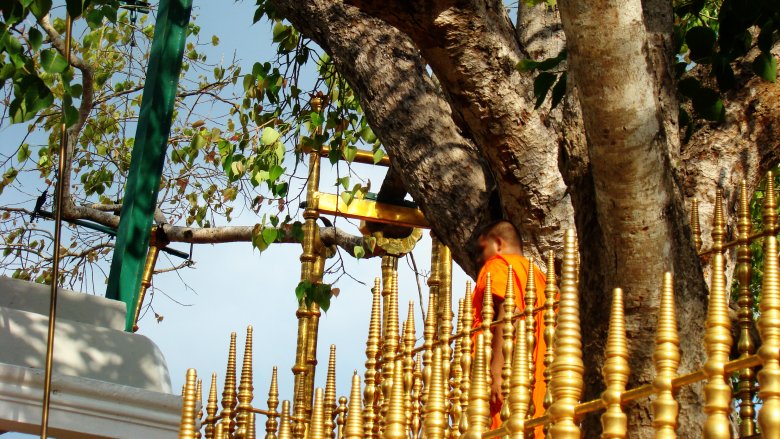
The tree was guarded by Buddhist monks for over 2,250 years. As if the fig tree growing from the branch of the original Bodhi tree weren't impressive enough, the site where it grows was adorned with statues, canals, walls, and various other glittering artifacts. It was also besieged by storms, vandals, and wild elephants. In 1985, the devotees tending the tree were attacked by terrorists, who killed 100 people but left the tree itself more or less unharmed. Buddhists still make pilgrimages to Anuradhapura to meditate beneath the Jaya Sri Maha Bodhi. It may not be the Bodhi itself, but it's definitely the next best thing.
Long live the leader!
General Sherman may already hold the record for size, but when it comes to giant sequoias, it's only a millennium old. Well, a couple of millennia old, at least. The oldest known sequoia is actually a full 1,000 years older than General Sherman. It's called President, and it sprouted 3,200 years ago, around the time of the Greek Dark Ages (which, incidentally, was about 1,700 years before Europe's Dark Ages). According to Vintage News, President is so large that no one has ever managed to photograph it in its entirety. At 247 feet tall, it's only slightly shorter than General Sherman, though its top shows signs of lightning strikes, so who knows how big it might have gotten if these passing storms had been a little more merciful?
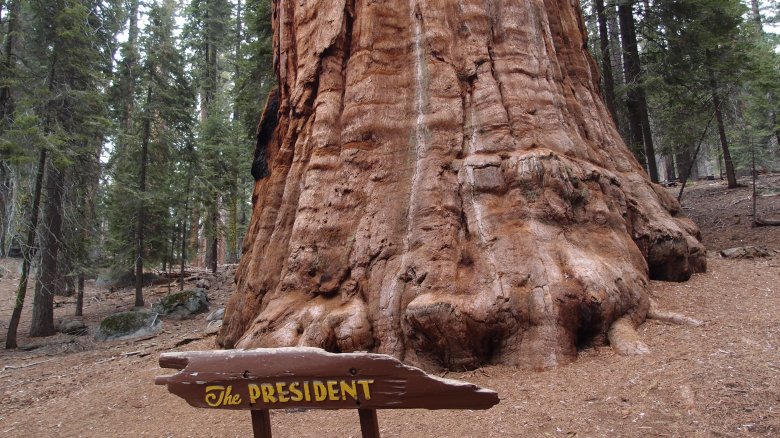
Researchers studying the tree have noted that the President will continue to break records because it's still growing at a rate of about one cubic meter per year, which is remarkable given its age. It also has about two billion leaves, and let's just say we'd hate to be tasked with counting them all (just kidding—that's an estimate). In any case, its rapid growth rate combined with all those leaves means the President is truly good at processing carbon dioxide, making it a mighty warrior in the battle against climate change. It's a shame we've cut down most of the remaining old-growth forest… oops.
This tree is dead, but it's still worth mentioning.
Until 2012, a giant tree named "The Senator" held the titles of the oldest bald cypress in Florida and the fifth-oldest tree in the United States. At 3,500 years old, the Senator was even older than the President, though not as tall.
Despite the hardships of life in central Florida, the senator continued to do what trees do—provide shade, absorb sunlight and CO2, and be large and magnificent—until one night, for unknown reasons, it burst into flames. According to NPR, officials initially blamed the fire on a lightning strike, noting that the tree appeared to have burned from the inside. The strike may have ignited a smoldering internal fire that eventually consumed the entire tree.
It was an unsatisfactory answer, and the reason it was so unsatisfactory was because it was far from the truth. The senator's killer was eventually apprehended after she confessed to a group of friends that she had started a fire inside the tree to better see her pipe. The fire got out of control, so she took a few photos on her smartphone and fled, just in case the police needed evidence to convict her. The next-oldest tree in the area, "Lady Liberty," is only 2,000 years old, so it will be some time before we see another bald cypress like the senator.
This tree is the oldest in South America.
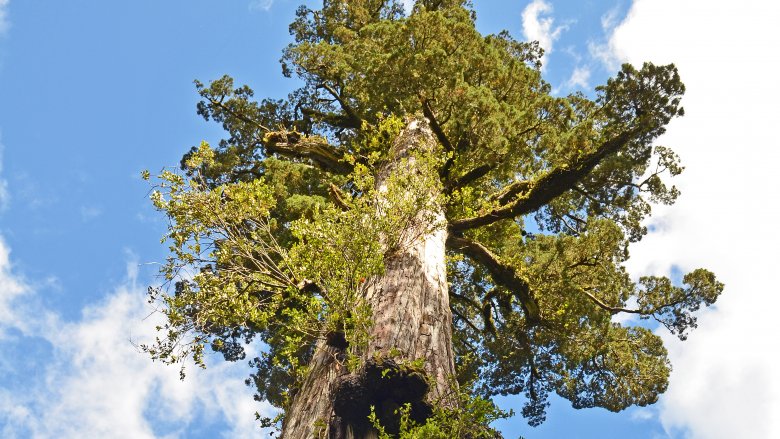
According to New Atlas, a Chilean alerce tree called Gran Abuelo (Spanish for "Great Grandfather") is the oldest tree in South America. You probably won't be surprised to learn that most of the other alerces on the continent were cut down until there were almost none left to be cut down, because that's what we humans do. The Spanish were especially keen on destroying alerce trees—they arrived in the 16th century to conquer, chop down, and sometimes burn them, because who needs beautiful 3,500-year-old trees when you can have a bunch of smelly cows instead?
In any case, the few alerces that still exist in Chile are in remote locations, accessible only by off-road vehicle, then by boat across a river. Gran Abuelo is a bit easier to find—it's located in Parque Nacional Alerce Costero, 85 miles south of Valdivia. However, to get there, you'll have to drive a poorly maintained dirt road, descend a steep trail over roots and sharp rocks, and cross a rickety rope bridge. Take note, trees of the world: the secret to longevity is to grow in places that are very difficult to reach.
This tree laughs in the face of volcanic eruptions
The world's oldest chestnut tree grows on a mountainside. It's not just any mountain—it's a volcano, and hardly a dormant one, having erupted at least 65 times in the last four hundred years alone. Furthermore, the tree is less than five miles from the crater, making it not only one of the oldest trees in the world, but also one of the steepest.
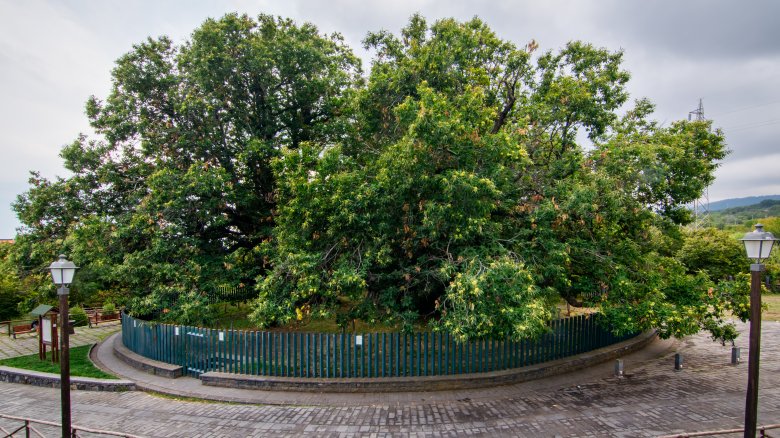
According to Italy Magazine , The tree is called the "Hundred Horse Chestnut." No one knows exactly how old it is—estimates range from 2,000 to 4,000 years, meaning it could be older than Gran Abuelo and possibly younger than Te Matua Ngahere. However, it holds at least one record. At 190 feet tall, it has the largest girth of any tree in the world.
You'd think there'd be a really cool story behind the name "Hundred Horse Chestnut," and there is. One rainy day, a princess and her retinue of 100 knights and servants sought shelter under the tree, and no one got wet. So the name wasn't inspired by a terrible battle or some weird horse party, but by the fact that the tree was once used as a giant umbrella. It's a cool name and all, but from a historical perspective, something like "Volcano Reign Chestnut" would be much cooler.
This tree is a political activist
Most trees simply stand around, occasionally dropping branches onto unsuspecting fences. Jomon Sugi has more pressing matters. This cryptomeria tree, considered by some to be the oldest tree in Japan, is hidden in the Yakushima mountains, on the northern slope of the highest peak. It hasn't actually been dated, but estimates of its age range from 2,000 to 7,200 years. This makes the tree controversial—at 2,000 years old, it wouldn't even be considered the oldest tree in Japan, but at 7,200 years old, it would be the oldest tree in the world. Conservative estimates place it somewhere in the middle, around 4,000 years old.
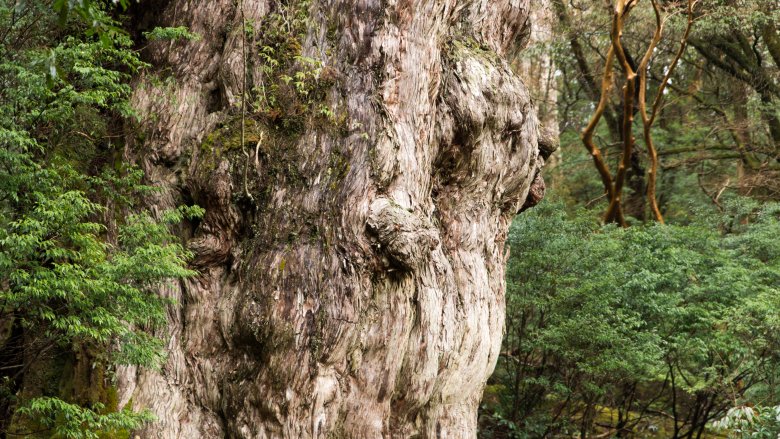
The tree was well known to locals but largely kept secret until the 1960s. According to Navitime Travel, when it was finally brought to public attention, it inspired a forest protection movement. Since then, Jomon Sugi has become a popular tourist attraction, but it's not easy to see—it takes five hours to climb to Jomon Sugi and five hours to return., If You're in shape. If you're not, your friends will have to leave you to die in the shade of that enormous, 16-foot-diameter tree. At least, that's probably the most sensible option when you're facing a long hike back to the trailhead.
This tree is as old as the pyramids
Cypress trees are quite prolific, and ancient specimens can be found all over the world. Iran has its own ancient cypress tree called Sarv-e Abarkooh, and it's so famous that there are stories about who might have planted it. Some legends say it was the son of the biblical Noah, while others say it was the prophet Zoroaster, although the dates for this seem a bit off. Sarv-e Abarkooh is believed to be 4,500 years old, and Zoroastrianism was founded approximately 3,500 years ago, so the tree actually predates the religion by a thousand years. If Sarv-e Abarkooh is as old as scientists believe, it likely sprouted around the same time the Egyptian pyramid builders laid the first stone at Giza. Khufu's mummy would have wanted it to still look this good 4,500 years later.
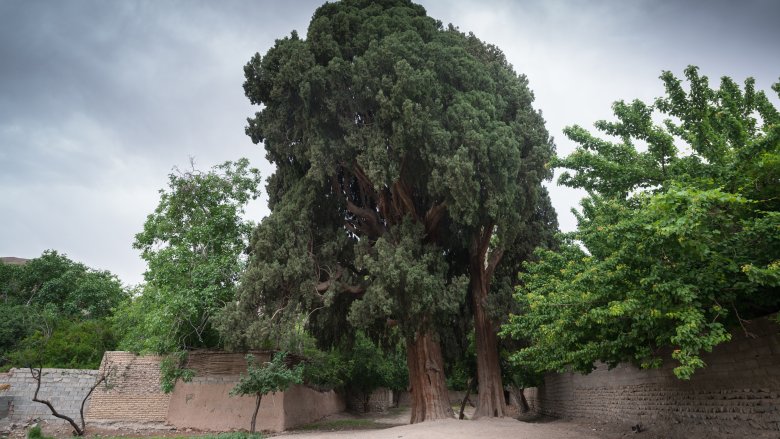
Unlike many of the trees on this list, Sarv-e Abarkuh is actually mentioned in historical texts, so it's not just famous now, it's been famous for centuries. According to Real Iran , the 14th-century geographer Hamdollah Mostofi called the tree "the cedar of world fame" in his book Nezhatol Quloob . "Worldwide fame" may be an exaggeration, but anything that witnessed the rise of the Persian Empire, the establishment of Islamic rule, the Mongol invasions, a pair of Russo-Persian wars, two world wars, and the atomic age deserves a little credit, whatever that means.
This tree isn't dead, but it knows when you will die.
It's impossible to say how old the Llangerney Yew is, as it has a strange, forked trunk and is missing a heartwood. The tree, located in Conwy, Wales, is likely somewhere between 4,000 and 5,000 years old, but that's not the only interesting thing about it. According to Atlas Obscura , The Llangerney Yew is a favourite hangout for a Welsh spirit called Angelistor, who spends every Halloween predicting the deaths of people who attend the nearby church.
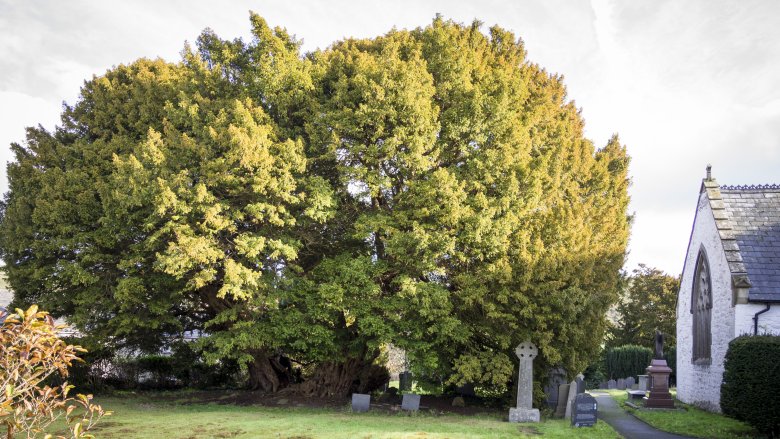
If you're a believer and want to know the year of your death, you could go to church on Halloween and have your name called. This sounds like the creepiest experience of all time, but it also raises a couple of questions. First, why would anyone go to a church ruled by a 5,000-year-old tree spirit who can tell you when the Grim Reaper will arrive? And second, why would anyone go to a specific church on Halloween? Some people are simply asking for lifelong PTSD.
Regardless, despite its creepy qualities (or perhaps because of them), British tree lovers named the Llangerniu Yew one of the fifty Great British Trees of 2002, proving that being old and creepy still has its perks.
This tree is so old that it doesn't need any other identification.
The oldest uncloned organism on Earth (other than that Siberian bacterium we're going to pretend doesn't exist) is a strange, gnarled, twisted thing living in California. No, not Kirk Douglas. It's a bristlecone pine, believed to be over 5,000 years old. This particular tree was dated in 2012, but the heartwood was lost, so the tree's age has never been confirmed. Plus, no one has given it a name, so honoring it with the world record for oldest tree is a bit awkward.
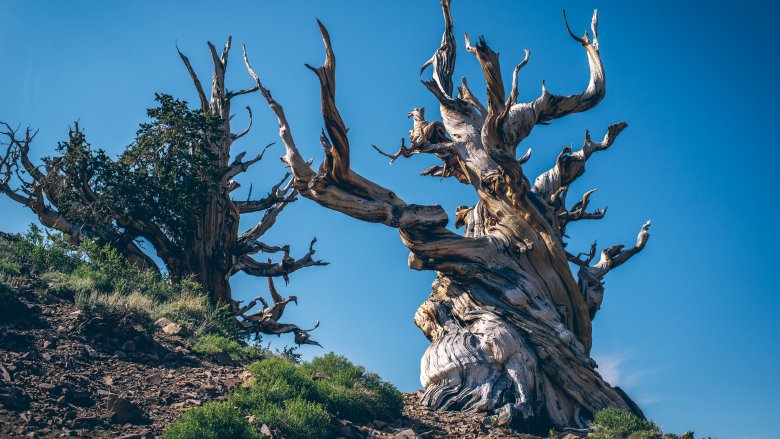
Not far from this unnamed tree is another, more famous tree named "Methuselah," after the biblical figure (who, ironically, lived only about 20 percent as long as the tree that bears his name). This tree has been reliably dated to be around 4,800 years old. According to PBS, Methuselah and its neighbors in California's Ancient Bristlecone Pine Forest grow at elevations between 9,500 and 11,500 feet above sea level, where it almost never rains.
So, how does the longest-living creature on Earth survive in one of the world's most hostile environments? The truth is, the bristlecone pine is just really smart. When you choose a home that no one else wants, there's no competition for water and nutrients. You can grow big and conserve resources if you keep growing. slowly . You can also completely hibernate when times get tough. If only humans could do that. Oh well… at least we can freeze our heads.