








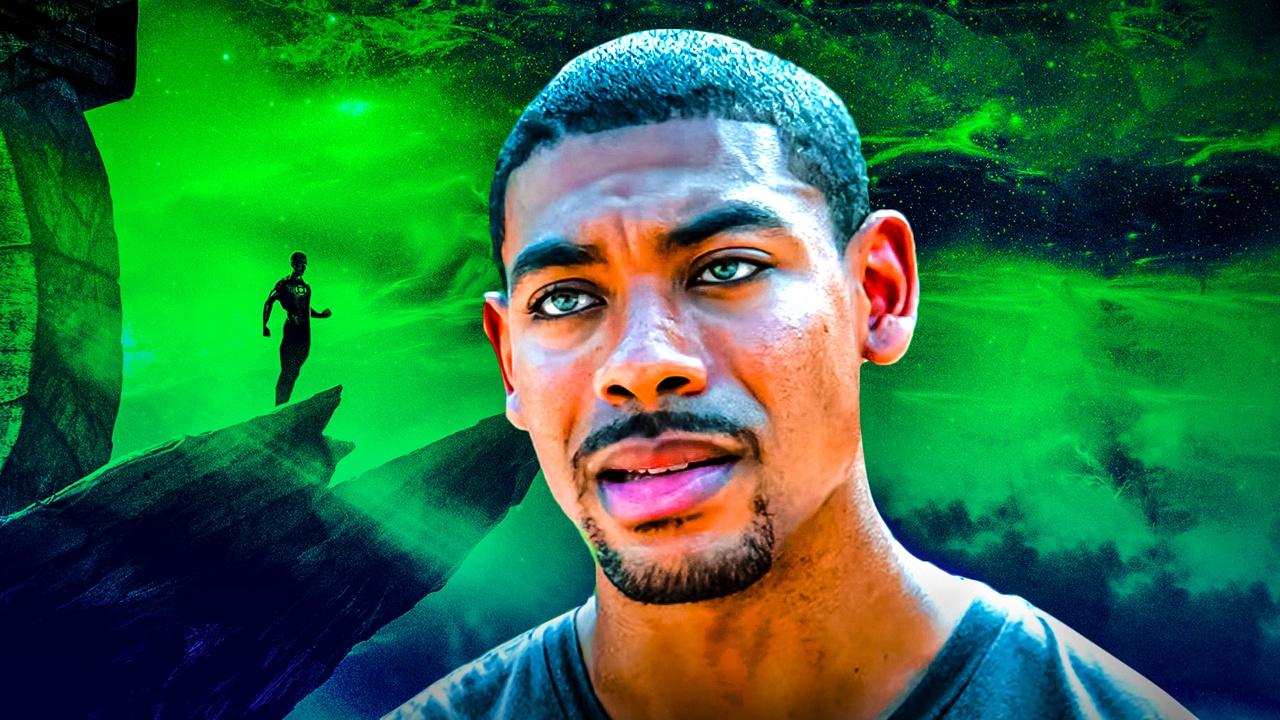
This August, the Green Lantern series will present an interesting dynamic between villain and hero. The upcoming HBO Max series will be a new entry in the DC Studios film universe, a fresh start for the superhero cinematic universe. The Green Lanterns have been excluded from the DCEU and haven't had a central role in major releases since 2011's Green Lantern, but Green Lantern will give audiences a good look at these intergalactic heroes.
While the relationship between the two main characters, Hal Jordan (Kyle Chandler) and John Stewart (Aaron Pierre), will be complex in "Lanterns," the series' true villain is something far more sinister. The villainous Sinestro, played by Ulrich Thomsen, has been confirmed to appear in "Lanterns." Sinestro's villainous arc shouldn't come as much of a surprise, given that he's a common foe of the Green Lanterns in DC Comics, but in the mainstream DC film and television space, his role in "Lanterns" will break the 12-year rule.
Lanterns showrunner Chris Mundie confirmed to Entertainment Weekly that Sinestro is closely tied to the show's plot due to his relationship with Hal Jordan. «"We're interested in the idea that Hal was trained by Sinestro," said Mundi, adding: «"What good or bad things did Hal learn from Sinestro?"»
«"Obviously, in canon, Sinestro is the main villain. We're interested in the idea that Hal was trained by Sinestro, and that Hal is training John. In the mentorship system, we're very interested in what's passed on and what's not, and how much that depends on human nature. We've talked a lot about programming, nurturing, and training... What good and bad things did Hal pick up from Sinestro? That raises a lot of interesting questions.".
Interestingly, the mentor-villain plotline hasn't been explored onscreen in 12 years of DC films and TV series. The typical DC film approach has been to feature hero-villain relationships in a more traditional good-versus-evil, protagonist-antagonist relationship, rather than one rooted in their pasts (except when the hero and villain were blood relatives).
Superman and Zod, Batman and the Joker, Aquaman and Black Manta, the Justice League and Darkseid. All of these hero-villain pairings followed a tradition whereby neither character had a pre-existing history as the other's mentor, a tradition that continues throughout the modern DCEU. Twelve years later, this will change in 2026, when Star Lanterns and the new DCEU introduce Sinestro as the main villain, who was also Hal Jordan's former mentor.
While not as common, the transition from mentor to villain is an intriguing dynamic worth exploring. It enriches the hero-villain relationship, and in an HBO series like Lanterns, it would certainly provide an interesting character study, especially given that Hal is now mentoring his own protégé, John.
While "Lanterns" breaks DC Studios' long-standing rule of the hero-villain ratio, it's not the first time it's done so, and several DC superhero projects have used a similar dynamic in the past.
DC Live-action Projects with Villain Mentors
Batman Begins (2005)
Christopher Nolan's Batman Begins was one of the first DC films to utilize the mentor-versus-hero dynamic. Christian Bale's Bruce Wayne was trained by Ra's al Ghul (Liam Neeson) in the League of Shadows. Ra's gave Bruce the training and guidance he needed to become Batman, but when his true villainous intentions were revealed, it drove a wedge between them.
Years later, Ra's resurfaced as the mastermind behind Scarecrow's plan to create a fear toxin, which he planned to use to poison Gotham City and consume itself. This brought him into direct conflict with Batman, the film's villain, who was seeking to save the city, and their pasts led to an even more compelling rivalry.
Green Lantern (2011)
«Green Lantern isn't the only film to utilize the mentor-student dynamic between Hal and Sinestro; the original 2011 Green Lantern film also employed a similar approach. In Green Lantern, Hal Jordan (Ryan Reynolds) is trained by Sinestro (Mark Strong) on the planet Oa.
In Green Lantern, Sinestro is not yet an outright villain, though he does act as an antagonist to Hal, challenging him with his disbelief and stealing the yellow ring for later use at the end of the film.
In a sequel, Sinestro would likely have been a more significant villain, but in Green Lantern, he is presented as Hal's mentor, and his path to evil is foreshadowed in the film.
Arrow (2012)
Arrow, the first in The CW's Arrowverse lineup, has featured a plethora of villains over its eight seasons, but one of the first was Oliver Queen's relationship with Slade Wilson, aka Deathstroke, in season two.
Oliver and Slade were trapped on Lian Yu Island, and Slade took Oliver under his wing, training him in various martial arts that helped him survive. This became a crucial part of his journey to becoming the Green Arrow. Slade and Oliver's relationship disintegrated on the island after Slade learned that Oliver chose to save Sara Lance over Shado, the woman he loved. In the present, he returns to seek revenge on Oliver and launches an attack on Star City, forcing his protégé to become his enemy.
The Flash (2014)
On The CW's The Flash, the Reverse-Flash storyline followed a similar pattern: a mentor turns villain. After Barry Allen briefly studied under Dr. Harrison Wells at Star Labs, it was revealed that he was actually the Reverse-Flash in disguise, and Barry's beloved mentor suddenly became his nemesis. Reverse-Flash is one of the Flash's main adversaries in the comics, but Harrison Wells' betrayal made their relationship even more dramatic in the show.
BONUS: Peacemaker (2022)
Peacemaker nearly broke DC's mentor-villain dynamic even before the events of Star Lanterns, though the dynamic between Peacemaker and his rival, the White Dragon, was rooted in a pre-existing familial connection, as Auggie was Christopher Smith's father. This backstory only enriched Peacemaker's character, as the trauma he suffered as a child at the hands of his father further exacerbated their complex relationship in the present.
Oggy trained Peacemaker in the art of killing, but it ultimately proved to be his undoing, as it was Peacemaker who took his life.