








The fear of snakes is as ancient as humanity itself, and "snake stories" were popular in myth and folklore long before the advent of the internet. Our instincts make us fear them, and it seems for good reason, as many of the world's most venomous creatures are snakes. And the smallest of them are the most deadly.
However, most of the largest snakes in the world are non-venomous and are often kept as pets. We offer you descriptions and photos of the largest snakes in the world.
10. Black mamba (Dendroaspis polylepis) – 3 meters long

In size, one of the most venomous snakes on the planet is second only to its queen, the 6th-ranked snake on our list. It's also one of the most aggressive snakes in the world, often attacking without apparent provocation. And escaping from a black mamba is extremely difficult. It can reach speeds of up to 11 km/h over short distances.
9. Olive python (Liasis olivaceus) – 4 meters

This non-venomous snake, one of the largest in Australia, is sometimes confused with the mulga, a venomous snake of the elapid family. The olive python is the most vulnerable to this similarity, as it is often killed, mistaken for its dangerous "look-alike.".
Olive pythons are harmless to humans and feed mainly on small mammals, birds, and reptiles.
8. Boa constrictor – 4.5 meters
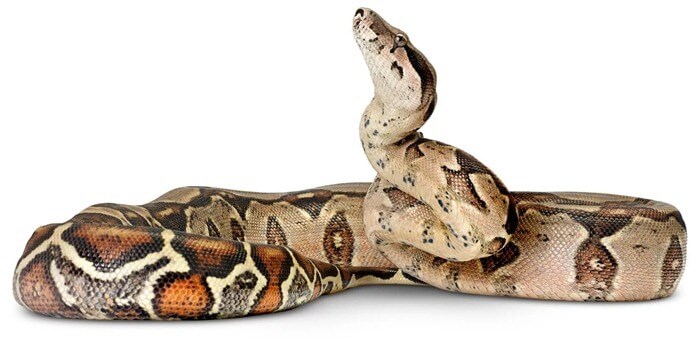
These chameleons of the snake world can fit into any habitat they inhabit. The common boa constrictor's coloration ranges from green and brown to yellow or red.
Boa constrictors are found in tropical Central and South America. They are excellent swimmers, although they prefer to live on land. They can eat anything from birds to monkeys. Common boa constrictors are non-venomous; they have small, hooked teeth that they use to grab their prey before wrapping their entire body around it and squeezing it to death.
However, they often turn from hunters to prey, as boa constrictors' exotic skins are highly sought after. Therefore, this snake species is listed as endangered.
7. Indian python, also known as the light tiger python (Python molurus molurus) - 5 meters

This snake was once the queen of the jungles of India, Sri Lanka, and the East Indies. Indian pythons are among the most ancient snake species and have tiny protrusions on their skin that indicate they may have once had legs. They are not venomous, but they have two rows of very sharp teeth that can inflict a very painful bite.
Pythons prefer to feed on mammals, and like other large snakes in the world, they kill their prey by constriction. They are capable of killing a deer and swallowing it whole.
Indian pythons live up to 20 years and are considered very useful for controlling pests such as rats and mice. In areas where humans have exterminated snakes or destroyed their habitat, these disease-carrying pests have become a serious threat to human health.
6. King cobra (Ophiophagus hannah) – 5.6 meters

This is the largest venomous snake in the world. It is considered a very dangerous reptile, as its venom can kill a human within 15 minutes. However, when possible, the king cobra avoids human contact. And when attacking, to drive off a two-legged enemy, it may deliver two or three "dummy" bites, conserving its venom for hunting.
The Latin name Ophiophagus hannah means "snake eater." And it's entirely justified, as the king cobra's diet consists primarily of other snakes, including venomous ones.
5. Burmese python (Python bivittatus) – 5.74 meters
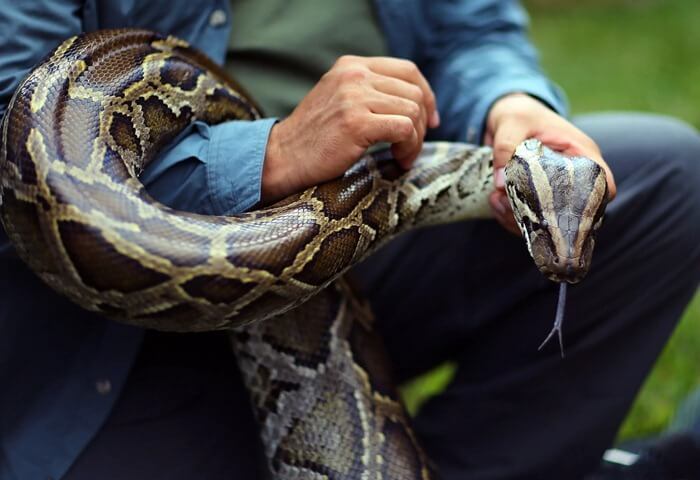
This snake has a beautiful patterned coat reminiscent of a giraffe's skin and is known for its calm disposition. Burmese pythons are often kept as pets.
In their natural habitat, these snakes can be found in South and Southeast Asia. Their diet consists of small mammals and birds, and, similar to anacondas, Burmese pythons constrict their prey until it suffocates. They then swallow their prey whole and may feed only two or three times a year.
Due to deteriorating habitat and the demand for snake skin and flesh, these giant creatures are becoming endangered in the wild. However, their numbers remain high in captivity.
4. Hieroglyphic python (Python sebae) – 6 meters

Adult hieroglyphic pythons typically reach 4.8 meters in length. However, there is unconfirmed information that in 1958, a seven-meter python was killed with a 1.5-meter Nile crocodile found in its stomach. It is difficult to say whether this information was true, as there are no photos or videos of one of the world's largest snakes.
These pythons also attack humans. In 2002, a snake swallowed a ten-year-old boy in South Africa.
3. Amethystine python (Morelia amethistina) – 6 meters
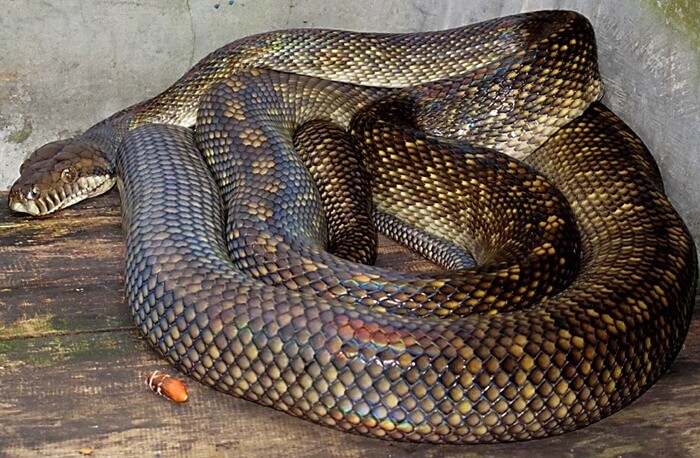
This species is found in Indonesia, Australia, and Papua New Guinea. The amethystine python is distinguished from other pythons by the large, symmetrical scutes that cover the top of its head. These snakes have a beautiful yellow-olive or olive-brown coloration with an iridescent sheen.
Amethystine pythons feed on small animals (including chickens) and often crawl into the yards of people who keep birds.
2. Giant or green anaconda (Eunectes murinus) - 9 meters
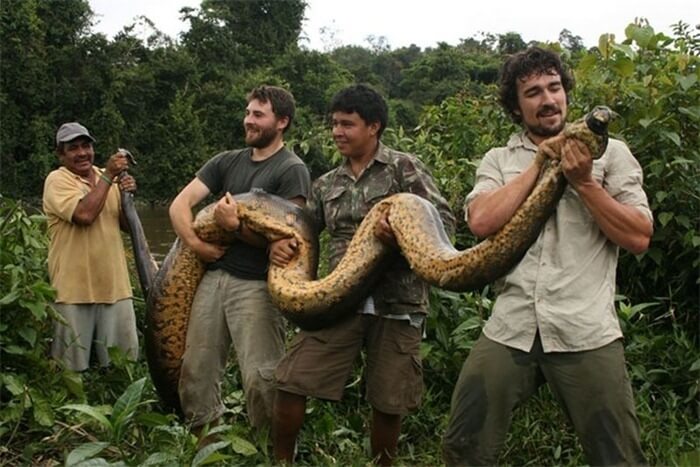
There are numerous legends and rumors about the anaconda's size. British explorer Percival Fawcett describes anacondas measuring over 18 and 24 meters. And in 2015, a photo of a gigantic anaconda, 40 meters long and weighing 2,067 kg, circulated online. It allegedly killed 257 people and 2,325 animals. It took British commandos in Africa 37 days to track down and kill it.
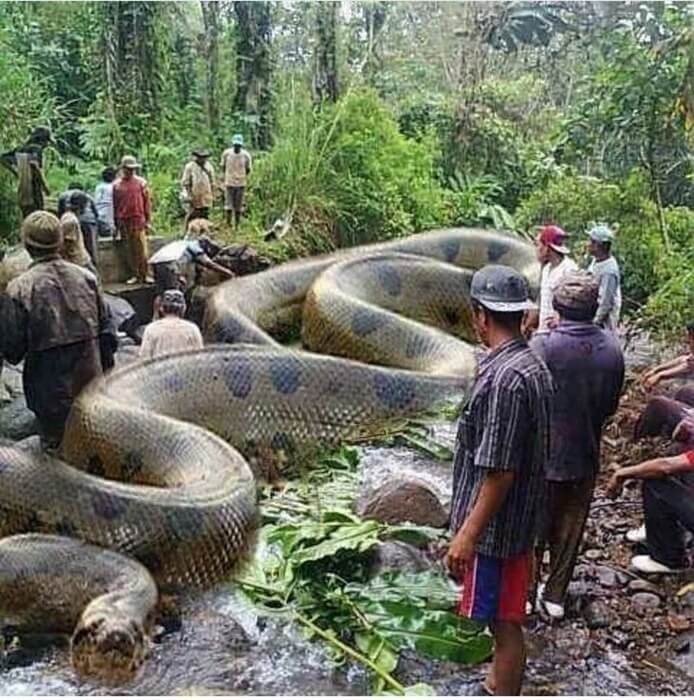
However, this photo turned out to be a fake, and the largest anaconda specimen currently known is housed in a zoological society terrarium in New York City. It stands approximately 9 meters tall and weighs 130 kg.
Green anacondas live primarily in the Amazon rainforest and can be found in swamps, rivers, and streams. They are very agile in water and never stray far from it. Their diet consists primarily of iguanas, birds, turtles, and other small to medium-sized creatures. These scaly giants kill their prey by coiling around it and squeezing it in a deadly embrace, preventing it from breathing. Their extremely elastic mouth allows them to swallow their prey whole, even if it is much larger than the anaconda itself. It can take months before the snake is ready to eat again.
1. Reticulated python (Python reticulatus) - 14.85 meters
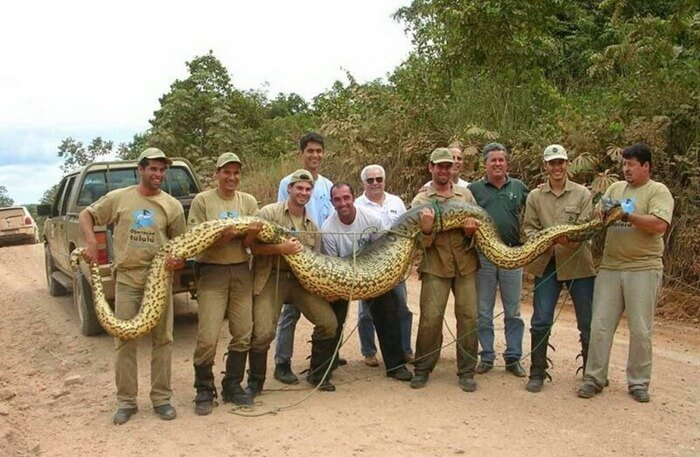
The world's largest snake was found in the jungles of Sumatra. It measured over 14 meters in length and weighed 447 kg. Scientists had never seen a snake of such size. The monster was named Guihua and entered into the Guinness Book of World Records. It can easily swallow a human and even a medium-sized cow. After such a meal, Guihua can go without food for several months.
Common reticulated pythons reach 5-7 meters in length and are known for their aggressive behavior. They can attack people and animals, both domestic and predatory. One video of the world's largest snakes shows a python killing and swallowing a small alligator.
These snakes are capable of dislocating their jaws to swallow prey close to their own weight and up to 1/4 of their body length.
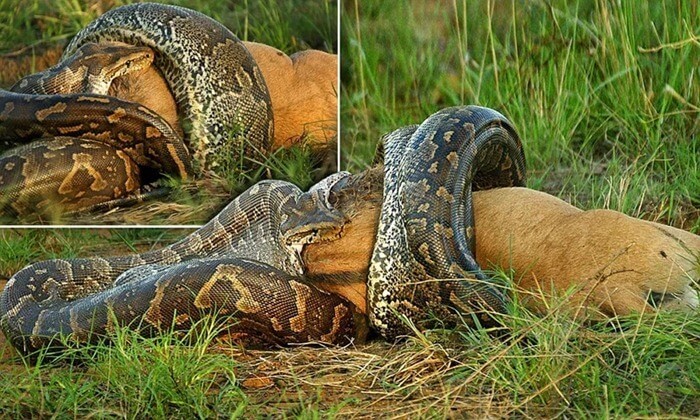
Although the reticulated python is fairly common in the wild, its population is gradually declining. Poachers actively hunt for its skin and gall bladder, which is used in Asian folk medicine.
The largest snake that ever lived on Earth

But even the world's largest reticulated python didn't reach the size of the Titanoboa. This extinct snake species, a close relative of the boa constrictor, lived approximately 61-58 million years ago. Titanoboa reached 15 meters in length and weighed about a ton.
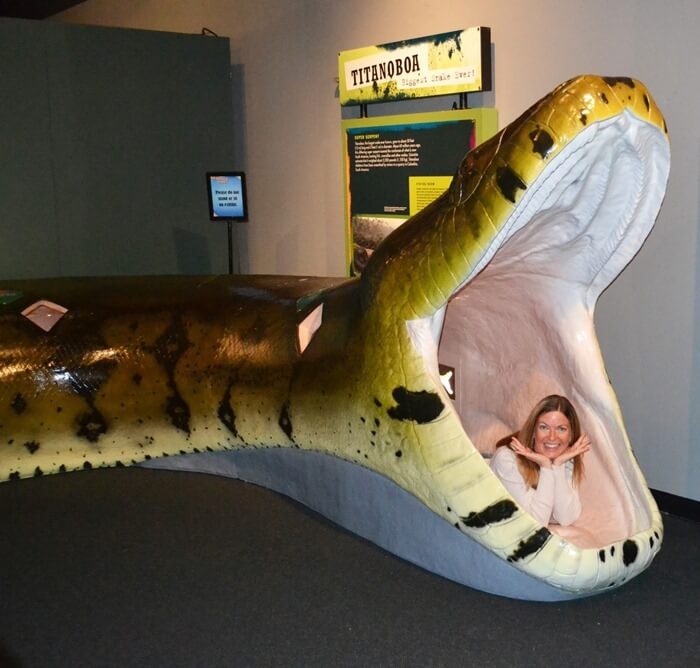
A giant snake lived in the humid, hot jungles of what is now Colombia. If it had survived to this day, Korney Chukovsky would have warned children not to go anywhere in Africa, but rather to the places where this enormous monster slithered.