








The world is getting smaller, and traveling around the globe has become easier than ever thanks to advances in aviation technology. However, many locations around the globe lack optimal conditions for airport construction. Yet, marvels of technology and engineering now allow airports to be built in places once considered impossible. However, these runways face challenges such as geography, design, and climate to ensure a suitable platform for smooth takeoffs and landings. Therefore, these 11 airports are sometimes considered the most dangerous airports in the world.
1. Gustafa III Airport on the Caribbean island of Saint Barthélemy is considered dangerous because the descent there is extremely steep, and planes taking off fly directly over the heads of sunbathers. Typically, only small aircraft are allowed to operate there.
Saint-Barthélemy Airport, also known as St. Barthélemy Airport, serves the village of Saint-Jean on the Caribbean island of Saint-Barthélemy. The runway is 2,133 feet long and is located just 15 meters above sea level. The runway is very short and ends at the beach. There are small signs warning sunbathers not to lie too close to the runway. Therefore, takeoffs are a source of excitement for many beachgoers, as planes fly directly overhead. However, landings are no less challenging, as they must quickly descend the slope of an exceptionally steep hill to reach the runway. Furthermore, the traffic circle at the top of the hill and the short runway make it difficult for the pilot to land safely. (source)
2. Barra Airport, located on the Scottish Isle of Barra, is the only airport in the world to use a sandy beach as a runway. The three runways are distinguished by wooden posts. The choice of runway depends on wind direction.

This public airport, in operation since 1936, serves flights to the Isle of Barra in the Western Isles of Scotland. The beach serves as a runway, making it the most unique airport in the world. Its altitude is only 1 meter above sea level. Only small aircraft with a capacity of up to 20 passengers, such as the Twin Otter, operate from this airport. The airport grounds feature three runways arranged in a triangle, each end of which is supported by permanent wooden poles. Only one runway is used for landing or takeoff at a time. The airport is closed at high tide and after sunset. The climate, wet sand, and short runway make it one of the most dangerous airports in the world. (source)
3. Courchevel Altiport Airport serves the ski resort of the same name in the French Alps. The go-around procedure, the lack of an instrument approach, the lack of lighting, the steep runway, and adverse weather conditions make landings and takeoffs hazardous.

The airport has a very short runway of just 1,762 feet and is surrounded by the French Alps. Landing at this airport is an art form that requires skill, as pilots must navigate deep valleys and land on a sloped runway, making landings impossible at times. The runway has no instrument approach or landing lights, making landings virtually impossible in poor weather, such as fog and low clouds. All this makes it one of the most dangerous airports in the world. Only highly qualified and certified pilots are permitted to fly at this airport, and only small aircraft carrying around 50 passengers are permitted. (source)
4. Tenzing Hillary Airport in Lukla, Nepal, serving Everest Base Camp, is surrounded by high ground on the northern side of the runway and a steep cliff on the southern side. Furthermore, strong winds and cloudy skies reduce visibility and make precise landings and takeoffs difficult.

Lukla Airport in Nepal is popular as many come here to begin their climb to the summit of Everest. It has a single, 1,729-foot runway and is located at an altitude of 2,845 meters. Access is permitted only to helicopters, small planes, and short takeoff and landing (STOL) aircraft. The high terrain and steep cliffs, as well as unpredictable weather such as sudden rain, clouds, and wind, lead to delays or complete closure of the airport. Only pilots with over 100 flight hours and at least one year of experience flying in Nepal, including 10 STOL flights to Lukla, are permitted to fly. Landing at this airport is considered extremely difficult by the Civil Aviation Authority of Nepal. Consequently, it has been ranked among the most dangerous airports in the world for many years. (source)
5. Located on the Portuguese island of Madeira, Madeira Airport has a short runway of just 1,600 meters. The runway was extended over the ocean on pylons, making it a true pilot's nightmare.

Madeira International Airport was notorious for its short runway, measuring just 5,249 feet. In 1986, it was extended by 656 feet, but this was still not enough for comfortable landings. The high mountains and ocean caused anxiety even for the most experienced pilots during landings. Further expansion was hampered by the terrain and orography, but Brazilian civil engineers achieved something unprecedented. The runway was further extended by 9,124 feet by constructing a platform supported by 180 columns, 230 feet high, extending into the ocean. This structure has received worldwide acclaim and numerous awards. However, it remains one of the most dangerous runways, as aircraft are now forced to land on a narrow strip supported by columns. (source)
6. Toncontin International Airport in Honduras has earned a bad reputation as a dangerous airport due to its mountainous terrain, steep approach, short runway, and numerous notorious air crashes.
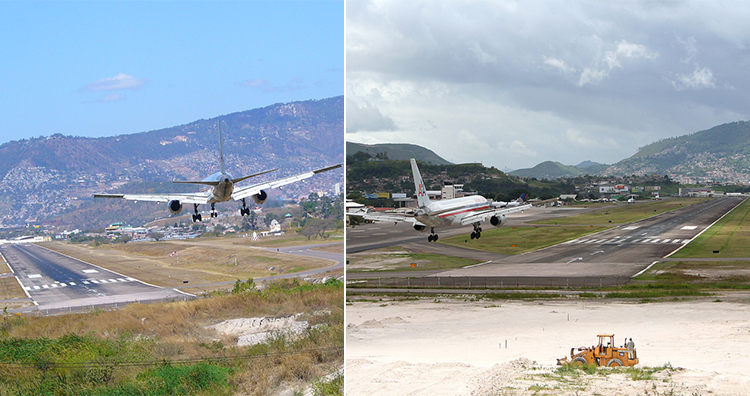
This airport is best known for being the most challenging airport to land in the world, especially in adverse weather conditions. The approach is terrifying even for the most experienced and certified pilots, as the airport is surrounded by mountains and residential areas, requiring pilots to make a remarkable 45-degree turn to avoid the mountainous terrain just minutes before landing in a deep valley. This wouldn't be so difficult if they had a long runway, but it's only 6,631 feet long, making the task even more challenging. The deadliest air crash occurred in 1989, when 132 people died when a plane crashed into the mountains. (source)
7. The runway of Gibraltar International Airport runs right through the city and crosses one of the busiest streets, which has to be closed during landings and takeoffs.
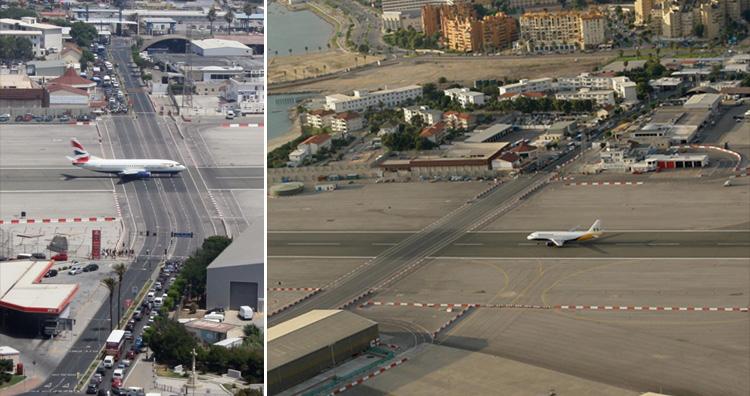
Gibraltar Airport was originally an emergency airfield for the British Navy, but today it operates as a fully functional airport for cargo and tourists. It is considered the most dangerous airport in Europe and ranks highly in global rankings. This reputation stems from its location just a few meters from the center of Gibraltar, with the runway running directly through the city. The runway intersects Winston Churchill Avenue, a major road, forcing it to be closed whenever an aircraft arrives or departs. The runway is only 5,511 feet long. Furthermore, strong winds around the Rock of Gibraltar and Algeciras Bay make landings difficult on windy days. (source)
8. An ice runway in Antarctica is built annually when the ocean freezes. The cold weather and the use of ice as a runway make this journey dangerous. It is only usable during the coldest months, and each plane is tracked by a laser beam to measure its penetration into the ice.

As its name suggests, the Ice Runway is built annually when the ocean is ice-covered and usable as a runway. It serves McMurdo Station in Antarctica as part of the U.S. Antarctica Program. The 10,000-foot runway offers ample space for landing and takeoff, but is only designed for aircraft with wheeled landing gear. This runway is built annually during the cold winter months and remains in use until December. Sophisticated technology, such as a laser beam aimed at the aircraft, is used to determine whether an aircraft has sunk below the 10-inch red line into the snow. If so, the aircraft is moved to a new location. The instability and slipperiness of ice, snow, and wind make landings and takeoffs on this runway so dangerous. (source)
9. Juancho E. Irausquin Airport on Saba Island is only 400 meters long, making it the shortest commercial runway in the world. A high hill on one side and cliffs dropping into the sea on the other make this runway very dangerous.

This airport is best known for having the world's shortest commercial runway. It is named after Aruban minister Juancho Irausquin and serves the city of Saba on the Dutch Caribbean island of the same name. The runway is only 1,312 feet long and can only accommodate propeller-driven aircraft, helicopters, or short takeoff and landing (STOL) aircraft. Besides its length, it is surrounded by high hills, cliffs at both ends, the sea, and unstable winds, making smooth landings and takeoffs difficult. (source)
10. Princess Juliana International Airport on the island of Saint Martin is a favorite spot for plane spotters. Pilots must maneuver to avoid mountains during takeoff, and low-flying landings are carried out directly over a crowded beach.

This airport, serving the Dutch side of the Caribbean island of St. Maarten, is best known for its low landings, which force planes to fly directly over people on the beach. Approach to Runway 10 is over water, and the runway is 7,024 feet long. Warning signs are posted on the beach warning of jet turbulence from arriving and departing aircraft. Takeoff is also challenging, as pilots must make sharp turns to avoid collisions with the mountains. While safe landings and takeoffs are challenging for pilots, the airport's proximity to Maho Beach makes it a fascinating sight for plane spotters. (source)
11. Paro Airport in Bhutan is surrounded by mountains up to 18,000 feet high and is located near mountainous areas, making landings challenging for pilots. Only a limited number of pilots are permitted to land at this airport. Flights are prohibited after sunset.

The airport is located in a deep valley near the town of Paro, nestled among the high Himalayan mountains. In addition to the terrain and weather conditions, the short runway (just 6,445 feet) makes takeoffs and landings difficult. Due to the dangers of flying here, only a small number of pilots are certified. Strong winds in the valley also cause turbulence, and visibility is reduced on cloudy and cold days. Furthermore, flights are permitted only during daylight hours and in good visual meteorological conditions, requiring pilots to make visual decisions rather than rely on instruments during takeoffs and landings. (source)