








Centuries from now, people will write about how, before the invention of "flying cars," people used cars that drove on concrete roads. And if World War III or even World War IV breaks out, people might stop writing altogether. Some of the most basic things we use today, like alarm clocks or erasers, didn't exist before modern inventions made them accessible. They were invented out of necessity, but people who came before us had other things that could replace them.
You might be interested to know what people used decades ago, before many modern inventions appeared.
1. Before the invention of alarm clocks, there was a profession called "wake-up callers," people who would go from client to client and knock on their windows or doors with sticks until they woke up.

The profession of "barker," or "caller," was highly valued until the 1950s, when alarm clocks became widely available and considered reliable. The first alarm clock was invented in 1757, but it wasn't widely used at the time. Roosters, obviously, weren't reliable.
«A "jailer" was a person whose job it was to wake people up on time (even if they didn't like it). He used a club or a heavy stick to knock on the windows and doors of his clients until they woke up. He wouldn't leave until he was sure the client was awake. If the windows were on the upper floors, long bamboo poles were used. One of the jailers got creative and used a pea shooter!
They also used a tool called a "snuffer" to extinguish gas lamps lit at sunset. People of both sexes and ages practiced this unique, but now extinct, profession. Sometimes police officers took on this work for extra income, earning a few pence a week. A large number of people worked in this profession, especially in industrial areas, where being late for work meant a pay cut. Who woke the snufferer? They probably didn't sleep at all. (1, 2)
2. Before the invention of razors, shark teeth and flint were sharpened and used for shaving. Some tribes continue to use such "razors" to this day.

In prehistoric times, mollusk shells, flint, and shark teeth were sharpened and used as razors. Some indigenous tribes continue to use them for shaving today. Depictions of such razors have been found in prehistoric caves. During the Bronze Age, people crafted razors from bronze and obsidian that were oval in shape and looked nothing like the modern razors used today.
The first modern straight razor was invented in Sheffield, England, after Benjamin Huntsman developed a hard steel suitable for use as a blade in 1740. This steel, still used today, is called "Sheffield steel." In the 19th century, beard shaving was not a common practice, and those who did were wealthy and hired servants to do it. After World War I, as modernization began to take its first steps, American men adopted clean shaving, starting a trend that spread worldwide. When King C. Gillette began producing modern safety razors, straight razors fell out of fashion. (source)
3. Before the invention of erasers, writers and artists used crustless bread to erase marks on paper.
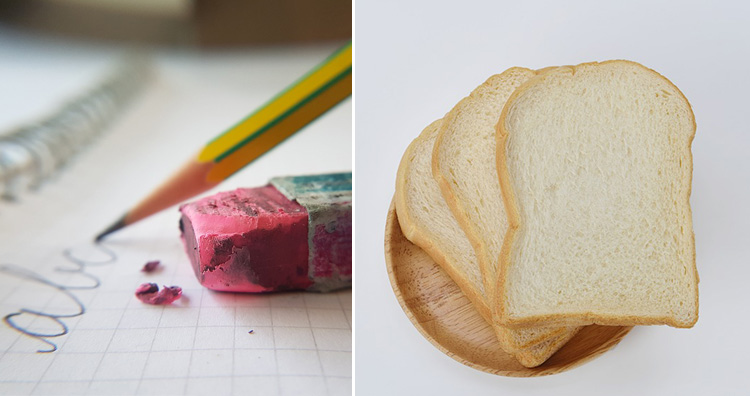
Before the English engineer Edward Nairne invented the rubber eraser in 1770, soft bread was used instead. The Japanese continued to use bread erasers long after the invention of the new eraser, during the Meiji era, which lasted from 1868 to 1912. Wax tablets were also used to erase charcoal and lead marks from paper, and sandstone and pumice were used to erase ink marks from parchment or papyrus.
When Nairn impulsively took rubber instead of bread, he discovered its properties. He sold it at an inflated price—three shillings for a half-inch cube—and called it "rubber" for its abrasive properties, not "eraser." But this was raw rubber. It wasn't until Charles Goodyear invented the vulcanization process in 1839 that modern erasers became popular in Western societies. (source)
4. Before the invention of modern pregnancy tests, a woman's urine was injected into a rat or mouse, and if the rodent went into heat, the woman was considered pregnant.
Today, pregnancy tests are readily available over-the-counter in pharmacies and provide instant results. But women didn't always urinate on sticks; they urinated on all sorts of objects. In ancient Egypt, women urinated on wheat and barley seeds, believing they would become pregnant if the seeds sprouted. If the wheat grew, they would have a girl, and if the barley grew, a boy. In the 10th century, sulfur was poured on women's urine, and if worms emerged, they were considered pregnant. In the 16th century, people used urine, like tea leaves, to predict whether a woman was pregnant. They were called "urine prophets.".
However, modern pregnancy tests can be considered the heirs to the work of scientists Selmar Askheim and Bernhard Zondek in 1927. Women's urine was injected into immature rodents. If the rodents "entered heat," that is, exhibited an estrous response (signs of physiological changes caused by reproductive hormones in adult female mammals), the woman was diagnosed as pregnant. To obtain results, the rodents had to be dissected. Later, the rodents were replaced with rabbits. Hormonal research and numerous other scientific experiments led to the invention of the modern pregnancy test approximately 50 years later. (1, 2)
5. Long before the invention of modern electroconvulsive therapy, the ancient Romans used electric fish to treat headaches and mental disorders—and it worked!

Electric shocks from black torpedo fish or electric rays were forms of electroconvulsive therapy that existed before modern times. Imagine being stung by a fish that delivers electric shocks to heal you! The ancient Roman physician Scribonius Largus, who treated the Emperor Claudius, recommended this therapy for headaches. In the first century, he wrote: "To immediately relieve and permanently cure a headache, no matter how long-lasting and intolerable, a live black torpedo is placed on the affected area until the pain ceases and the affected area becomes numb.".
Current research is exploring this practice to understand the effects of electrotherapy using electronic and electromagnetic devices in migraine treatment compared to medication. (source)
6. In Finland and Russia, even before refrigeration was invented, people would throw frogs into milk to keep it from spoiling. This trick worked well.

Frogs would undoubtedly be grateful to Oliver Evans, who designed the first refrigeration machine in 1805, and to the many others who contributed to the development of refrigeration as we know it today. Residents of Russia and Finland would drop live brown Russian frogs into milk to preserve it. Until recently, it was believed that frogs prevented milk from spoiling, until science proved otherwise.
A 2012 study led by organic chemist A.T. Lebedev of Moscow State University found that frogs contain a mixture of 76 peptides, a sequence of amino acids that are antimicrobial compounds that act as effectively as antibiotics against bacteria. salmonella и staphylococcus . In 2010, scientists from the United Arab Emirates reached a similar conclusion regarding frog skin secretions. They discovered that the secretions of the North American mink frog could be useful in treating drug-resistant bacterial infections in Iraqi soldiers. (1, 2)
7. In ancient Rome, people used human and animal urine to whiten clothes and teeth, even before the invention of modern bleach. This method was so popular that one Roman emperor had to impose a tax on it.
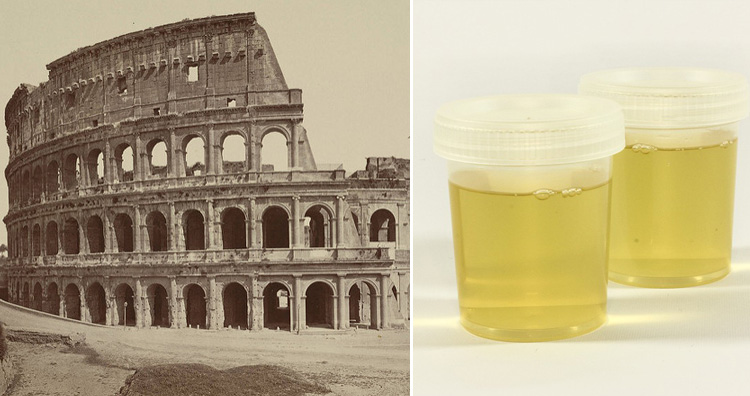
The ancient Romans valued the ammonia (an ingredient used today in household cleaning products) in urine so much that their emperor, Vespasian, imposed a tax on the collection of urine from public toilets. People discovered that urine effectively removed dirt and grease from laundry and also whitened it, even before the invention of modern bleach. They also believed that urine whitened teeth. These properties of urine made it a highly prized commodity.
In Rome, people's urinals were taken to a laundry called a "fullonica." There, urine was diluted with water and poured onto clothes. Workers stood in tubs filled with urine and dirty laundry, stomping on them. Even early Europeans were known to use urine to remove stubborn stains from clothing and as a pre-wash soak. Urine collected in chamber pots was used as "chamber lye," and in some parts of the United Kingdom, it was called "lant" and "viting.". (1, 2, 3)
8. Giant concrete "sound mirrors" were used before the invention of radar to detect enemy aircraft. The Japanese used "battle tubes.".

In 1935, Sir Robert Watson-Watt invented the first radar, which used pulsed radio waves to detect enemy aircraft up to 100 miles away. Before radar, giant concrete "sound mirrors" were used. Dr. William Sansom Tucker created acoustic mirrors that were used as warning systems, detecting enemy aircraft by the sound emitted by their engines. The range of these "sound mirrors" was only about 15 miles, but this gave the British ample time to prepare for an attack.
During World War I, the Japanese had their own method for detecting enemy aircraft. They developed listening devices known as "war tubes," which allowed a person to listen through stethoscope-like headphones. These large, tube-shaped devices also worked on the principle of detecting the sound of approaching aircraft from several miles away. Their use was discontinued during World War II. (1, 2)
9. Before the invention of heart-lung machines, surgeons performing open-heart surgery would connect a patient's heart to a donor, usually a parent, who would oxygenate the patient's blood and pump it back into the body.

Before the invention of heart-lung oxygenators, surgeons used other methods for cardiac surgery. The first open-heart surgery was performed on September 2, 1952, under the direction of surgeon F. John Lewis and others, including C. Walton Lillehei. This procedure utilized hypothermia, where the patient was cooled in a cold water bath, but this gave surgeons only 10-15 minutes to perform the procedure, which was insufficient for complex cases.
To solve this problem, Lillehei invented the cross-circulation technique, in which a donor, usually a parent, was connected to the patient to provide oxygenation using the donor's lungs and heart, with the blood being pumped back into the patient's body. On March 26, 1954, he successfully performed surgery to correct a ventricular septal defect, but the patient, a 13-month-old child, died 11 days later from pneumonia. Forty-four more similar surgeries were performed using this technique, of which 32 patients survived. It was Lillehei who later introduced the bubble oxygenator, making open-heart surgery accessible to surgeons worldwide. (1, 2)
10. In the 19th and 20th centuries, athletes consumed alcohol during marathons because sports drinks had not yet been invented.

Today, it's known that alcohol causes dehydration, so athletes shouldn't consume it during a marathon. However, in the 19th and early 20th centuries, sports drinks hadn't yet been invented. Back then, there were no kiosks offering energy drinks and water to athletes at marathons. People on bicycles or cars with alcohol were waiting for each runner along the route.
They fortified themselves with shots of whiskey, brandy, or other alcoholic beverages. In 1924, a marathon was held in Paris where runners were offered wine. Spyridon Louis, the winner of the 1896 Olympic marathon, fortified himself with cognac about six miles from the finish. If runners drank anything other than spirits, they were considered insufficiently "manly" and looked down upon. Marathon organizers also discouraged water consumption during races.
In the 1960s, people began to understand the importance of adequate hydration, and it took another decade for it to become common practice during marathons. When a group of scientists from the University of Florida School of Medicine invented Gatorade in 1965, the situation changed. (source)