








Earth's magical ecosystems may be fading, but they're still full of amazing surprises—like these ten animal behaviors, each so opposite to what you'd expect they're practically oxymoronic.
10. Flying squid
Often mistaken for flying fish, there are at least six known species of flying squid, and possibly dozens more. But since seeing them in action is a spectacle that can be witnessed in the blink of an eye, scientists have little to do. Most reports come from sailors who find them on deck in the morning.
Marine biologist Silvia Macia, however, was lucky. While on vacation in 2001, she saw a torpedo-shaped Caribbean reef squid, alarmed by the noise of her boat, launch itself out of the water and arc through the air. Macia estimated it reached a height of two meters and covered a distance of ten meters (50 times its own length). But it wasn't just a leap. The squid "extended its fins and spread its arms radially in midair," guiding its flight like an inside-out bird. As she and her husband later wrote in a paper with other biologists, "'gliding' is too passive a term for it; 'flight' is more appropriate because it implies something active." One of Macia's co-authors even claimed to have seen squid flapping their fins like wings. They also fire jets of water for extra thrust, sometimes with enough force to keep up with boats. Sometimes they can even be seen flying in flocks.
We don't know exactly why squid started flying, but it probably helps them save energy when escaping from predators.
9. Walking bats
Although bats are mammals, they are so well adapted to flight that their "legs" don't allow them to walk. In most species, they are little more than "attachment points for the wing surface." Even crawling on the ground is an effort.
Of the 1,110 bat species, only two have a true gait: the vampire bat and the smaller short-tailed burrower bat. For the vampire bat, walking is vital. After landing near sleeping prey, it must sneak up unnoticed to feed on its blood. One type of vampire bat can even run, using its wings for extra propulsion.
Less well known are the New Zealand burrowing bats, whose walking adaptations include grooves on the soles of their feet, clawed toes, and even pockets for storing wings. In fact, this species is so well adapted for walking that it spends 40 percent of its time foraging on the ground. Yet, it can still fly as well as any other bat—unlike birds adapted for walking.
8. Bat-catching snakes
Since (most) bats can't walk and snakes can't fly, you might think they're not very closely related. But some snakes have actually taken to the air—at least, so to speak.
In a cave in the Yucatan rainforest, a population of yellow-and-red rat snakes has taken up residence in the ceiling crevices, clinging to bats. Considering the dense flock of bats that emerge each night from the "Bat Cave," as locals call it, this behavior makes sense.
And, interestingly, they're not the only species to occupy this terrifying niche. 1,000 kilometers away, across the Caribbean, boa constrictors snatch bats from the air and also strike from cave ceilings. But even more astonishingly, they do this in flocks, coordinating their positions to increase their chances of getting a bite.
7. Fish-eating spiders

While some spiders are known to eat frogs, rodents, and birds, what kind of spider eats fish?
According to a review of the existing literature, this is not as unusual as it seems. Species from five genera and from every continent except Antarctica are listed. In North America, semi-aquatic spiders catch small freshwater mosquitofish by attaching their hind legs to a rock or plant and "fishing" with their front legs on the surface of the water.
After landing the catch, feeding often takes several hours. Why does it take so long? Because, on average, spiders spend at least twice as long catching fish as they do.
6. Hornet-cooking bees

Stinging isn't the only suicide attack used by nature's bodhisattvas, bees. When a hornet attacks a nest, hundreds of worker bees swarm around the intruder, frying it alive with their body heat. Surprisingly, this behavior, known as "hot-ball defense," wasn't documented until 1995, when it was studied in detail in Japan.
By rapidly vibrating their wing muscles for half an hour, bees can reach temperatures of 46 degrees Celsius, enough to kill a hornet in captivity. But although this temperature is just below the frying point for bees, it appears to reduce their lifespan. Furthermore, it appears to disinhibit them neurologically, making them more likely to join the orbs in the future than bees that have never participated.
Some bee species can also use unheated balls to smother invaders or dance in waves, projecting flickering signals to warn potential attackers. However, whatever they do, they must act quickly. Over time, the hornets release pheromones to attract reinforcements.
5. Sea spiders
You might think spiders are wary of water. But many species live near it and even in it. The so-called diving spider, for example, lives underwater in a silken base filled, bubble by bubble, with air from the surface. Once established, oxygen levels remain stable thanks to diffusion from nearby aquatic plants.
What's even more surprising is that coastal spiders (Amaurobioides ) can travel by sea, which explains how they reached southern Africa from South America during the Miocene. They also reached Australia and New Zealand. Using their legs as sails and silk as an anchor, coastal spiders can travel the world.
First described in 2015, this behavior explains Darwin's puzzle of spiders blowing onto ships even miles from shore.
4. Komodo with the Immaculate Conception
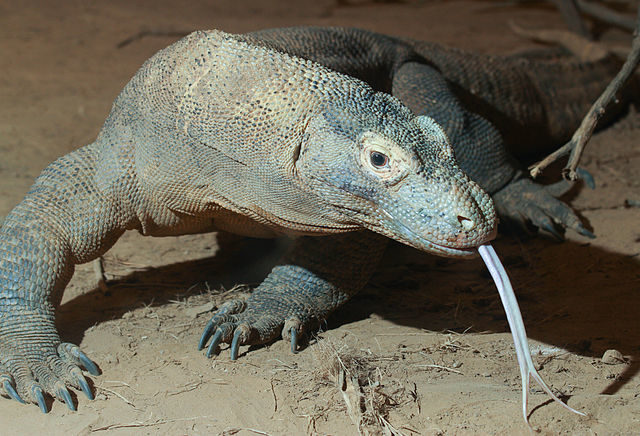
In 2006, in a biological journalNature A strange case report was published of two female Komodo dragons—both kept in zoos in England—reproducing without mating with a male. One laid 11 eggs, eight of which developed normally, while the other laid 22, four of which hatched. Because the second dragon had actually mated two and a half years earlier, researchers initially assumed she was simply storing sperm, as some reptiles can do. However, genetic analysis revealed that her offspring were identical to her, only male. Meanwhile, the other dragon never mated.
Asexual reproduction, known as parthenogenesis, is extremely rare. In the absence of sperm to provide the other half of her offspring's chromosomes, the mother simply duplicates her own. Only 0.1 percent of vertebrates are capable of this feat. Komodo dragons are thought to be unique among them due to their isolated habitat, the islands of Indonesia, as parthenogenesis allows (at least in principle) females stranded on an island to independently establish a new colony.
Unfortunately, however, the offspring produced in this way, being genetically less diverse, are more susceptible to disease. They are also exclusively male, since, unlike humans, two identical chromosomes in Komodo dragons (namely, ZZ) produce a male. So, parthenogenesis is not actually an advantage for this endangered monitor species.
3. Bird-catching fish
With the exception of sharks, relationships between birds and fish are almost always top-down. Fish don't catch birds from the air.
Or were they? In 2014, a team of researchers from South Africa saw a tigerfish leap out of a lake and catch a swallow mid-flight. It happened so quickly that at first they weren't sure what they'd seen. As it turned out, it was the first confirmed sighting of a freshwater fish hunting a bird in mid-air. And it wouldn't be their last. Before leaving, the team had seen up to 20 such strikes every day. The anecdotal reports were true: bird-hunting fish are common in the region, they're just less well-studied.
It also happens elsewhere. Another species of bird-catcher is the silver arowana, a flying fish that hunts not only birds but also bats and even mice in what remains of the Amazon rainforest.
2. Land fish
Birds aren't even immune to fish on land. On the Tarn River in Albi, France, there's a small island where pigeons fly to preen themselves, and catfish come to hunt them.
The European catfish is actually quite dangerous. They typically range from 1 to 1.5 meters in length, but individual specimens have been known to reach 3 meters, making them the largest freshwater fish on the continent. And despite their relatively "primitive" evolutionary level, their remarkable adaptability keeps them at the top of the food chain.
To track pigeons on land, catfish swim nearby, detecting vibrations with their barbels (or "whiskers") on their upper jaw. They then splash out of the water onto the island, snatching any moving pigeon before retreating into the depths. The whole process takes less than four seconds.
1. Tree-climbing fish
Further mocking the old adage "a fish out of water," some species actually prefer it. By trapping water bubbles in their gill chambers, Asian mudskippers can breathe on land for up to two days, obtaining oxygen not only through their gills but also through their skin—as long as it's moist. Specially adapted fins allow them to walk (or jump) on land, and even their vision is better on land.
But humanity has long known this. A recent discovery by scientists catching up with local knowledge is that some of them can also climb trees. Darkgills and slender mudskippers are two species of tree-climbers. According to researchers, they use a combination of suction, friction, slug-like secretions, and their fins to climb vertically up tree trunks.
Even more astonishing, however, was their movement through water. Recordings of the darkgill mudskipper in Java showed it jumping from vertical slopes, such as mangrove roots, onto water, and then from water onto another vertical slope on land. Using its body for propulsion, it reached speeds of 1.7 meters per second.