








Over millions of years of evolution, animals have developed a multitude of impressive abilities that help them survive. These abilities prove useful when searching for food or protecting themselves from becoming prey to other animals. Some of these abilities help them attract potential mates for reproduction. Whatever the purpose, these abilities evoke awe and are a source of inspiration for many inventors. It's no wonder that comic book artists find inspiration in these animals with extraordinary abilities for their superheroes and supervillains.
1. Male dung beetles can pull 1,141 times their own body weight. This is equivalent to a human pulling six double-decker buses full of people.
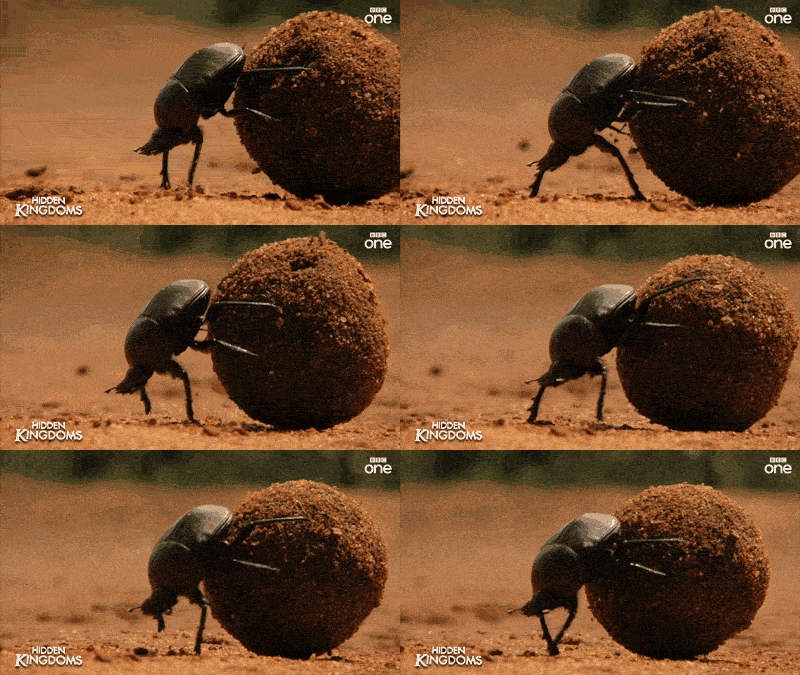
Dung beetles are found on every continent except Australia and feed on dung, mushrooms, rotting fruit, and leaves. Most locate dung by smell. They then roll it into a ball and run away quickly in a straight line, overcoming any obstacles, to distance themselves from other beetles and avoid being stolen.
Beetles bury balls of dung either to store it as food or to turn it into a nesting ball for the pair to build a home in. Dung beetles can typically roll dung weighing up to 10 times their own weight, but males Onthophagus taurus They are capable of rolling dung weighing up to 1,141 times their own weight.
The incredible amount of dung they roll into coils isn't the only amazing thing about these beetles. They are the only known insects capable of navigating by the Milky Way or very bright stars. An African species Scarabaeus zambesianus navigates by the polarization patterns of moonlight. (source)
2. There is a species of jellyfish called "immortal jellyfish," which, as the name suggests, do not die of old age. If fatally wounded or at a very advanced age, they simply revert to their adult stage and begin the life cycle anew.
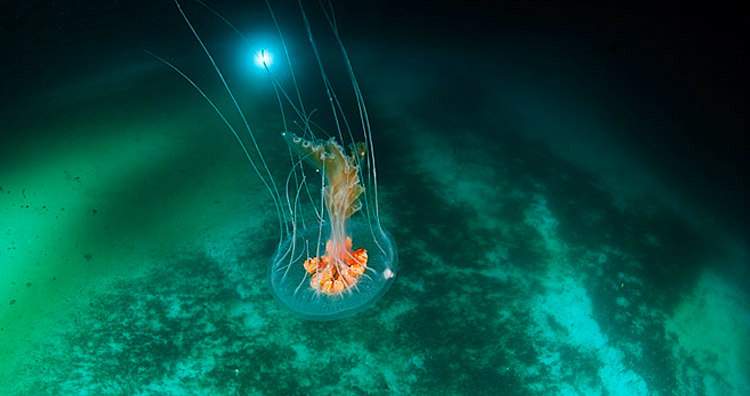
The life cycle of jellyfish is complex and includes two phases: the sexual phase, also known as the "medusa," and the asexual phase, known as the "polyp." A fertilized egg develops into a swimming larva, which then develops into a polyp. Polyps are non-motile. They live on the seafloor or attach themselves to boat hulls, plankton, other invertebrates, or, less commonly, fish. As they grow, they also reproduce by budding, forming new polyps. When the polyps mature, they transform into medusae—a free-swimming form known as jellyfish that reproduces sexually and incubates eggs.
Although most species of jellyfish have a limited lifespan, the jellyfish Turritopsis dohrnii — the only known species capable of reverting to the polyp stage in the face of starvation, body injury, or even temperature change. During the polyp stage, jellyfish reproduce asexually, forming new polyps, which then grow into new medusae. Essentially, this species of jellyfish is biologically immortal and can only die as a result of predation, disease, or death, whether accidental or intentional. (source)
3. As a defensive strategy, the Alpine ibex climbs nearly vertical rocky areas to protect itself from predators. This gravity-defying species of wild goat can live at altitudes of up to 3,300 meters. (10,800 feet) above sea level.
Ibexes are several species of mountain goat known for their excellent climbing skills. Like mountain goats, which aren't actually goats, mountain goats have cloven hooves that can diverge, internal pads that provide traction, and hook-like structures called "dewclaws" that prevent slipping. Their shoulder and neck muscles are so strong that they allow mountain goats to leap up to six feet without a running start.
Mountain goats prefer to live at fairly high altitudes—Siberian ibexes, for example, are typically found on cliffs at altitudes of 2,000 to 5,000 meters, while Welsh ibexes live at altitudes of 2,500 to 4,500 meters. However, this defensive strategy is of little use when the predator is an eagle. Eagles simply snatch the goat, throw it off the mountain, and then eat it.
These goats also frequently climb artificial structures, such as walls, houses, and especially dams. Alpine ibex goats often climb the Cingino Dam in northern Italy to lick salt and mineral deposits from the dam's stones. (source)
4. Hagfish are ancient eel-like creatures that secrete copious amounts of thick mucus when threatened. The mucus is composed of fibers thinner than the width of a blood cell and comparable in strength to Kevlar.

The mucus proves extremely useful when predators like sharks, conger eels, or groupers attempt to bite the hagfish. The mucus clogs the gills, significantly impeding breathing, and the hagfish simply escapes. With such a reliable defense mechanism, it's no wonder there have been virtually no evolutionary changes between modern hagfish and the hagfish of 300 million years ago.
Hagfish are equipped with over a hundred glands on their bodies that secrete a mixture of microfibers and mucus. As Douglas Fudge of Chapman University in California discovered, the fibers are tightly coiled, like a ball of wool, within thin cell membranes. When mixed with water, these membranes burst, and the fibers unwind. The mucus expands nearly 10,000-fold, forming up to 20 liters of sticky, gelatinous material. After an accident involving a truck full of hagfish on July 14, 2017, the road and car were completely coated in this mucus.

The mucus has many potential uses, including as a bioalternative to Kevlar and shark protection for divers, both of which are being explored by the US Navy. Navy researchers have successfully used bacteria E. coli to recreate proteins in mucus. Lukas Boni, a researcher at ETH Zürich, is working on using mucus as a heat-free alternative to commercial gelatin. (1, 2)
5. Pistol shrimp snap their claws so fast that water instantly evaporates, forming a bubble that travels at 100 kilometers per hour and produces a sound of 218 decibels. When the bubble collapses, it reaches a temperature of 5,000° K (4,700° C) and produces a flash of light.
Pistol shrimp, also known as "snapping shrimp," have one regular claw and one large claw that accounts for half their body size. This dominant claw differs from the regular claws by having a "hammer" that moves backward perpendicular to the other claw. When the hammer is released, it snaps back with such force that it releases bubbles of hot water vapor that stun prey or even kill small fish. It can even shatter a small glass jar.
The clicking sound these creatures produce is so loud that it rivals that of sperm whales and beluga whales—the loudest underwater animals. The bubbles formed by the clicking are called cavitation bubbles, and when they collapse, they emit short flashes of light—an effect known as sonoluminescence. When a bubble collapses, it reaches temperatures of over 5,000° K (4,700° C), equivalent to the estimated surface temperature of the Sun at 5,800° K (5,500° C). (source)