








While the less materialistic among us might disagree, to say that money rules the world is probably an understatement. The entire world's economy is based on the assumption that money, whether virtual or real, can be exchanged for virtually anything we need in the world. Money also has a very interesting history, which arose because tens of thousands of years ago we began exchanging things. We discovered that we could trade things we didn't need for things we did need. After all, we invented money to represent and exchange things, not the things themselves. Since the invention of money, we have been refining its management, establishing rules and regulations for its fair exchange. Here are some interesting facts about money and its history that you probably didn't know.
1. The oldest form of currency in the world was cows. As early as 9000 BC, people exchanged livestock for the goods and services they needed.

Throughout history, various items have been used as currency. These are typically items considered valuable, reusable, or exchangeable by those who receive them. Among the earliest and most common media of exchange were livestock, sacks of grain, decorative items such as cowrie shells and beads, and metalwork.
Since 9000 BC, cattle and the dung they produced were considered a form of currency. A standardized coinage system was introduced only in 1000 BC. During the Zhou Dynasty, small knives and shovels, or bronze replicas of cowrie shells, were used. Between 700 and 500 BC, India, China, and cities around the Aegean Sea independently began minting coins. (source)
2. The Chinese were the first to invent paper money in the 7th century.
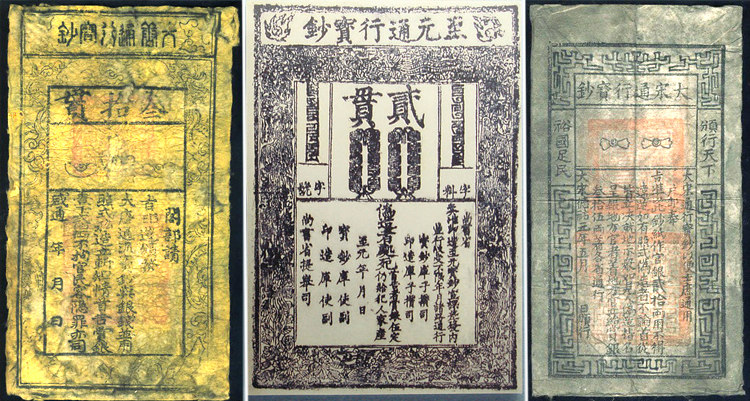
Paper money began to develop during the Tang Dynasty, as merchants and wholesalers preferred paper to avoid carrying copper coins during large trade transactions. By 960 CE, the Song Dynasty, experiencing a copper shortage, began issuing and generally distributing banknotes in lieu of genuine copper coins, with the promise of redemption later. The central government soon realized the economic benefits of using paper money, and by the early 12th century, 26 million bundles of banknotes, equivalent in number to coins, were being printed annually.
By the 13th century, the idea of paper money had been brought to Europe from China by travelers such as Marco Polo and William of Rubruck. European banks soon embraced the concept and began issuing banknotes with personalized inscriptions, including the recipient's name and the cashier's signature. In 1695, the Bank of England became the first bank to issue banknotes on a regular basis, to raise funds for the war against France.
Following the wars unleashed by Louis XIV, France experienced a shortage of precious metals, and banknotes were introduced as the official currency. By the mid-19th century, the Bank of England gradually transitioned to standardized banknotes with fixed denominations, allowing any bearer to receive the specified amount. (source)
3. Dollar bills are called "bucks" because, according to one theory, they replaced deer skins or whole deer carcasses as currency in the 18th century.
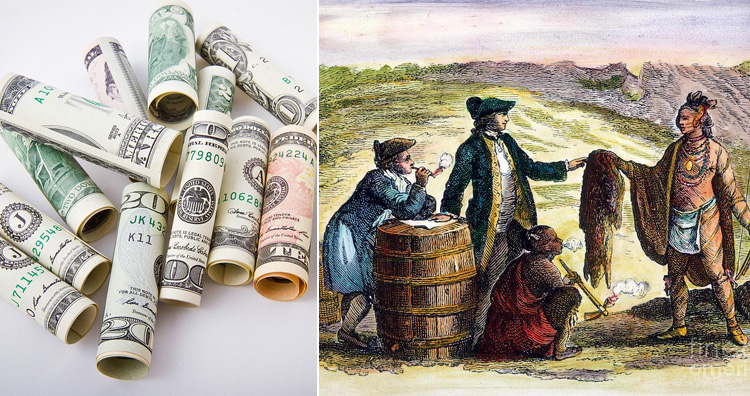
In the 18th century, deerskins were a common means of exchanging valuables. The earliest reference to the word "buck" as a currency appears in the writings of Conrad Weiser, a Dutch explorer who acted as a go-between for the early colonists and Native Americans, dating back to 1748. He wrote of a theft, claiming that someone had been "robbed of 300 dollars" and that a barrel of whiskey sold to Native Americans was worth "5 dollars." While some claim that the word "buck" refers to young Black male slaves used as pack animals and exchanged for goods, there is no evidence to support this. (source)
4. Although $100 is the largest denomination today, in the past there were bills of much larger denominations: $500, $1,000, $5,000, $10,000, and even $100,000.
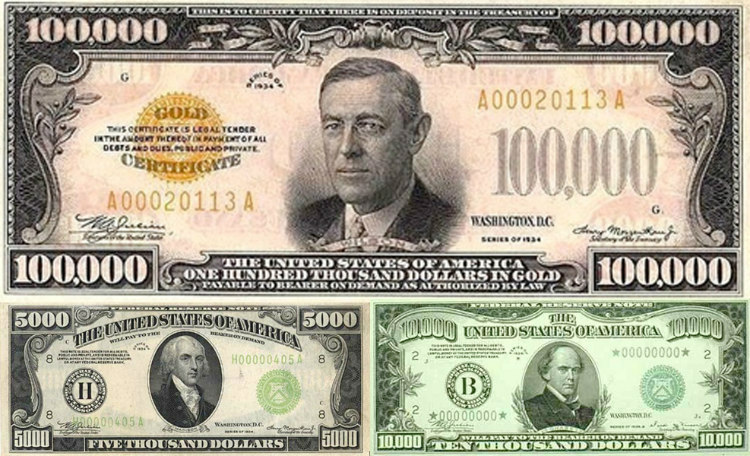
In 1928, the United States federal government amended its banknote printing system. In addition to issuing notes in denominations from $1 to $100, bills were also issued in denominations of $500, $1,000, $5,000, and $10,000, featuring portraits of William McKinley, Grover Cleveland, James Madison, and Salmon P. Chase, respectively.
However, the issuance of these banknotes was intended not only to save wallet space for the wealthy but also to facilitate money transfers between banks and other financial institutions at a time when complex systems such as wire transfers had not yet been fully developed. The largest banknote issued by the United States to date is the Series 1934 $100,000 Gold Certificate, issued between December 1934 and January 1935. (source)
5. Musa I of Mali was the richest man in history, with a net worth of $400 billion (in 2010 dollars), and he was so generous with gold that the metal lost its value for a decade.

Musa Kieta I of Mali was the tenth Mansa (king), conqueror, and emperor of the West African Empire of Mali in the early 14th century. He is said to have conquered more than 24 cities, as well as the surrounding districts, villages, and estates. During his reign, he amassed a fortune mining salt and gold in Mali, which also made him incredibly wealthy. A devout Muslim, he made the pilgrimage to Mecca between 1324 and 1325 with 60,000 men and 12,000 slaves, each carrying 4 pounds of gold bullion.
Along the way, Musa was so generous with gold that the economies of the regions he passed through collapsed, and the cities of Cairo, Medina, and Mecca were forced to endure a decade during which gold was practically worthless. To support the gold market, Musa borrowed as much gold as he could from moneylenders in Cairo at high interest rates. (source)
6. The Bank of England issues the highest denomination notes, called "Giants" (£1 million) and "Titans" (£100 million).

Banknotes issued by the Bank of England are the sole legal tender throughout England. Although Scotland and Northern Ireland issue their own banknotes, their value is determined by agreement between the issuers and receivers, while banknotes from Jersey, Guernsey, and the Isle of Man are legal tender only at the regional level. To issue banknotes, banks in Scotland and Northern Ireland must hold Bank of England-issued banknotes of equivalent value.
Since the total value of these notes would exceed one billion pounds, the Bank of England issued special denominations called "Giants" worth one million pounds and "Titans" worth one hundred million pounds. These notes are intended for internal bank use only and are not made public for security reasons. However, cancelled notes are often given to employers, who sometimes offer them for sale. (source)
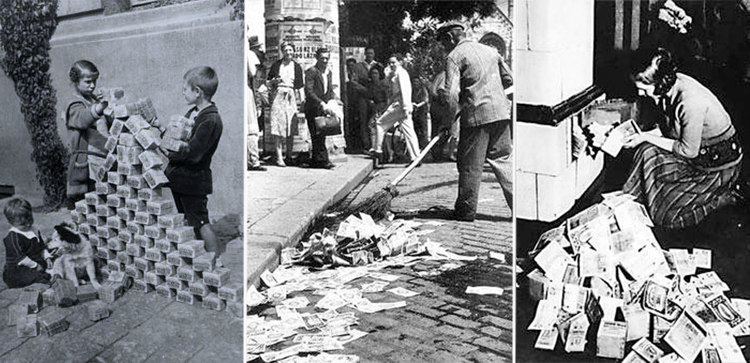
7. In 1923, hyperinflation in Germany was so severe that the exchange rate rose from 9 marks to 4.2 trillion marks per dollar. The cost of a loaf of bread rose to 2 trillion marks, and people burned their money to stay warm because it was cheaper than buying firewood.
During World War I, German Emperor Wilhelm II and the German parliament financed the war entirely with borrowed funds, unlike the French Third Republic, which introduced its first income tax. Germany hoped to recoup all the money, as well as pay reparations to the defeated allies, after winning the war, but this did not happen. This led to the mark's appreciation against the US dollar from 4.2 to 7.9, a rise that continued.
In the first half of 1921, their currency remained relatively stable at 90 marks to the dollar, and Germany emerged from the war with its industrial infrastructure intact. However, when the victorious powers began demanding reparations, the situation worsened. Germany was forced to pay 50 billion gold marks, and since reparations had to be paid in hard currency, not paper marks, which quickly depreciated, it massively printed banknotes to buy foreign currency to pay, which again led to a sharp rise in inflation.
By November 1923, the exchange rate was 4,210,500,000,000 German marks to the US dollar, and one gold mark was worth one trillion paper marks. A loaf of bread cost two trillion marks, and people collected their wages in suitcases and carts. If stolen, thieves left the money and took the suitcases. Some even used them as wallpaper. Inflation was so rapid that a family sent a boy to buy two loaves of bread. He stopped to play soccer and by the time he got to the store, he could only afford one. (1, 2)
8. The exact origin of the dollar symbol is unknown. One theory is that it originated from the Spanish peso, where the letters "PS" combined form something similar to "$.".

According to the Bureau of Engraving and Printing, the dollar symbol originated from the Spanish peso, which was the common currency in colonial America in the late 18th century. The unit "peso de ocho reales" translates to "eight reales." It was abbreviated to "PS," which may have given rise to the dollar sign. The first printed reference to this sign dates back to the early 1800s, and by the time it was used on American currency, it was already in widespread use. Another, less common theory is that the initials of the United States, "U" and "S," may have been superimposed, with the lower portion of the "U" removed to create a sign resembling the dollar symbol. (1, 2)
9. The most expensive coin in the world is the "Flying Hair Dollar." It was recently sold for $10,016,875.
In 1791, Congress passed a joint resolution establishing a national mint, and its official establishment was authorized by the Coinage Act of 1792. However, actual minting did not begin until 1794, and the "Flowing Hair Dollar" became the first dollar coin issued by the United States federal government. It was designed by Robert Scot, Chief Engraver of the United States Mint, and minted in 1794 and 1795.
On one side of the coin is a bust of Liberty with flowing hair, and on the obverse are stars representing the fifteen states that signed the Constitution at the time. On the other side is an eagle and wreath. The coin's size and weight were based on the Spanish dollar, which was popular in America at the time. (source)
10. Banknotes from Canada, Mexico, India, Russia and Israel have raised dots similar to Braille to help visually impaired people distinguish between denominations.

After consulting with people who are blind or visually impaired, the Canadian government developed a tactile feature consisting of groups of raised dots to identify banknote denominations. These dots are not Braille, as consultations revealed that Braille is not reliable enough and not all potential banknote users can read it. Other currencies that use special raised symbols for the visually impaired include Mexican banknotes, Indian rupees, Israeli new shekels, Russian rubles, and Swiss francs. (source)