








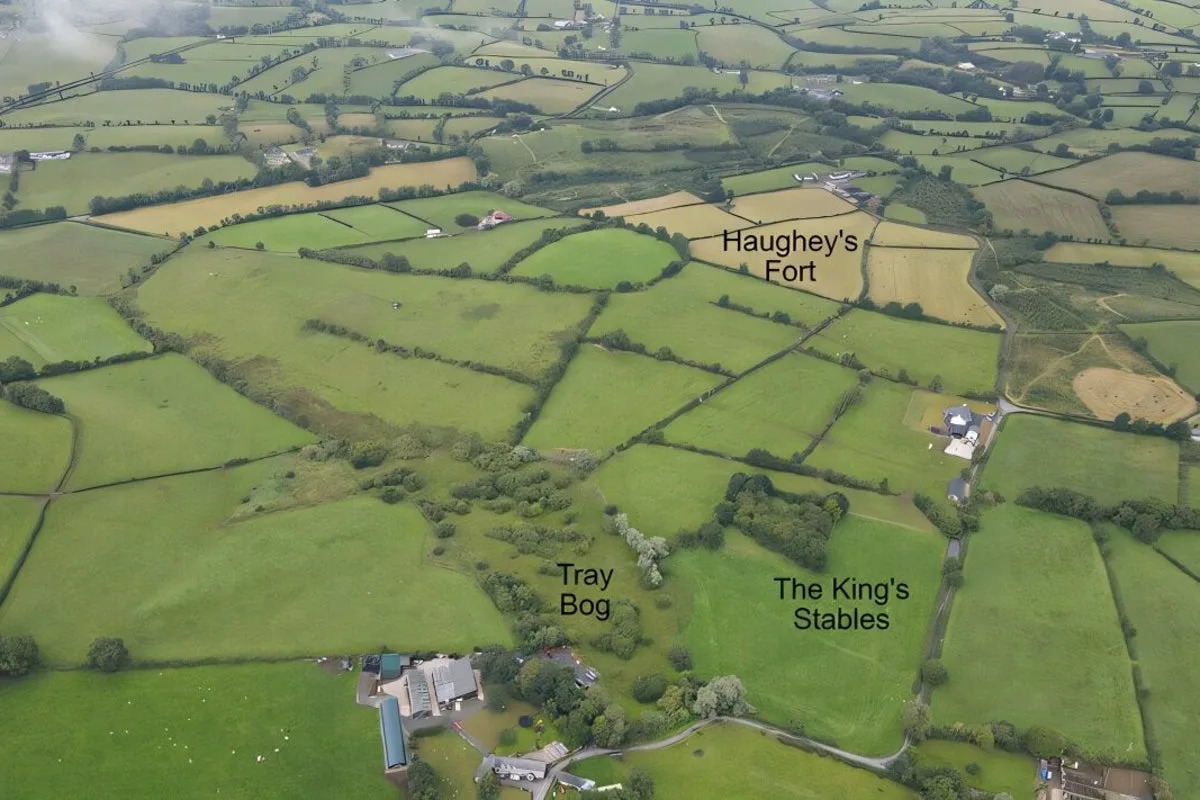
A prehistoric settlement in Ireland was one of the world's first cities and a major manufacturing centre, according to new research.
Fort Haughey near Armagh in Northern Ireland was a meticulously planned settlement that, from around 1200 BC, supported craft production and rituals on an unprecedented scale. The region was already known as the capital of Iron Age Ulster and had links to early medieval literature, and recent research has shown that it was also a thriving and complex center in the Late Bronze Age.
The study found evidence of over 200 possible wooden dwellings at Fort Haugi, indicating the presence of a dense and well-organised settlement far beyond what would have been expected from a typical hillfort in the area nearly 3,000 years ago.
«"Our study demonstrates the scale, organization and interconnectedness of cultures in Bronze Age Ireland that have not been fully recognized until now," said James O'Driscoll, author of the study published in the journal Antiquity .
Large circular buildings, some up to 30 meters in diameter, surrounded the residential structures. These likely served as public or communal spaces, supporting the idea that the region was a well-connected "urban" center, according to archaeologists from the University of Glasgow.
Excavations at the site revealed evidence of specialized bronze and gold processing, large-scale feasts, and high-status artifacts, suggesting a thriving economic activity and social organization within this "city." Imported artifacts found at the site indicate long-distance connections with regions as far away as Iberia and Central Europe.
Fort Haugi itself was part of a much larger complex that included an artificial pool where archaeologists have discovered evidence of ritual burials, weapon castings, animal remains, and fragments of human bones.
According to the researchers, a wide alley enclosed by a wooden fence connected the fort with the pool and probably served as a venue for ceremonial processions.
The fort probably had an outer enclosure covering 109 hectares, equivalent to 155 football pitches, and was one of the largest known archaeological sites in Ireland or Britain.
«"The evidence from Fort Haugie indicates that it was a large, densely populated settlement where craft production, exchange and social activity were closely intertwined," Mr O'Driscoll said.
As the researchers noted, the findings indicate that Fort Haughey was one of the earliest examples of an "urban center," where large, organized settlements began to form around 3,000 years ago. "This fundamentally changes our understanding of the site and highlights how closely communities in Ireland were linked to broader developments in Bronze Age Europe," said Mr. O'Driscoll.