








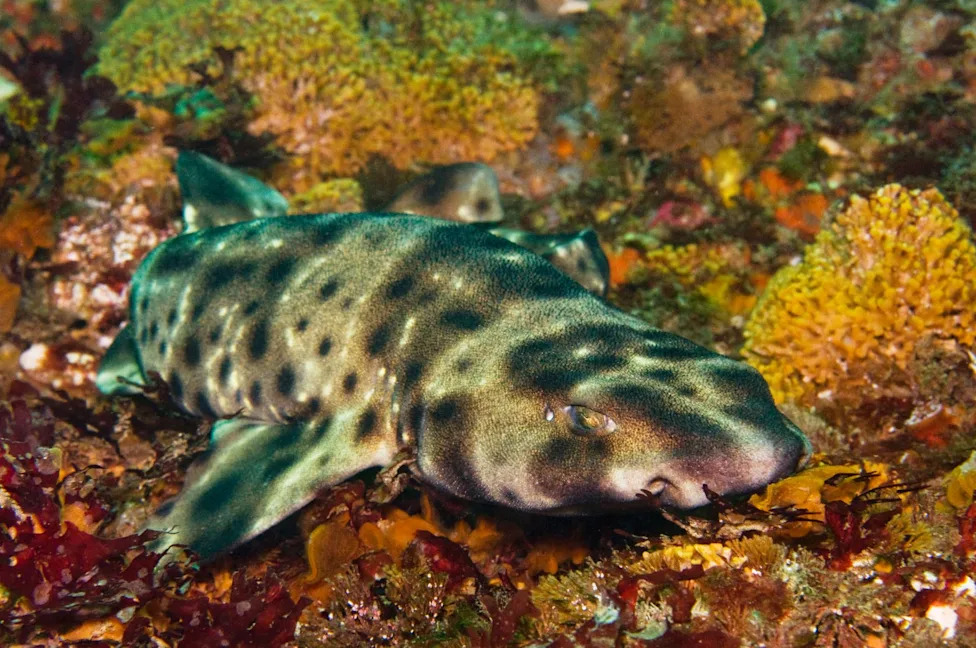
A study conducted at a California aquarium is challenging the conventional notion of sharks as nothing more than relentless hunters.
Several species of these sharks have been observed to consistently return to toys and floating objects after feeding, and one horn shark even converted orange rings into a sleeping area.
What's happened?
A study published in the journal Applied Animal Behaviour Science found that sharks and rays may use toys for more than just feeding.
The study was conducted over 12 weeks at the Cabrillo Marine Aquarium in Southern California, where biologists Autumn Smith and Patrick Sun tracked captive animals' responses to enrichment items.
According to AOL, the team offered floating and sinking toys to 13 captive animals of four species: horn sharks, blowhead sharks, leopard sharks, and a California stingray. Smith began the project after noticing that many sharks and rays in the aquarium remained motionless for long periods of time and suspected they might be lacking stimulation.
As AOL reports, over the weeks, the animals became much more active in their play, swimming through hoops, carrying objects on their noses, flicking their tails at toys, and gently biting them.
Some sharks also interacted with the toys, exhibiting hunting-like behavior, such as lunging at a plastic squid and then retreating abruptly at the last second. One horn shark, Bud, showed a particular preference for the orange rings and even slept on them.
The toys were placed in the enclosure an hour before feeding, removed during mealtime, and returned 30 minutes afterward so that the researchers could compare behavior before and after feeding. The sharks' interest in the toys increased even more, as their use increased after feeding, suggesting that the animals were motivated by more than just hunger.
Why is this important?
This pattern refutes the long-held belief that sharks are guided solely by appetite and instinct.
Instead, the results point to curiosity, preferences, and individual differences in animals, which are often reduced to a much more simplified representation.
While sharks and rays benefit from mental stimulation, aquariums and other animals kept in controlled environments require more careful consideration not only of food and space, but also of ways to enrich their environment.
Habitat enrichment programs have traditionally been used for mammals and birds, but fish have often been excluded because scientists assumed they weren't intelligent enough to benefit from toys or puzzles. This study challenges that assumption.
Interest in toys varied by species, with leopard sharks being particularly active, making up to 120 interactions with toys per hour, while others showed lower levels of engagement.
Color also mattered: yellow and orange toys attracted more attention than red ones, disproving the common belief that sharks are particularly drawn to the color red.
The findings expand researchers' understanding of how these animals perceive and interact with their environment.
The research also shows that wildlife is often much more complex than movie myths and popular belief make it out to be.
Perceiving sharks as curious animals rather than one-dimensional predators may also influence views on conservation and humane treatment of sharks.
What is being done?
Aquariums are increasingly conducting targeted experiments to enrich the habitat.
This study suggests that adding toys and novelty items can reveal behavioral traits that may go unnoticed in conventional enclosures, providing caregivers with new ways to ensure animal welfare.
Researchers are also paying more attention to differences between species and how individual sharks respond, as a one-size-fits-all approach can miss what specific animals actually like or benefit from.
The study also suggests that better questions can change what researchers observe. Instead of assuming that a motionless shark is simply inactive, scientists can now examine whether it requires more stimulation, more variety, or a different type of environment.
What initially looked like a simple toy experiment has shown that sharks and rays can be far more curious, expressive, and individualistic than many people think.
Subscribe to TCD's free newsletters to receive helpful tips, actionable advice, and a chance to win $5,000 toward your home improvement. To see more stories like this, change your Google preferences here.