








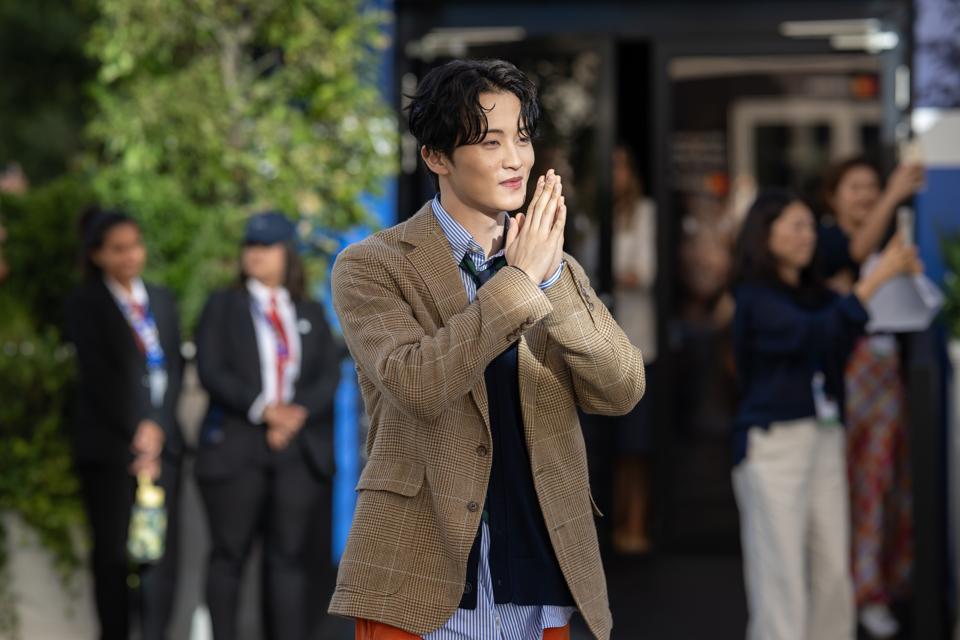
Two months after ending his decade-long partnership with SM Entertainment, Mark Lee took the next step. On June 4, the Canadian rapper and singer officially launched Upper Room, his own independent label and agency. According to the company's official Instagram announcement, Lee will serve as co-CEO and co-creator.
What does Upper Room mean to Mark Lee?
Upper Room announced that it "will serve as a starting point for his music, vision, and the various projects he will pursue in the future, marking the beginning of a new chapter." The name also has biblical significance (Mark has made references to his faith before); Upper Room refers to the room in which the Last Supper took place in the Gospel of Mark, the very text whose author shares his English name, Mark Lee. The company's promotional video briefly references the biblical passage Mark 14:12-15.
The latest Instagram post also includes Matthew 6:33, which reads, «Seek first the kingdom of God and His righteousness, and all these things will be added to you.».
Upper room
Mark Lee/Instagram
The message also read:
«For me, the Upper Room is a prepared place – it holds within itself something beyond form, a quiet readiness… a moment frozen just before everything begins.».
There's something about it... not loud, but undeniable. A silence that seems almost sacred—as if it had been waiting for this moment long before.
Not empty, but collected.
Don't be silent, but listen.
And inside him… a voice begins to form.».
Who is Mark Lee?
Mark Lee hails from Toronto, Canada, and moved to Seoul in 2012 to join SM Entertainment as a trainee. He officially debuted in 2016 as a member of the subgroup NCT U, and a few months later as a member of NCT 127 and NCT Dream. Over the course of more than a decade, he has become one of the group's most prominent members internationally, renowned for his rapping, bilingualism, and consistent performance across NCT's various subgroups and lineups. He released his first solo album in April 2025. The Firstfirst. «"I think this album helped me find myself," he told The Hollywood Reporter ahead of its release.
In April of this year, SM Entertainment announced his departure, stating, "After a long period of thorough and thoughtful discussions with Mark regarding his future activities, we have come to a mutual agreement to terminate his exclusive contract effective April 8.".
In a handwritten note posted to Instagram on April 2, ten years after his debut, Lee addressed his fans directly: "Of all the things my heart wants to say right now, I sincerely want to say thank you. Thank you for your love, support, and for helping me become who I am today.".
FORBES | Hannah Abraham: Why Mark Lee's Departure from NCT Is So Important for K-Pop
The number of idols launching their own labels is growing.
Mark Lee joins a significant and growing group of K-pop idols who have transitioned from working for major record labels to independent business ownership, and the results of this transition range from institution-building success stories to instructive examples.
Perhaps the most illustrative example is Jay Park, who founded AOMG in 2013 after leaving 2PM and built it into one of Korea's most respected hip-hop labels, signing artists such as Gray, Lee Hee, Simon Dominic, and Yugyeom. Park stepped down as CEO of both AOMG and H1GHR MUSIC (which he co-founded with Cha Cha Malone in 2017) at the end of 2021, citing a need for introspection.
SEOUL, SOUTH KOREA - MARCH 5: Gucci global brand ambassador, actor and singer Park Jae-beom (Park Jay, Jay Park) attends a photocall for the opening of the GUCCI 2024 women's collection pop-up store "Gucci Ancora" on March 5, 2024 in Seoul, South Korea. (Photo by Han Myung-gu/Getty Images)
Getty Images
The labels continued operating without him, but entered a turbulent period. In 2024, following the resignation of CEO DJ Pumpkin amid internal discord, Gray, Lee Hi, Woo Won-jae, and Goosebumps left without renewing their contracts.
In 2019, after leaving YG Entertainment, PSY announced the creation of his label, P Nation, and the company signed promising artists, including rapper Jessi, then-couple HyunA and Dawn, Crush, and Heize. SK Group's SK Telecom also invested 5 billion won for 10% shares.
However, by 2025, all of the original signed artists had left the label without renewing their contracts (eight artists remained with the label, including MAMAMOO's Hwasa). Since then, P Nation has launched its first girl group, Baby DONT Cry, produced by (G)I-DLE's Jeon Soyeon, so the label is still active, but has significantly scaled back its activities compared to its 2019 ambitions.
SEOUL, SOUTH KOREA – DECEMBER 25: EXO's Chen, Xiumin, and Baekhyun attend the 2017 SBS Gayo Daejeon at the Gocheok Sky Dome on December 25, 2017 in Seoul, South Korea. (Photo: The Chosunilbo JNS/Imazins via Getty Images)
ImaZins via Getty Images
The most problematic case in recent memory is INB100, founded by EXO's Baekhyun in 2023 to manage the solo projects of himself, Chen, and Xiumin following their departures from SM Entertainment. In May 2024, the label was absorbed into One Hundred Label as a subsidiary under chairman Cha Ga Won. However, in April of this year, Chen, Baekhyun, and Xiumin filed notices of intent to terminate their exclusive contracts with INB100 due to alleged unpaid compensation, marking an abrupt end to a label that initially appeared to be one of the most commercially viable independent ventures in the industry.
KOZ Entertainment, founded by Zico in 2018 after leaving Seven Seasons, was acquired by HYBE in 2020. The move saved the company from financial losses but ultimately made it the least successful label in HYBE's portfolio, recording the lowest revenue figures of all HYBE subsidiaries until its CEO's resignation in 2023, according to K-pop news aggregator Allkpop. Kang Daniel's Konnect Entertainment, founded in 2019 following a contract dispute, has since closed down entirely.
BLACKPINK's Rosé, Jennie, Jisoo, and Lisa attend the 2022 MTV Video Music Awards held at the Prudential Center on August 28, 2022, in Newark, New Jersey. (Photo by Christopher Polk/Variety via Getty Images)
Variety via Getty Images
BLACKPINK's Jennie launched ODD ATELIER in 2023, Lisa founded LLOUD, and Jisoo, along with her brother, created BLISSOO. All three artists remain active at the time of publication, though it is too early to assess their long-term viability as labels beyond managing the solo careers of their founders.
There seems to be a pattern: artists who have built a loyal fan base and established a creative identity within major entertainment companies reach a point where the label infrastructure that nurtured them becomes a limiting factor. However, idol-owned labels that thrive after the departure of their founders are rare. Those who succeed—and even AOMG's success is currently being complicated by the deteriorating situation following Jay Park's departure—do so by developing other artists with genuine creative passion. Those who struggle view the label primarily as a vehicle for a solo career.
What does the Upper Room symbolize for Mark Lee? We'll find out.
This article was originally published on Forbes.com.