








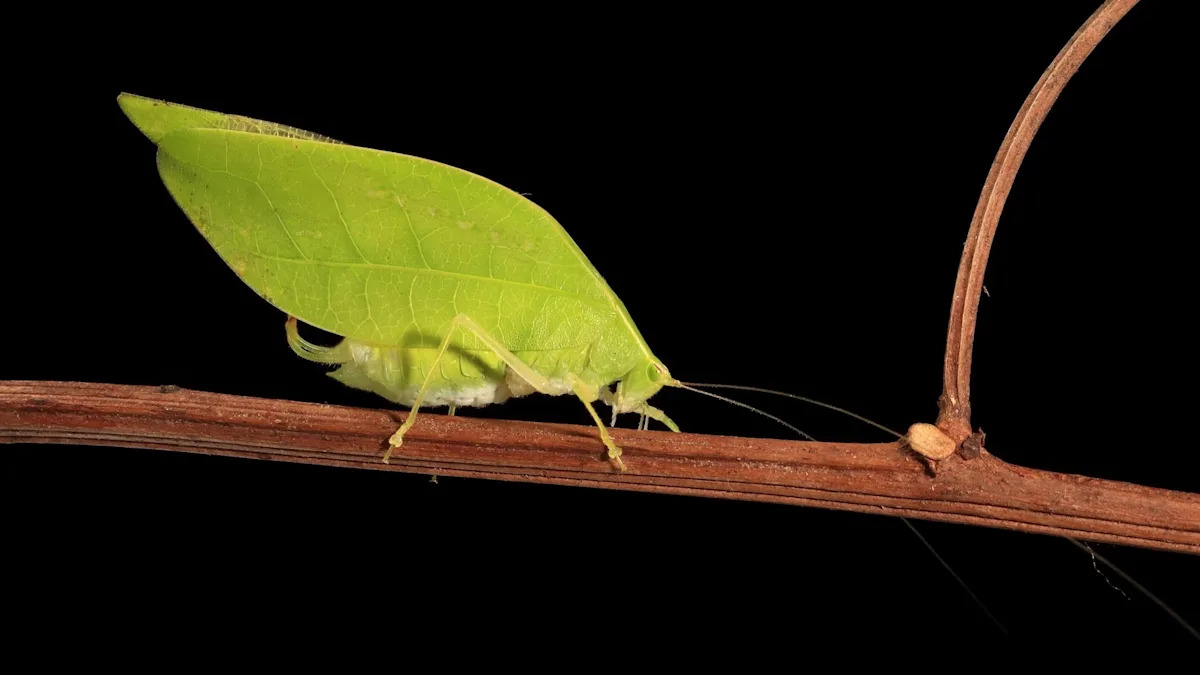
When it comes to reproduction, animals use every means possible to attract a mate. Emitting loud mating calls, displaying brightly colored wings, inflating the throat sac, and literally shaking the tail feather—all of this ensures the birth of the next generation of the species. Some insects even go so far as to camouflage themselves as something completely different—leaves.
Typically used as a means of camouflage, leaf camouflage in male grasshoppers appears to enhance their mating calls and make them more attractive to the opposite sex. The study's findings are detailed in a paper published today in the journal Proceedings of the Royal Society B , and represent one of the first demonstrations of how leaf mimicry enhances sexual signals in male grasshoppers.
To protect themselves from predators, various species of grasshoppers have evolved wings with leaf-like structures. Panamanian grasshoppers camouflaged as leaves ( Arota festae ), even change color from green to bright pink to better mimic leaves. However, entomologists still don't know whether these leaf-like structures play a role in grasshopper mating.
This new study examined the species Viadana brunneri from Barro Colorado Island in Panama. To attract mates, grasshoppers create songs by rubbing specialized structures on their wings together. Many tropical species, such as V. brunneri , the part of the wing that imitates leaves makes up most of its surface.
Much of the structure of the wings is designed to make male grasshoppers look more like a leaf. Image: Christian Ziegler.
Previously, scientists believed that physical adaptations for survival and for attracting mates could conflict with each other, especially when they are physically connected. The brightly colored tail feathers of the male peacock may help him attract females, but they also make them easier for predators to detect. Male grasshoppers, on the other hand, are able to use the acoustic properties of their defensive structures to their reproductive advantage. They are a rare example of how adaptations for self-defense and reproduction can work together without necessarily putting the animal at risk.
The team conducted a series of bioacoustic, behavioral, and biophysical experiments, demonstrating that these leaf-like structures on the wings make them more attractive to females and also help them camouflage. After removing the leaf-like structures from the male's wings, V. brunneri The pitch of his calls increased, and the volume of his songs also changed. The team then played these calls to females, who preferred the lower-pitched calls of males with intact wing leaflets.
While male grasshoppers sing all the songs, females express their interest by responding with clicks. The insects emit short, sporadic, and infrequent calls, perhaps lasting only two seconds per night. They produce these calls in an ultrasonic mode, which our ears cannot detect. It has also been found that the leaf-like parts of the male grasshopper's wing vibrate, amplifying their songs and making them more noticeable to females.
«"Our study represents a rare example of the harmonious interaction of natural and sexual selection, leading to the emergence of traits that simultaneously improve survival and mating success," said Dr. Benito Wainwright, co-author of the study and an evolutionary biologist at the University of St. Andrews, in a statement. "We are now excited to begin studying how this intriguing interaction evolved in grasshoppers.".