








Internal combustion engines are widely used in vehicles. They operate in confined spaces using fuel. These engines are portable and more convenient than electric, hybrid, and other types of engines. However, the main drawback of these engines is pollution. Internal combustion engines produce large amounts of air pollutants.
Many engineers are developing new technologies to replace this engine, such as electric motors, hybrid powertrains, hydrogen fuel cells, and even compressed-air vehicles. However, none of these technologies are efficient. Therefore, we need a more advanced internal combustion engine.
Here's the good news: more advanced combustion engines will be available in the future.
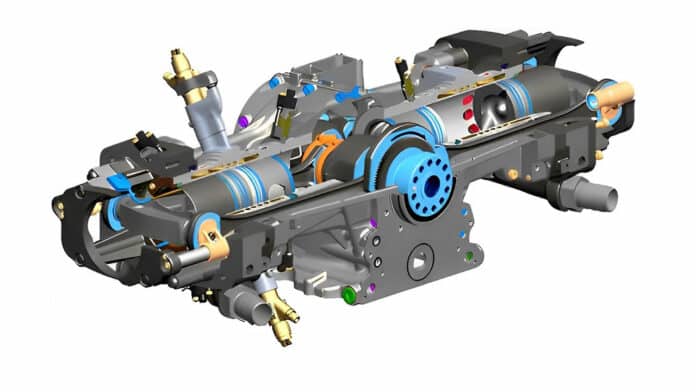
Ecomotor is developing a new engine called the opposed-piston-cylinder (OPOC) engine. The opposed-piston-cylinder (OPOC) engine is the most promising new type of internal combustion engine.
OPOC engine architecture:
The OPOC engine is a two-stroke engine with opposed pistons and cylinders. It consists of two cylinders with pistons at each end. It has no cylinder head, so there are no valves.
In a conventional engine, each piston travels approximately half the distance traveled by the cylinder. Compared to other conventional engines, the OPOC is significantly smaller.
In an opposed-piston cylinder, the bearing load is very low. This means friction will be lower than in a conventional engine.
Each piston in the engine has one crankshaft with connecting rods (the inner pistons have short connecting rods, and the opposite outer pistons have long ones).
When the pistons move together, they compress the inlet charge to ignite it. This simply means the engine has a high specific power.
OPOC technical specifications:
- Dry weight: 296 lbs
- Dimensions: 22.8 x 41.3 x 18.5 inches, length x width x height.
- Cylinder diameter: 100 millimeters
- 325 horsepower at 3500 rpm.
- Torque: 664 lb-ft at 2100 rpm.
- Power Density: 1.1 horsepower/lb
OPOC Features:
- Smaller size
- Less weight
- Less details
- Higher efficiency
- Unrivaled power density
- Truly modular design
How the OPOC engine works:
The engine completes a complete cycle with the movement of two pistons. Intake and exhaust occur simultaneously at the beginning of the compression stroke and after the combustion stroke. This process allows engines to produce very high power for their weight.