






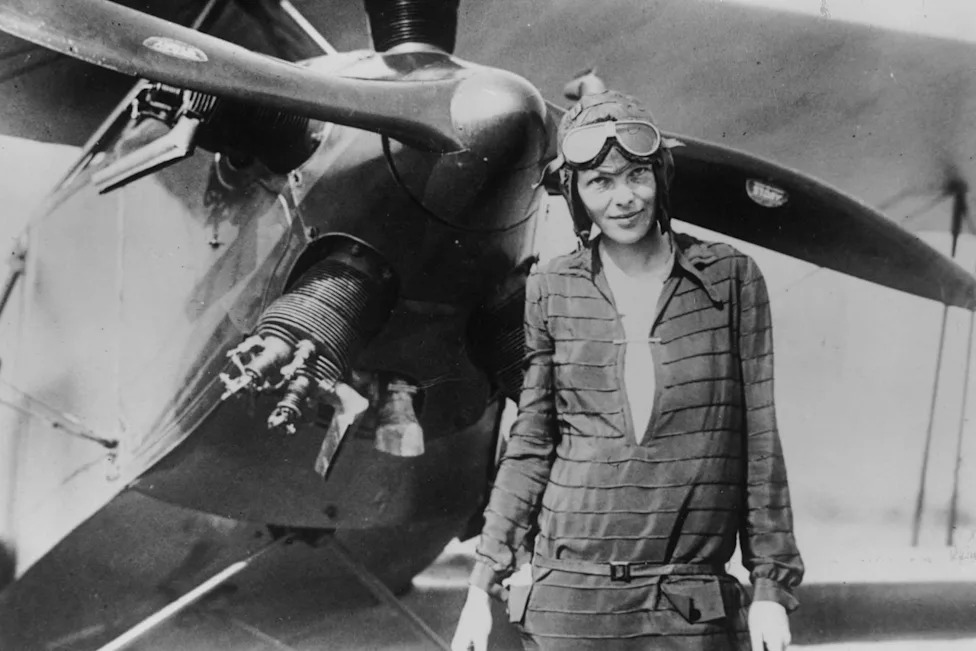
A new expedition to the Pacific Ocean may provide answers to the nearly 90-year-old mystery of the unsolved fate of legendary aviator Amelia Earhart.
Almost everyone has heard some version of Earhart's story and the theories surrounding her disappearance in 1937.
Earhart was attempting a historic feat: becoming the first woman to fly around the world. On July 2, 1937, Earhart and her navigator, Fred Noonan, were flying from Lae, New Guinea, to tiny Howland Island, located approximately 2,500 miles from Lae, when they disappeared without a trace. Less than two years later, they were officially declared dead.
Researchers hope to learn more about Earhart and Noonan's final moments during a fall expedition to find what they believe is the Lockheed 10-E Electra they were flying when they disappeared.
An expedition team, including staff from Purdue University and the Institute of Archaeological Heritage, is investigating a visual anomaly in a lagoon on Nikumaroro Island, part of the Pacific island nation of Kiribati. The team hopes to determine whether this anomaly, known as the "Taraiya object" and first detected by satellites in 2020, is the remains of Earhart's plane.
A new expedition to the Pacific Ocean may provide answers to the nearly 90-year-old mystery of the unsolved fate of legendary aviator Amelia Earhart (Getty Images).
«I am very confident about this,» he told the publication. USA TODAY Richard Pettigrew, executive director of the Institute of Archaeological Heritage and expedition leader. "I'm thrilled.".
According to this theory, Earhart and Noonan landed on the remote island of Nikumaroro after failing to reach Howland Island.
Researchers cite several pieces of evidence to support this theory, including human bones discovered on the island in 1940, which, when analyzed in 2018, convincingly showed they belonged to a woman of Earhart's height. Items such as a woman's shoe, a powder case, and a jar of freckle cream, dating back to the 1930s, were also found on the island.
Earhart and her navigator, Fred Noonan, were attempting a round-the-world flight when they disappeared in the Pacific Ocean on July 2, 1937 (Topical Press Agency/Getty Images).
«"The evidence in support of the Nikumaroro hypothesis remains compelling, and the only way to answer this question is to travel to Nikumaroro, inspect the Taraya site in person, and follow the evidence wherever it leads," Pettigrew said in a July 24 press release.
The expedition to study the Taraia site was first announced last year, but was postponed pending final approval from the Kiribati government.
According to a press release, the expedition team will depart from Tarawa, Kiribati, for Nikumaroro Island on October 7. Archaeologists, filmmakers, divers, and other team members will remain on the island for several days.
This fall, an expedition team will investigate a visual anomaly in a lagoon on Nikumaroro Island, part of the Pacific island nation of Kiribati, in hopes of determining whether it is the remains of Earhart's plane (Hulton Archive/Getty Images).
«"Earhart challenged established norms, pushed the boundaries of what was possible, and inspired countless others to follow her example," said Purdue University Senior Vice President Steve Schultz, who will lead the university's team on the expedition.
«"As we prepare to embark on this expedition, we do so with a deep sense of responsibility to her legacy and a determination to find answers that have eluded the world for decades," Schultz said in a press release last month.
Earhart served as a career counselor for women at Purdue University and as an advisor in its Department of Aeronautics. The Purdue Research Foundation purchased Earhart's Lockheed Electra, and the university stated that she intends to return it after her around-the-world trip for future research.