








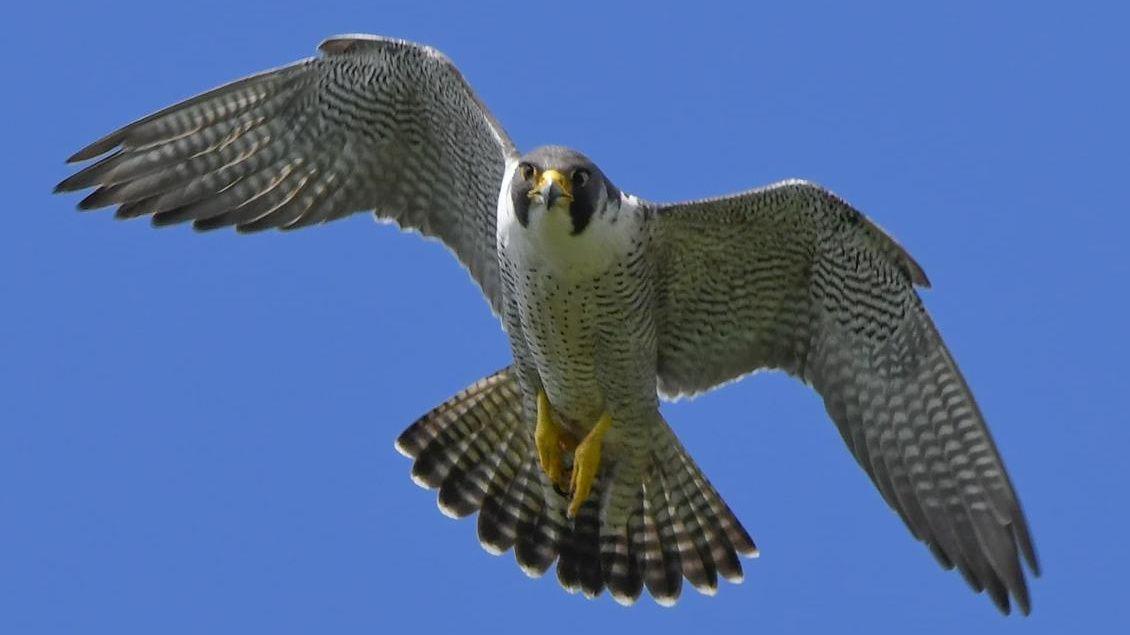
Residents have expressed concern about the fate of protected birds near an old water tower that is slated for demolition.
The 64-metre (210 ft) tower in Trimley St Mary, Suffolk, has reached the "end of its economic life" and needs to be demolished, according to a demolition application submitted by owner Propland Estates.
The statement said work was planned to begin in August, but residents asked that it not begin until two peregrine falcons with a chick had left the site.
East Suffolk Council said it had received a demolition notice and was "taking action, including to address the impact on any protected species." The BBC was unable to contact Propland Estates for comment.
The water tower, built in 1934 and a landmark on the A14, could once hold up to 150,000 gallons (682,000 litres) of water.
It was later drained and more recently used as a telecommunications tower.
Following demolition, the site will be left in a "leveling condition in preparation for its future use," which has not yet been determined, Propland Estates said in a statement.
Residents call the tower both a "landmark" and an "eyesore" [Geograph].
Jenna Beach, who lives near the tower, said peregrine falcons have nested on the building's roof for years.
These large and powerful birds of prey are classified as a Schedule 1 species under the Wildlife and Countryside Act 1981, meaning they are protected from disturbance.
Their breeding period lasts from March to September.
Beach said she worries about where the birds might go.
«"My husband and I love it when the falcons fly there and listen to them sing in the garden," she said.
«"This is a highly protected species and cannot be disturbed, so removal and any research will have to wait until they leave the area.".
Protected bird species typically begin breeding in March [Jenna Beach]
John Huckle, who runs an environmental consultancy on the Suffolk-Norfolk border, said any work would "have to wait" until the birds had finished nesting.
Because of their conservation status, he said, it would also be necessary to ensure that their chicks were no longer nest-dependent before the project began.
«"Some birds abandon the nest quickly, but others, such as peregrine falcons, are more dependent on the nest site, so the nest may be used for several weeks after the chicks first fly, remaining close to the nest so the parents can feed them," he said.
«"This doesn't necessarily mean they'll have to stop demolition, but they will need proof that the nest has been abandoned before work begins.".
The water tower has long been a familiar sight for motorists driving along the A14 [David Dixon/Geograph]
Hackl added that peregrine falcons are "pretty site-specific," meaning they prefer to return to the same spot each year.
After the demolition, they will simply "have to look for another place," he said.
A statement from East Suffolk Council said: "The council has received a demolition notice and is in the process of reviewing the matter, including the impact on any protected species and the method of demolition.".
Do you have a story proposal for Suffolk? Contact us using the form below.
Follow news Suffolk on BBC Sounds , Facebook , Instagram и X.
Read more about this story
-
The Landmark water tower appears to be set for demolition.
-
The chickens from the cathedral are weighed, ringed and swabbed.
-
The first osprey chick was born in the reserve in 2026.
-
Monitoring of peregrine falcon chicks continues due to the resumption of their activity.
Related links
-
East Suffolk Council