








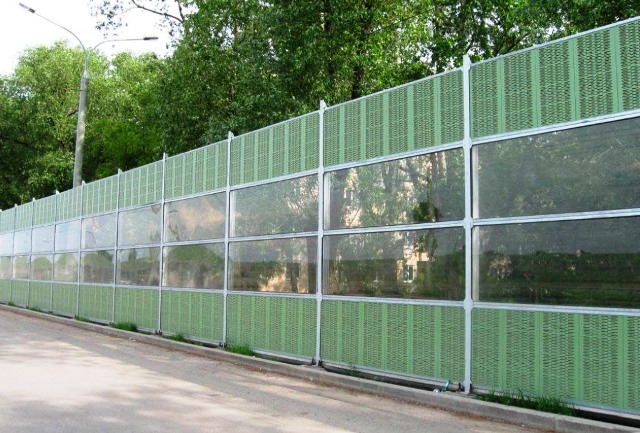
Increased traffic volumes lead to increased noise exposure, which contributes to discomfort and health problems. Protecting the population from noise is an important social issue.
Permissible sound levels in workplaces, residential, and public buildings must comply with the requirements of Sanitary Standards SN 2.2.4/2.1.8.562-96. If these levels are exceeded by 15-20 dBA, various noise protection structures are used. One solution to ensure acoustic comfort is the use of noise barriers.
A roadside noise barrier is a continuous noise barrier installed on a foundation. The barrier consists of supporting posts and acoustic panels secured between them. Acoustic panels can completely reflect sound waves or absorb most of them. Depending on the type of panels used, barriers are classified as reflective, sound-absorbing, and combined. Panels can be made of translucent materials or solid metal, which also determines the type of barrier.
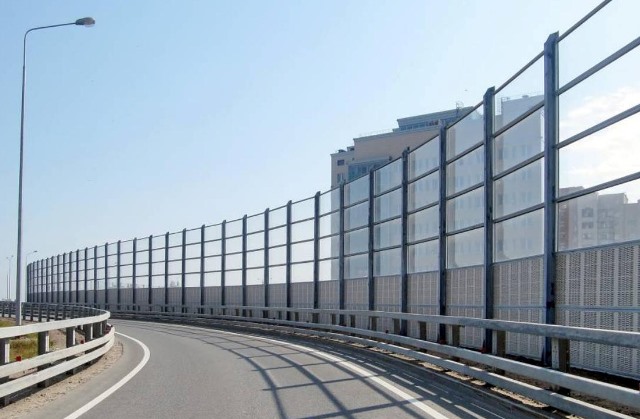
Technical requirements
All noise barriers installed along highways are subject to strict technical requirements. The basic technical requirements for noise barriers are defined in accordance with GOST 32957.
- Noise levels achieved as a result of screen installation. These values are measured with sound level meters at control points. They must comply with the parameters specified in the technical requirements and design documentation and meet sanitary sound level standards for the protected facilities. The acoustic performance must be maintained for at least eight years.
- Mechanical strength and stability throughout the entire service life of the screen. Its design is calculated for static and dynamic loads. When determining load parameters, climatic conditions and terrain are taken into account. Wind, snow, and seismic loads are determined. Particular attention is paid to the tight fit of structural elements. Structural elements must meet the strength specifications specified in the design documentation and ensure the screen's durability and strength with a reserve during the warranty period.
- Requirements for the quality of components and assembly work during screen installation. Noise barriers are installed according to approved design documentation with a permissible positional error of no more than 0.05 meters. Screens along highways must meet traffic safety standards. Barriers or parapets are provided around the screens to prevent vehicles from colliding with the structure in the event of an emergency.
- Fire safety of screens. Structural elements must be made of fireproof materials. An exception is translucent panels, which can be made of fire-resistant material. Special fire passages are provided at screen installation locations to allow quick access for firefighters and evacuation of people from the fire.
- Compliance with local architectural and landscape design requirements. Screens installed in cities must be aesthetically pleasing to preserve the architectural features of the urban environment. Noise barriers must ensure adequate road illumination and avoid fatigue for drivers and passengers.
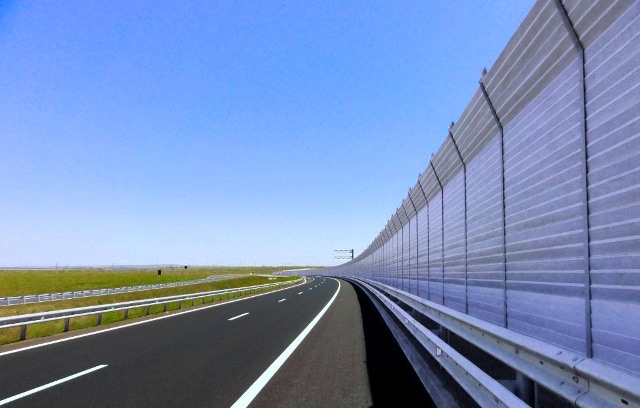
The geometric parameters of noise barriers, their length, and height are determined by the required noise reduction and the terrain features of the installation site. Quality control of the barriers and their compliance with the stated parameters is carried out in accordance with GOST 32958.