








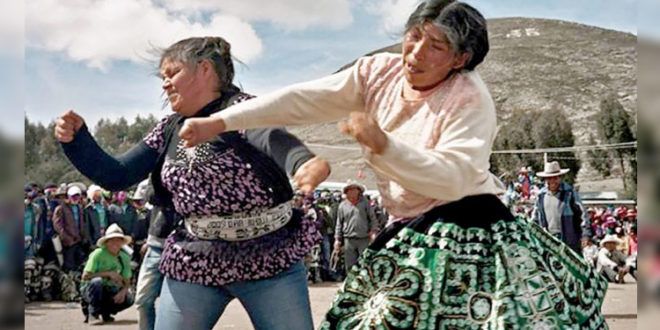
Every year on Christmas Eve, when the world awakens to the sounds of gifts and carols, in the Peruvian province of Chumbivilcas, preparations begin for communal fistfights. These fights are part of the Tacanakuy festival and are accompanied by music, dancing, food, and drink. People of all ages, from small children to the elderly, dress up in colorful costumes, fight each other with their fists to settle scores, and then join in the fun. Read on to learn more about the unique Tacanakuy festival, Peru's Christmas fistfighting festival.
The Takanakuy festival originated in the hilly region of Santo Tomas, one of the poorest regions of Peru. Because this region is geographically cut off from mainland Peru, indigenous people resolve their differences through fistfights during the Takanakuy festival.

Santo Tomás is the capital of Chumbivilcas, an Andean province in southern Peru. Residents of the hilly region of Santo Tomás are known for their resilience and hardiness. They are cut off from most resources and government services. Therefore, the people of Santo Tomás have developed a unique way to resolve conflicts. Whenever they have disagreements, instead of going to court, they resolve their problems during the Takanakuy festival.
In Quechua, the word "« takanakuy »" means "when the blood boils." The Takanakuy festival is celebrated every year on Christmas Eve. During this festival, all matters, big and small, are resolved. Grievances ranging from kidnapped girls/boys/sheep to spilled beer are heard. Even property disputes are resolved during this festival.
Participants in the Takanakuy celebration wear one of five traditional costumes representing five traditional characters with distinct roles based on Andean cultural symbols. They also wear a variety of colorful ski masks to conceal their identities before battle.

To celebrate the Takanakuy festival, Peruvians dress up in one of five traditional costumes. These costumes represent traditional characters of Andean culture. These costumes include: maheno , kvarawatanna , Negro , Langos и k'ara gallo . Mahano — is a traditional outfit for horse riding. It consists of woolen riding pants, a traditional Peruvian jacket, a leather cap, a hollow bull horn for drinking, and uayachullu (Peruvian ski mask). Kvarawatanna - It's the same suit as maheno, but with the addition of leather cowboy pants, a leather jacket and a dead bird or deer skull on the head.
Costumes blacks depict colonial-era slave owners. They include high leather boots, a shirt and vest, smart worsted trousers, a silk-embroidered cloak, and a cardboard crown. In Peru, the word "« Langos» means "locust" and the suit Langos really does look like a locust. Those who don't wear any particular type of clothing are categorized «Kara Gallo» . They take part in the procession, but do not participate in the ceremonial battles.
Preparations for Takanakuya begin several days in advance. During this period, people drink and dress up in costumes. Then, on December 25th, family processions head to the battlefield, ready to beat each other up and settle scores.

Peruvians begin preparing for Takanakuya several days before December 25th. During this time, people drink and dance, preparing for the battle. On December 25th, the entire community gathers at the local church. They have breakfast and drinks there, and then head to the battle site. The procession is family-oriented and begins with a poignant song performed by male singers as they march through the streets.
These days, many tourists visit the Santo Tomas Hills to witness the unique Takanakuy festival. Often, the tourists who gather there outnumber the indigenous population of the settlement. These people don't take part in the battles, but rather attend as spectators and join in the festivities.
Before the fight, the fighters wrap their arms in scarves. The fight begins with the participants shouting out their opponents' names, shaking hands, or hugging, and then the bout begins, reminiscent of martial arts or boxing. The fight ends with hugs or a handshake. After the fight, everyone drinks alcohol and celebrates.
Men, women, and children—everyone—take part in fights during the Takanakuy festival. Not all fighters participate to settle a serious issue. Some participate simply for sport or because they're drunk. Before the fight, people wrap scarves around their bare arms. Then, the fighters shout out their opponent's name. Both approach the central circle and shake hands or embrace. Then the fistfight begins.
During the fight, biting, hair pulling, and hitting those on the ground are prohibited. To ensure fair play and crowd control, local referees are present, armed with Roman-style whips. After the fight, the opponents shake hands or embrace. Champions are awarded honorary titles that last for life. After the fight, the townspeople dance, drink, and celebrate. The fighters drink more than everyone else to numb the pain.
The day after Christmas, a second celebration takes place in the village of Llique. Here, the best fighters from different villages compete against each other to release pent-up negative energy. Takanakuy is now celebrated in many cities and villages across Peru, including Cusco and Lima.

On December 26th, another celebration takes place in the village of Llique, located in Cusco. The best fighters from many indigenous villages gather there for a second bout. The fights involve the strongest men, women, and children from various villages. The Takanakuy festival is believed to have originated in Santo Tomas during the colonial period. It is now celebrated in almost every province of Peru. People of all social classes, including the middle and upper classes, participate. Even non-native people now participate in this cultural custom.
However, not everyone approves of Takanakuy. The Lima government has unsuccessfully tried to stop the fighting. Nevertheless, most people believe that fighting during Takanakuy actually has a therapeutic effect. They believe that confronting social tensions once a year is better than harboring negative feelings among society.
[sources: 1,2,3,4]