








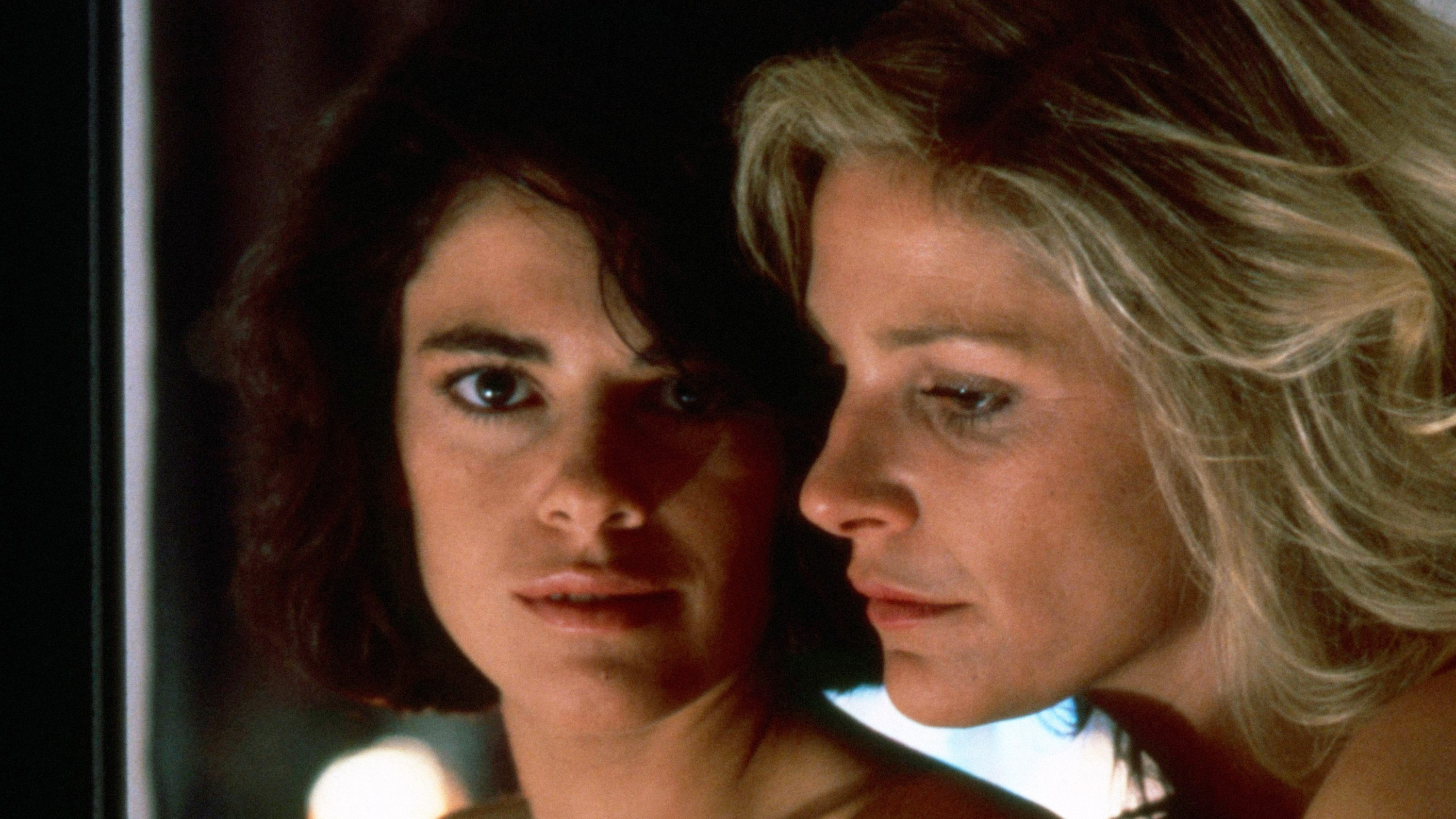
With the possible exception of director Donna Deitch, who was exceptionally single-minded, even the creators of the lesbian romance Desert Hearts never imagined that four decades after its release, the film would become the subject of historical studies and critical essays. But in the spring and summer of 1986, Deitch's first feature film, based on Jane Ruhl's novel Desert Hearts, exceeded all expectations, becoming a commercial hit and an instant queer classic—a classic that still resonates in the cultural landscape today.
In honor of Pride Month and its upcoming presentation at Frameline in San Francisco, we revisit the making of this iconic lesbian love story through the eyes of the three women at its heart: director and stars Patricia Charbonneau and Helen Shaver—better known to fans as Kay Rivers and Vivian Bell. From anecdotes about life on the Nevada desert set to attempts to sell the film to distributors on VHS, their stories illuminate the film's winding journey from a bold, grassroots project to a Sundance hit that redefined lesbian love stories on the big screen.
Related articles
Provincetown Film Festival Announces 2026 Winners: "The Hine Trial," "Maddie's Secret," "Barbara Forever" and More.
The unexpectedly cult Korean film "Take Care of My Cat" returns to theaters in 4K—watch the new trailer.
This interview has been edited for clarity and brevity.
Bringing clarity to the situation
«"This is a good opportunity to set the record straight, if you don't mind," Deitch said at the start of one of our first conversations, which touched on everything from his inspiration for John Huston's The Misfits to what journalists have misunderstood about Desert Hearts over the years. "I mean, I've read all sorts of crazy stuff, like how I sold my house to pay for the film. I didn't have a house to sell.".
With each major anniversary and re-release, Deitch fondly recalls how, as a young documentarian with no feature-length experience, she turned the rights to Rule's low-key 1964 novel into a critically acclaimed film. But she takes issue with some of the details that permeated the narrative, including her struggle to secure the rights and her near-loss of control over the project because studios wanted to replace her with a man. In fact, she says, it was relatively easy to convince Rule to direct her adaptation of the story of a wide-ranging romance between a casino worker and a professor seeking a quickie divorce in Reno in the late 1950s. And she only briefly considered accepting the studio's money before realizing how it would impact her work.
«"I was thinking about writing an original screenplay, but someone gave me the book ["Desert of the Heart"], and I thought, 'As a central metaphor, this encompasses everything I think about in terms of what this story needs. The screenplay I'm going to write is, in a sense, contained in this book.' That's what prompted me to contact Jane Ruhl," Deitch said, adding that in the late '70s, all you had to do to contact the famous resident of Galiano Island, British Columbia, was send a letter with "Jane Ruhl, Canada" written on the envelope.
Deitch, who interpreted the book's central theme as "if you don't play, you can't win" and incorporated this line into the film, recalled that Ruhl received one or two offers to adapt "Desert of the Heart" but decided early in the negotiations that she "wasn't going to give them, whoever they were, the rights." Meanwhile, her negotiations with the author about the film's direction proved far more fruitful, even if her own interactions with studios weren't quite as successful.
«"Once I got the rights from her, which was very easy, I had a few meetings myself, maybe two, about financing the film. We never got any further," Deitch said, denying another detail circulating in some sources. "There was never any talk of replacing me with a male director. I was never present for long enough in the meetings because they wanted to change the ending.".
Deciding she wasn't interested in the strings attached to the financing offer, Deitch, now agentless, began a two-year campaign to raise funds for the film through sponsorship parties. The young director decided that Gloria Steinem's support would be key to attracting potential investors to these meetings, where she sold shares of the film for $15,000 apiece. And, having met through a mutual friend, Deitch convinced Steinem—who had screened the UCLA graduate's thesis film, "Woman to Woman: A Documentary About Prostitutes, Housewives, and Other Mothers," at the offices of Ms. Magazine—to join the project.
Thanks to invitations to parties in New York, San Francisco, and other cities, which included the names of Steinem, Lily Tomlin, and Stockard Channing, Deitch was able to raise approximately $1 million for the film. Several years remained before filming began: staffing, casting, and script revisions were still underway. But by 1984, she had finalized the script with the help of screenwriter Natalie Cooper, and she had managed to find not only the leads—the young New York stage actress Charbonneau and the more experienced Canadian beauty Shaver—but also Audra Lindley for the key supporting role of Frances Parker.
Before the year was out, the director and actors embarked on a month-long shoot in the desert, along with a crew led by future cinematographer Robert Elswit (Boogie Nights and There Will Be Blood) and production designer Jeannine Oppewall (Tender Mercies). Armed with inspiration such as a Wild West photo book titled "Vanishing Breed" and Huston's tragic 1961 novel about Reno, this enthusiastic group of creatives was ready to bring Deitch's atmospheric love story to life. But only time would tell whether they could truly pull off their vision with only a modest budget and the energy of aspiring filmmakers.
Life at the Grand Motor Lodge«
When the cast and crew gathered for a few days at their home base, the Grand Motor Lodge in Reno, to get to know each other before the intense filming began, Deitch set the tone for what would become one of the most memorable filming experiences of their careers.
«"When I arrived in Reno, there was a huge bouquet of gladioli waiting for me in my room at the Grand Motor Lodge and a note from Donna that said, 'I need you. Your experience, your intelligence. We don't have time for hard feelings, so when we have disagreements, we need to resolve them now.' It was just a fantastic start," said Shaver, who appeared in several films and television series before and after "Desert Hearts" and eventually became an award-winning director in her own right.
«"That was the spirit: We were creating something together—the cast, the crew, everyone—and everyone felt like they were involved," Shaver said, adding: that it didn't even occur to her to ask Deitch if there wasn't some hint of impostor syndrome hidden behind his self-confident demeanor.
Over the years, including in Criterion bonus materials , Deitch's collaboration with the filmmakers of Desert Hearts highlighted both the clarity of her vision and the remarkable support she received from everyone involved. Part of her success with her colleagues seems to be due to luck and an eye for talent, as in the case of the still-promising Elswit and Oppewall, who served as her unofficial producers during filming.
«"I remember one time on set, Jeannine came up to me and said, 'You're obviously still rehearsing this scene. Take your time.' Yeah, what production designer would say that to a director?" Deitch said, laughing as she described the unusually close bond between the three of them and how she later realized how much they helped her navigate the filming process.
But Deitch also showed foresight, arranging for the entire cast and crew to live on location for four weeks, so that when the cameras weren't rolling, they could hang out in a motel somewhere—socializing, reviewing footage, or relaxing—while remaining immersed in the world of the film. "It was a bit like a small theater company somewhere in the country putting on a play," Deitch said, describing the motel, which Shaver nicknamed "The Not-So-Grand Motel," as one of those "U-shaped places" surrounding a swimming pool. "Of course, all films are collaborative, but here it had a small community feel, a kind of family atmosphere. And there were no agents coming in and talking to their clients—nothing like that.".
Like her more experienced co-stars, Charbonneau, who had worked exclusively in theater up until that point, felt comfortable in the intimate setting. "Because we all lived together—we weren't in Hollywood, we weren't in the L.A. scene, we were in this hotel outside of Reno—we were essentially our own little microcosm. And there was never a sense of, 'Okay, we have to rush, rush, rush. This isn't going to work,'" said the actress, who was 25 and pregnant when filming began. "I had nothing to compare it to at the time, but oh my God, then… Well, every other set was intense.".
Like Oppewall, who scouted locations early, New York-based Charbonneau arrived in Reno ahead of schedule to prepare for her screen debut by working as a money changer. But nights spent at the casino were just the first step in Charbonneau's journey to embodying Kay, a free-spirited sculptress by day who unsettles Vivian from the very first screening. Once she arrived on set, dressed in jeans and collared shirts chosen by costume designer Linda M. Bass, and surrounded by Oppewall's impressive interiors, the stunning brunette truly immersed herself in a character inspired by romantic Western characters like Clark Gable's troubled cowboy in The Misfits and a young Elvis.
«I never felt for a second that we were in 1959. There was nothing that made me feel like it was 1985. It was definitely 1959 »"," Charbonneau said, referring in particular to the furnishings of Kay's small home, the ranch Oppewall converted into housing for the divorced Francises, and the abandoned hotel that served as the fictional Golden Circle casino.
«"I mean, knowing Jeannine's sets, the costumes, Robert's work as a cinematographer, I already understood quite well—even at 25—that this was an extraordinary group of people. So I was filled with excitement: 'What are we going to shoot?'" she said.
Charbonneau wasn't the only one eagerly awaiting the start of filming. When the film's dusty, dreamy world, populated by period elements yet detached from reality, began to come to life in dailies, "everyone was thrilled," Shaver recalled. "We were saying to each other, 'You know who's going to see this movie? Scorsese's going to see this movie.' We were listing everyone who was going to see the movie," she said, laughing wistfully.
«"But who could have foreseen this?" she added. "Here we are, 40 years later, and people are discovering this film for the first or fifteenth time and finding a resonance with it. I certainly didn't expect that. I don't think any of us did.".
Creating an innovative love scene
While filming Desert Hearts often feels like a month-long poolside getaway, there were inevitably challenging moments for the director and actors, including creating the climactic love scene that defines the film—even more challenging than the dramatic production design and breathtaking scenery.
Deutch waited until the last week of filming to shoot the two-part scene in which Kay and Vivian, exiled from the ranch, finally engage in intimacy. But ever since she began dreaming about her first feature film, long before she read Rule's rather chaste novel, she knew sex would be the central theme. "I didn't want to make another movie that ends in a bisexual triangle or suicide. None of that interested me. I just made the movie I wanted to see—and it had to have a really hot love scene," Deutch said, joking that lesbian films without sex seem to appeal to many people because "everyone makes them," but not her.
Besides being very attractive, she was determined for this moment to be meaningful, unlike many of the sex scenes she'd watched in preparation. This meant the scene needed to have a beginning, middle, and end, like any other carefully crafted sequence. But it also required chemistry between the two actors to make it truly compelling.
«"In most Hollywood films, if an actor is a star, they don't audition. So, what's called 'chemistry' only emerges during filming; it's either there or it isn't. Everyone tries, but it's not always possible to achieve the desired result," Deitch said.
«"That's what I was most excited about: I had to see it, because if I didn't see it in the audition, it might not happen," she added, describing how she initially chose the relatively inexperienced Charbonneau and then chose Shaver based on the actors' chemistry at the Los Angeles casting call. "In that audition she [Charbonneau] had with Helen, it was obvious—no doubt about it.".
Both Charbonneau and Shaver understood how important this captivating moment between Kay and Vivian was to Deitch's vision and had no qualms about filming it, despite warnings from their agents. ("People thought this movie shouldn't have anyone in it, even if they didn't have to take their clothes off and make love to another person of the same sex," Deitch recalled.) But when it came time to strip down for the closed-set shoot involving Deitch, Elswit, the magician [Martin J. Leighton], and the stars, the scene proved challenging in unexpected ways.
«"After filming that scene—after I felt incredibly intimate, incredibly vulnerable—I went home to my little hotel room, ran a bath, and burst into tears," said Charbonneau, who, aside from being pregnant, had never filmed an intimate scene before, unlike her co-star. "It was a long time ago, of course, but I remember that moment very clearly. It was just a moment of relief, a sense of accomplishment.".
«"It was hard for me. I wanted it to be right. I was in very good hands, so it wasn't so much about that. It was about finding that sensuality and being comfortable with a few other people in the room—you know, at 25 years old," she said, pausing briefly. "It was so important to get it right, because why make a movie if you're going to ruin their moment of true love?"»
For 33-year-old Shaver, filming this scene was perhaps a little less stressful, partly because she had experience being naked on camera, and partly because she struggled to get out of her own head and into the character. Elswit was especially helpful in this last aspect, teaching her to let go of little things that viewers wouldn't notice, like a tired look in a close-up. And when it came time to film Vivian's orgasmic sexual awakening, she embraced the dynamic of the scene, which she described as "emotionally draining" but also "satisfying and exciting," and the fact that Vivian allowed herself to be caught up in her desire for Kay and where it might lead.
«"For me, the difference between a truly good performance that's impossible to fault and a great performance that's impossible to take your eyes off of is whether the actor is willing to be fully present in the moment, accepting the imaginary circumstances but speaking from [their] truth. But, like any intimate relationship, that doesn't happen on the first date," Shriver said, reflecting on Vivant's evolution over the weeks of filming.
During a love scene, she said, "I was coming to terms with the fact that I'd never had an orgasm with another person... And at one point [my hand] goes up, and you see my little finger... twitch," describing the subtle, involuntary gesture that she experienced as a breakthrough. "I don't know if the audience sees it now, but I felt it when it happened, and I let it happen.".
After another conversation about intimate moments that occurred during filming and a few jokes about nipples, Shaver steered the conversation in a different direction, livening it up in her signature way. "I'll tell you, the most challenging scene, the scene I had the hardest time getting through, oddly enough, was the horse walk," she said, referring to the sequence where Vivian and Kay lead the horses across a plateau for logistical reasons. "I was like, 'Why aren't we riding horses?'—that was the first thing that bothered me. But there was a moment in the dialogue that I really struggled with. And then one of the horses stepped on my foot.".
Cigarettes and video cassettes
After filming the love scene and the final shots, the cast and crew of "Desert Hearts" left Reno, hopeful but still uncertain about the film's fate. Now Deitch faced the most important task—selling the film, but first she needed to find an editor, which meant raising additional funds. "I didn't have the money for an editor while we were shooting," Deitch said, explaining that she had to work on post-production afterward out of necessity. "It's very unusual. But if you don't have the money, you don't have it.".
Deitch returned to selling stock in the film to raise money—including from Lindley, who presented her with a check for $15,000 at a wrap party—and her efforts were rewarded with some luck. Badlands editor Robert Estrin, who had launched a new company working exclusively with videotape, was available, and Deitch, despite the uncertainty, jumped at the chance to work with him. "He said to me, 'Look, I'm editing on video now. This is my new thing... If you want me to work, it's included,'" Deitch said, describing how she managed to bring Estrin on board when other filmmakers were too intimidated by the process, which in her case involved transferring master copies from 35mm film to 3/4-inch videotape.
«"And he said, 'And the second thing I have to tell you is that I wasn't there, as you know, during your shoot, so I need to do something that's probably a little disturbing to you. I need to take these 3/4-inch tapes, all of your footage, and splice master to master. I need to look at the film exactly like this… because I need to see the continuity of the entire scene,'" Deitch said, joking that "if you really want to experience the nightmare," hand over the master tapes of your film and then watch them splice together on videotape, which degrades in the process.
«"He did, and we started. I don't think I finished the first video because it was too hard to watch. But that's how we got started," she said.
Eventually, Deitch got over the shock of seeing the footage on video and resigned herself to the idea that everything would be fine once she saw the final version on film. As the film neared completion, both she and Estrin—whose vintage transitions add even more romance to the wide-angle landscapes and intimate close-ups of Elswit—were pleased with the progress, so the debutant director decided to screen it for a select group of distributors ahead of upcoming film festivals. It proved a challenging public debut for Desert Hearts, but at least it confirmed to Deitch that she had made the steamy lesbian film she had been aiming for.
«"It was terrifying because they'd never seen anything like it," Deitch said, referring to the audience's reaction to the video editing, which convinced her to wait until the film was released again on 35mm to offer it to theaters. "But what was so funny was that we were in this theater, and when the love scene started, some people started lighting cigarettes.".
Recalling the days when people still smoked in movie theaters, she added, "It was funny. But beyond that, it was terrifying. Because, you know, you're sitting in the theater, watching your movie, and you feel what's happening.".
However, when the final version of Desert Hearts reached the studios, everything changed. After screening at the Telluride Film Festival in Toronto in the fall of 1985 and then triumphing at Sundance a few months later, the film sparked a bidding war for distribution rights—not to mention, according to the director, fulfilling the actors' dream of being seen by the biggest names in the industry. Ultimately, the Samuel Goldwyn Company secured the film's distribution rights for 20 years, and in the spring of 1986, it grossed well beyond expectations. By the summer, the film was hailed as a first by both audiences and critics in the LGBT community for its cinematic quality, gripping love scene, and hopeful ending.
Of course, an explicit lesbian romance featuring two straight women wasn't without its critics. Charbonneau, who returned to Reno with Shaver and Deitch just weeks after giving birth to shoot a poster, was heavily criticized for bringing her infant to press conferences. (Charbonneau recalled one interviewer, possibly from the Village Voice, writing something along the lines of, "Is this her sign of heterosexuality?", referring to the presence of her infant.) But unlike many classic queer-themed films, even the initial reaction to Desert Hearts was overwhelmingly positive. The director and stars began to realize they had created something truly culturally significant, something that would largely define the next four decades of their lives.
«"In a way, it was the beginning of everything for me—the realization of a dream, the opportunity to make a film, the beginning of motherhood," said Charbonneau, who now watches the film with strong emotions, imagining herself as a 25-year-old and thinking about people like Lindley who are no longer with us.
«"What can I say? This is one of the most wonderful moments of my life and certainly one of the highlights of my career," she said.
Like her co-star, Shaver described the film's creation as a transformative moment, one that had a ripple effect on both her career and personal life—helping her get into filmmaking and introducing her to her second husband, with whom she has a son. "None of us did it for the money. None of us did it because we thought, 'Okay, this is going to be a movie that's going to last 40 years, this is going to have potential.' It wasn't like that. It was a much more pure, simple, 'I need to do this. I want to do this. This movie needs to be made,'" Shaver said, adding that the experience "changed her life on every level.".
«"When I opened the script and read the second paragraph—it was something like, 'The train pulls into the station, and a woman, Vivian Bell, gets off,' and there's a description of her—I knew I was going to be in this movie. It was incredibly clear," she said. "So when I look back on that moment, I think, 'Well, that was the bell.' But I didn't think that 40 years later I'd be here, the grandmother of a 14-month-old boy, talking to you.".
Deitch, who often talks to strangers about the film and invites them to screenings, is perhaps least surprised by the widespread reach of her first feature. From the start, the director, who later made The Women of Brewster Place, adhered to the principle of "if you don't play, you don't win," as if she always knew the bet would pay off. And her conviction that this was the film that needed to see the light of day has only strengthened over the years.
«"I think I'm the custodian of this film. I'm not the producer or the director, but I am the custodian because this film will outlive us all," Deitch said, summing up where she and the Desert Hearts stand four decades later.
The 40th anniversary screening of Desert Hearts will take place at Frameline Cinema on Thursday, June 18.