






ShareTweetWhatsAppPinShareEmail0 Share
Blood has always held more significance than just a simple biological fluid. It sustains life, signals injury, and has long symbolized everything from lineage and sacrifice to vitality and death. Throughout history, people have consumed it, prescribed it as medicine, offered it as sacrifices to supernatural forces, added it to paint and mortar, and sometimes found uses for it that seem almost impossible today.
Modern scientific methods have made some of these practices even stranger. Archaeologists can now identify proteins and other biological traces left behind thousands of years ago, finding blood in Bronze Age kitchen utensils, Ancient Egyptian ritual drinks, African sculptures, and centuries-old medicines.
Here are ten unusual ways blood was used in the past.
See also: 10 Stunning New Discoveries About Humanity's Past, Based on DNA.
10 Bronze Age Mongolian Nomads: Food
Bronze Age cauldrons filled with blood have been discovered in gruesome archaeological finds.
Approximately 2,700 years ago, people living in what is now northern Mongolia cooked something bloody in large bronze cauldrons. This isn't just a suggestion of a particularly grisly meal. Modern protein analysis has revealed direct evidence of ruminant blood in two ancient vessels.
Proteins came primarily from sheep, goats, or closely related animals. Researchers believe the blood was likely collected during slaughter and then used in cooking. One likely source is blood sausage, which is still a staple of Mongolian cuisine.
One of the cauldrons also contained milk proteins, including a peptide specific to yak milk. This doesn't necessarily mean someone invented sausages made from yak blood and milk in the Bronze Age. Dairy products could have been introduced into the vessel during a separate cooking or processing process, and the researchers acknowledge other possible uses for the blood, including rituals.
However, the food explanation has an appealing continuity. Thousands of years before refrigeration or modern meat processing, livestock farmers may have already been ensuring that almost nothing from a slaughtered animal was wasted, including its blood.[1]
9 Ancient Roman Cure for Epilepsy
Why did Roman doctors prescribe gladiators' blood as a cure for epilepsy?
Roman gladiatorial combat was bloody. For some spectators, it was apparently more than just entertainment. It was medicine.
Ancient authors recorded the belief that drinking the warm blood of a recently wounded or slain gladiator could help treat epilepsy. Celsus described patients who reportedly drank blood directly from a gladiator's slit throat, and Pliny the Elder wrote with disgust of epileptics drinking the blood of fallen fighters, as if from living chalices.
This practice was partly based on the belief that fresh blood contained a person's vital force. Gladiators, who personified strength, courage, and physical prowess, may have seemed particularly effective donors. The sudden shock and horror associated with consuming blood at an execution or in the arena also became part of later explanations for why some patients claimed it was effective.
There may even have been a deceptive reason for the cure's reputation. Some forms of epilepsy naturally undergo periods of remission. If seizures ceased after a person ingested the gladiator's warm blood, the cure was credited with the cure.
For a gladiator, of course, this was one of those types of medical treatments in which being a donor was significantly worse than being a patient.[2]
8 Ancient Egyptian Ritual Psychedelic Drinks
The ancient Egyptians used psychedelics, and this vase proves it.
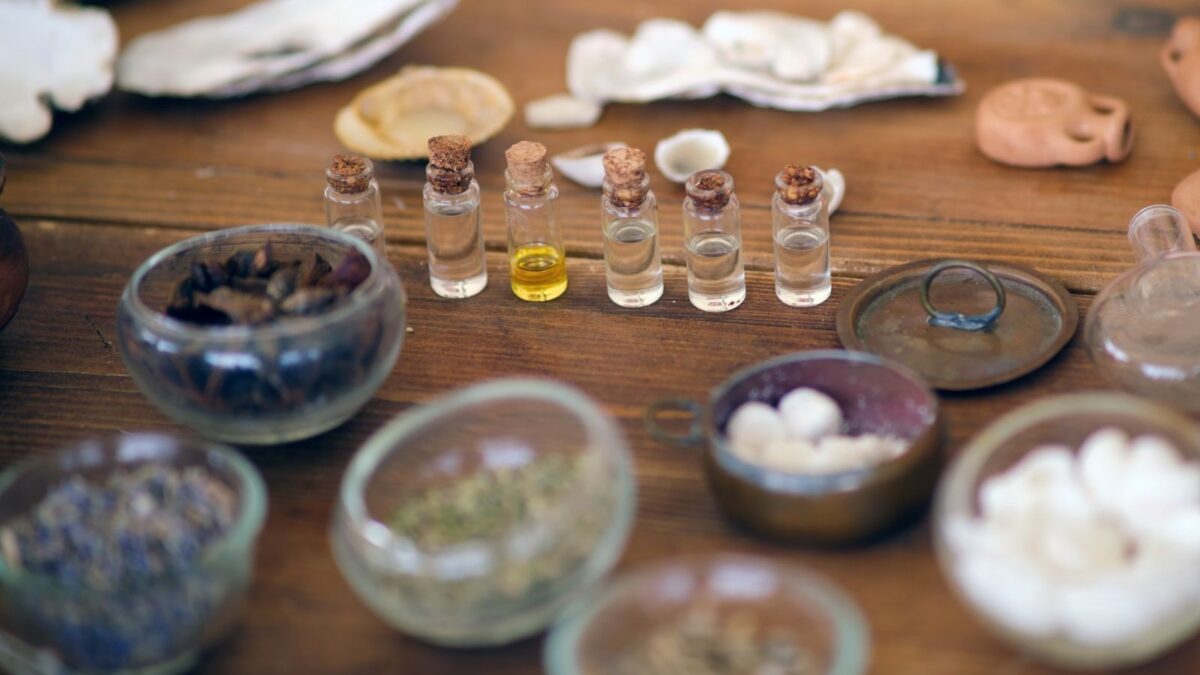
A small Egyptian vessel, decorated with the face of the dwarf god Bes, sat in a museum collection for years, seemingly harmless. Scientists then analyzed the remains it contained.
The bowl, dating back approximately 2,000 years, contained a remarkable mixture. Researchers identified Syrian rue, blue water lily, another medicinal plant, a fermented fruit alcoholic drink, honey or royal jelly, wheat, sesame, and traces of human bodily fluids.
These human samples contained substances consistent with the presence of blood, breast milk, and oral or vaginal mucus.
Bes was associated with protection, fertility, childbirth, music, dancing, and other aspects of domestic and ritual life. Both Syrian rue and blue water lily contain compounds capable of psychoactive effects, and alcohol would have added another dimension to this experience. Therefore, researchers believe the cup may have contained a ritual drink, not an ordinary everyday beverage.
It's unclear exactly what ceremony required this combination. Authors speculate it may have been associated with rituals involving Bes, intoxication, fertility, or mythological reenactments, but a single vessel cannot establish a universal Egyptian recipe.
Whatever its purpose, it's definitely not a cup you'd want to take to a party without first asking what's in it.[3]
7 Dogon and Bamana Artists: Coverings for Ritual Statues
History of the Dogon and their ancient science.
Some wooden sculptures from Mali developed thick, dark surface layers that puzzled restorers. This patina didn't resemble ordinary paint, varnish, or the natural discoloration of old wood. The answer turned out to be much more organic.
Scientists analyzed samples of ritual sculptures from the Dogon and Bamana peoples, dating back several centuries. Traces of blood were found in seven of the eight samples.
This discovery confirmed ethnographic evidence describing multiple ritual offerings applied directly to sacred objects. The blood of sacrificed animals could be poured or rubbed onto the figurines along with other substances, including millet-based preparations. Over time, these repeated libations formed a dense surface coating visible on the sculptures.
Thus, blood was more than just a decorative element. These objects played an active role in religious life, and each new offering could renew or enhance their ritual significance. What now appears as a uniform dark patina may in fact retain traces of ceremonies repeated over generations.
Museums typically take pains to ensure their collections are free of fingerprints and traces of bodily fluids. For these objects, removing old stains would mean removing part of what originally made them sacred.[4]
6. Early Modern Europeans: Medicine
Centuries when Europe ate the dead.
In early modern Europe, if you fell ill, your local pharmacy might offer you medicines containing herbs, minerals, animal products, and sometimes even parts of another person.
In European cadaveric medicine, human skulls, fat, flesh, and blood were used to treat various ailments. Fresh blood was particularly popular, as some believed it preserved the life force of the person from whom it came.
For the poorest patients who couldn't afford sophisticated medications, public executions represented a disturbingly economical source of income. In parts of Germany and Scandinavia, epileptics would sometimes gather near the scaffold with cups, hoping to drink the condemned man's still-warm blood. In some places, patients were then ordered to run until they fainted, which was thought to facilitate the medication's effect.
This practice existed far longer than the term "early modern medicine" might suggest. Nineteenth-century descriptions still mention the collection of blood from executions, and in 1908, a woman in Freiberg, Germany, unsuccessfully attempted to obtain the blood of an executed criminal to treat epilepsy.
By that time, medical science had changed dramatically, but apparently some people were not ready to give up a remedy that had centuries of terrible traditions behind it.[5]
5. Nazca: Blood for a Bountiful Harvest
Nazca Culture: Read Between the Lines
The ancient Nazca lands of southern Peru are famous for their massive desert geoglyphs, but their ritual practices may have been far more bloody than the lines carved into the landscape.
Archaeologists have discovered numerous so-called trophy heads associated with the Nazca culture. Some show cut marks, indicating that the scalp was intentionally cut open during preparation, while other evidence points to decapitation as part of a complex system of ritual violence.
One particularly revealing burial at La Tize revealed a decapitated man, whose cervical vertebrae bore cut marks consistent with decapitation occurring around the time of death. Next to him was a ceramic vessel shaped like a human head, with a tree sprouting from it.
This strange combination has helped researchers connect decapitation with ideas of fertility, agricultural renewal, and rebirth. Comparable Andean traditions also linked ritual bloodshed to nourishing the land before planting. However, archaeologists cannot prove that the Nazca themselves followed every detail of these later practices.
It can be said that Nazca imagery repeatedly linked severed heads, plants, and renewal. Blood spilled during ritual violence could therefore symbolize more than just death. In the harsh desert conditions, where crops depended on unstable water supplies, it could also symbolize new life.[6]
4. Sikan: A binder for paints and a symbol of rebirth
🔴🔵Chiclayo: Restos de sangre humana fueron encontrados en máscara de oro del Señor de Sicán
Approximately 1,000 years ago, the Sican people of northern Peru buried a nobleman beneath a monumental temple. They placed his body upside down, painted it bright red, and surrounded it with unusual funerary items, including a gold funerary mask covered in red cinnabar.
This pigment was discovered several decades ago. Researchers were puzzled by what organic material was holding it to the metal after a millennium underground.
Eventually, proteomic analysis revealed the answer: the paint contained proteins from human blood and bird eggs.
Blood and egg whites likely helped bind the cinnabar pigment to the gold surface, but the choice of ingredients may also have had symbolic significance. The severed head of a man was positioned vertically beneath a mask, while two young women in the tomb were positioned in poses interpreted as childbirth and midwifery.
Researchers have suggested that the bright red mixture of cinnabar and human blood may have symbolized vitality and rebirth, helping to transform the deceased ruler into an afterlife.
Thus, for the Sicans, human blood could serve two functions at once: to hold the paint on the golden mask and to help that mask symbolize the return of life.[7]
3. Revolutionary France: Political Relics
The brutal execution of King Louis XVI of France
When Louis XVI was executed by guillotine on January 21, 1793, thousands of people gathered in Paris to see the former king beheaded.
For some spectators, simply watching the execution was not enough.
Contemporary accounts described how, after the execution, people rushed to the scaffold and dipped handkerchiefs in Louis's blood. Others reportedly collected pieces of his hair or clothing. At least one account claimed that the bloody handkerchiefs were carried away, with people shouting that they contained "the tyrant's blood.".
These macabre souvenirs were in keeping with the highly political atmosphere of the French Revolution. Louis was no longer simply a corpse or even a deposed monarch. His execution symbolized the destruction of the old royal order, and possessing something stained with his blood allowed supporters of the Revolution to take home a tangible souvenir of that moment.
Later, legends arose that the decorated pumpkin contained one such bloody relic, and early DNA studies briefly seemed to confirm this story. However, more comprehensive genetic analysis later undermined this identification, making it unlikely that the surviving specimen actually belonged to Louis XVI.
Fortunately for those with an interest in the macabre, the dubious pumpkin is unnecessary. Eyewitness accounts already clearly indicate that some viewers perceived the blood of the executed king as the most disturbing political souvenir in the world.[8]
2. Kingdom of Dahomey: Blood in the Sacred Solution
House of Blood: The Untold Story of Human Sacrifice in Africa
In the 19th-century kingdom of Dahomey, in what is now Benin, human blood was reportedly used for something far more lasting than just a ritual offering. Tradition holds that it was mixed directly into the walls of sacred buildings.
King Ghezo, who reigned from 1818 to 1858, built funerary structures in the Abomey palace complex in memory of his predecessor, Adandozan. According to oral tradition, the mortar used in the construction contained red oil, ritual water, and the blood of 41 human victims—a number with special spiritual significance.
For years, it sounded like the kind of horror story that could unfold around a powerful African kingdom.
The scientists then tested the walls.
In 2024, a proteomic study identified proteins from human and chicken blood in material taken from the sacred structure. The analysis could not confirm that the blood was provided by 41 individuals, but it did demonstrate that human blood was indeed incorporated into the building material.
This practice is consistent with Voodoo traditions, in which blood sacrifices could sanctify sacred sites, strengthen spiritual powers, and maintain connections between the living and ancestors.
Most rulers honored the memory of the dead with statues or monuments. Dahomey apparently went even further, making blood part of the architecture itself.[9]
1. Luoyue: Rock paintings connected by blood ties.
The mystery of cave paintings created with human blood.
For more than 2,000 years, enormous red figures have clinged to the limestone cliffs of Huashan in southern China, braving heat, humidity, monsoon rains, and everything else the subtropical climate can throw at them.
Recently, researchers discovered that part of the secretion may have been blood.
The Luoyue people created their paintings using a complex, multi-layered system. First, a limestone cliff was laid down. On top of this, the artists applied a solution containing slaked lime, calcium phosphate or bone ash, and blood. The final red layer consisted of clay rich in fine particles of hematite pigment.
The researchers discovered proteins from human and animal blood in the material. These proteins apparently facilitated the formation of tightly packed calcium carbonate crystals, effectively helping the pigment-containing layer bond with the limestone beneath.
The attachment proved remarkably strong. Some samples were so firmly attached to the rock that the researchers needed a power drill to remove them.
Scientists also discovered proteins consistent with human blood from women during childbirth, suggesting that fertility beliefs influenced blood selection. This interpretation remains speculative, but the practical effect is much more obvious.
Two thousand years ago, artists from Luoyue added blood to their paints and inadvertently—or perhaps intentionally—created a kind of biomineralized glue that could withstand millennia of tropical climates.
Many artists claim to put their blood into their work. Perhaps the Luoyues meant it literally.[10]
More great lists
 10 Incredibly Complex Ways People Used to Tell Time.
 10 Most Frequently Used Household Items…
 10 Amazing Radioactive Products People Actually Used.
 10 Incredible People Who Overcame Their Grief and Used…
 10 Truly Evil People Who Used Halloween As The Perfect Cover-Up
 10 Strange Things People Used to Do on New Year's
 10 Worst Fashion Trends of the Last Century
 10 Unusual But Necessary Food Safety Rules of the Past
 10 Most Common Technical Terms That Hide a Dark Past.
Fact checked by Darci Heikkinen ShareTweetWhatsAppPinShareEmail0 Share Jana Louise Smith
Yana makes her living as a freelance writer and author. She has written one book on a dare and hundreds of articles. Yana loves uncovering unusual facts about science, nature, and the human mind.
Read more: Facebook Smashwords HubPages