







WhatsAppRedditShareEmailTweetPin0 Shares
The International Spy Museum in Washington, D.C., houses, according to its curator, "the world's largest public display of espionage-related artifacts." These range from decoy pens to vehicles representing different countries and decades. But, as in MI6's Q Lab, some exhibits are more surprising than others. Here are ten of the most disturbing.
10. Pigeon camera
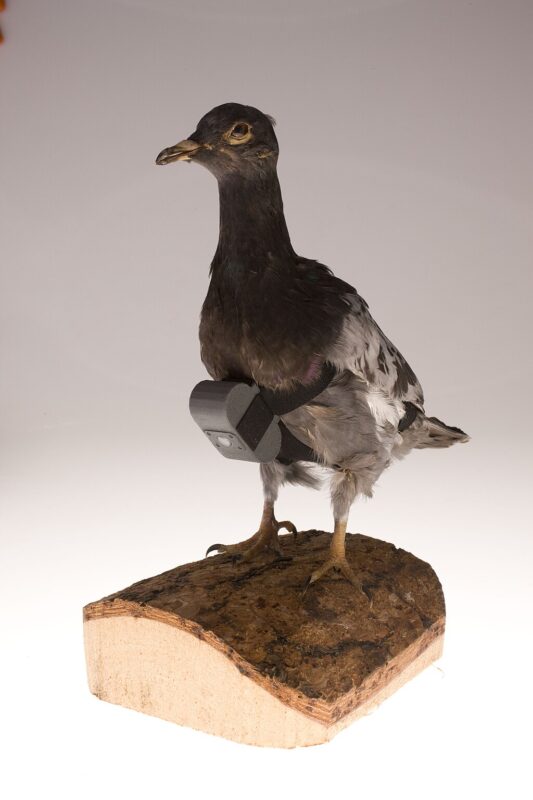
Animals have often been used for military purposes. For example, dolphins and sea lions have been used to detect mines, bats have been armed with bombs, and elephants were once used as living tanks. But for reconnaissance missions, nothing beats birds. Pigeons are particularly useful due to their homing instinct, hence their use as messengers during the two world wars—for which they received numerous medals (which we're sure they showed off to their granddaughters). This instinct also allows trainers to release them in locations where their return route will take them over a target of interest.
During the Cold War, the CIA saw potential and attached tiny cameras to birds. Compared to airplanes and satellites, they reasoned, pigeons fly closer to the ground, allowing them to capture more valuable information. Operators could set the camera to shoot instantly or to trigger after a preset delay. The camera mounted on the pigeon at the Spy Museum is only a replica (the real one is on display at the CIA's private museum in Virginia), but it is an exact replica. The camera itself is less than 5 centimeters in diameter and weighs about 35 grams—a cutting-edge achievement at the time.
Apparently, the plan was to fly pigeons equipped with cameras to Moscow and secretly release them—possibly through a hole in the floor of a car. However, it is unknown whether these birds were actually used or how often.
9. Universal skeleton key
From a forensic perspective, lock picking is a challenging endeavor. Even professionals leave scratches in the keyhole—a clear sign that it has been forced. Of course, lock picking can also be a labor-intensive process. That's why, since at least the 1960s, key duplication has been the preferred method. Using a portable device to record the key's pattern, spies could record the position of the key's teeth to later duplicate it. Naturally, this method relied on the availability of the key. Furthermore, making the key took time.
This is where the so-called "cam-operated pin tumbler lock system" comes in. This device, a masterpiece of precision engineering, features a key with removable teeth and a cylindrical dispenser for replacing each of them. A key blank is inserted into the lock, leaving no trace of forced entry, to determine the position of the pins, and the dispenser replaces the teeth. The detailed description here is a bit complex, but essentially, it allows anyone to have a custom key made right on the spot—near the lock they want to open.
Developed by a British toolmaker as a hobby, it was never intended for mass production. However, as soon as the CIA learned of it, they ordered a whole batch for their spies.
8. Artificial glass eye
A counterfeit is exactly the kind of complex mechanism you'd expect from the inventors of spy technology. And what could be more iconic to this profession than a glass eye that's not just a glass eye? In pop culture, such a device is best known thanks to James Bond's arch-nemesis, Ernst Stavro Blofeld, head of SPECTRE, whose bionic eye could record and store video, as well as play it back on a connected device. It could also receive audiovisual data from the twin eye worn by Primo, aka Cyclops, Blofeld's representative. (Incidentally, Primo's eye is on display at the Spy Museum.)
However, the museum's real fake glass eye—the very same one actually used by spies in the field, in this case during World War I—is considerably less sophisticated. Meticulously hand-painted to depict even blood vessels, it was used solely to conceal intelligence during missions. This could include, for example, a list of spies in microdot form—that is, a sheet of text reduced to such a size that it was unrecognizable even as text without proper magnification.
7. Bulgarian umbrella
Umbrellas are ubiquitous on the streets of London and serve as effective cover in many ways. In 1978, the so-called "Bulgarian umbrella" was chosen by the KGB to assassinate Bulgarian dissident Georgi Markov. Since his defection to the West nine years earlier, he had been a thorn in the side of his government, speaking out against living conditions in his country and the USSR on the American-backed Radio Free Europe.
The Bulgarian umbrella was essentially a pistol that fired a tiny, pinhead-sized pellet of ricin. Few other poisons could guarantee a lethal outcome with the tiny dose this pellet delivered—and it had to be tiny, so as not to arouse suspicion, at least until it was too late. As Markov recalled to his friend and colleague Theo Lirkoff shortly before his death, a burly foreigner nudged him in the leg with the tip of an umbrella near his workplace in London, at the BBC Foreign Service. The attacker apologized and fled in a taxi. Just a few hours later, Markov began to feel weak, and the next day he was hospitalized, where his condition rapidly worsened. This apparently gave the killer ample time to escape.
6. Lipsticks with a twist

In the spirit of Penelope Pitstop from "Wacky Races" and her girly gadgets, the KGB lipstick pistol "delivered a deadly 'kiss.'" This single-shot 4.5mm pistol fired not with a conventional trigger, but by pushing the barrel into the victim. Otherwise, it looked like an ordinary lipstick, attracting little attention from Cold War-era border guards. (Incidentally, a pistol shaped like a tobacco pipe existed for male agents.)
This femme fatale pistol (a replica of the original) isn't the only deadly gadget in the Spy Museum's collection. There's another one they've nicknamed "The Smell of Death." This black, unremarkable pistol, borrowed from North Korea, is designed to hold a vial of "liquefied poison gas." Spies and assassins commonly carry it, though primarily for suicide if captured.
The museum displays numerous other North Korean spy gadgets. The most popular, according to a South Korean journalist who apparently spied on visitors, is a Parker pen with a poisoned needle that kills by paralysis and asphyxiation. A perfect complement to lipstick, this pen is triggered by twisting the top and pressing down, launching the needle toward the victim from up to 10 meters away. It was apparently used during the raid on the South Korean prime minister's residence in 1968.
5. Camera in a bra
Women have long been excellent spies, not least because they were rarely suspected—especially in patriarchal countries. One of the most intriguing gadgets aimed at women was a bra nicknamed "The Meadow." Developed by a group of female Stasi agents, it was equipped with a camera activated by a handheld remote control. Essentially, it allowed agents to help suppress dissent without taking off their favorite summer dress.
Recently, the giant corporation Nestlé equipped a bra with a mini-camera for a bizarre advertising campaign. The idea was to raise awareness of breast cancer by showing, from the breast's perspective, how often "breasts are examined every day." The film then asked, "When was the last time you checked your breasts?" Of course, this campaign was likely a rather cynical move to distance itself from the aggressive advertising of breast milk substitutes in the past.
4. 45-Second Camouflage Kit
The CIA's 45-Second Disguise Kit contains everything an agent might need to quickly change their appearance. Items range from the mundane to the outlandish—from scissors and a comb to a false mustache and shoe inserts to alter their gait. The kit also included a paint brush and mixing bowls, a wig, alcohol glue, tweezers, cold sore cream, glasses, mascara (for a mustache), and, of course, a mirror.
The main advantage, however, was its speed of application. Developed for the Cold War by the agency's chief of disguise, Tony Mendez, it allowed a person to disguise themselves in 45 seconds—despite 45 stages. In one version, the first stage involved disguising the outfit itself, specifically as a grocery cart with an inflatable paper bag, bread, and vegetables—all at the push of a button. The next stage involved turning the jacket inside out, transforming it into a woman's coat with an attached shawl. Then, the agent would pull up his trousers to reveal black stockings, tuck his shoes under his shirt to simulate sagging breasts, and put on "new black Mary Janes." Finally, he completed the look with a gray curly wig. Another version, developed for a 1970s mission to spy on a Russian nuclear facility, disguised the agent as a bearded old professor. This version used a "semi-animated" mask from a prosthetic artist who worked on Planet of the Apes.
3. Rectal instrument set
The CIA's rectal instrument kit had nothing to do with working on the rectum. It was actually a pill-shaped container designed to conceal objects in the anus. The standard contents were a collection of escape tools—lock picks, drills, saws, knives, files, wire cutters, and so on. During the Cold War, it was issued to agents as a means of avoiding strip searches.
Despite its impressive size (approximately the length of an adult man's palm), the capsule was precision-crafted for safe insertion. It had no sharp edges, closed tightly with a click, and had a completely smooth surface, preventing it from falling out inside the agent's body.
In this regard, it was superior to the MI6 version. It not only had sharp edges, but also intentionally roughened handles running along the entire capsule, presumably to make it easier to open when wet.
2. Artificial scrotum

An artificial scrotum, designed to conceal (ahem) sensitive items like a miniature escape radio, was another invention of Tony Mendez's when he was chief of the CIA's Disguise Division. He believed the scrotum was the only area not thoroughly inspected during a strip search. To pitch the idea to his boss, Mendez ordered a subordinate—a young technical officer—to wear it to a meeting with Director Richard Helms, then remove his pants to see if Helms could tell the difference. However, the director, a conservative man, simply left the room in horror and disapproved of its use. Instead, the scrotum was tossed in a desk drawer and forgotten for decades.
Little is known about this gadget. The Spy Museum received no records when it was acquired. However, they speculate that it is made of latex and, with its folds and pubic hair, is modeled after a real person's testicles. They also believe it was intended to be glued.
As the museum guide noted, the artificial scrotum at least proves that espionage isn't as glamorous as the Bond films make it out to be. "This job," she said, choosing her words carefully, "requires a lot of… dedication.".
1. Stazy aromatic jars«
The East German secret police, the Stasi, was one of the most bizarre and paranoid organizations of its kind. Few things illustrate this better than their scented bottles, used to collect secret information.
Each of these sealed glass containers contained the scent of a citizen the government feared. The scents were collected in a variety of ways: from personal belongings during searches, clothing left in locker rooms or at work stations, and sweat-absorbing rags hidden in chairs during interrogations. Sometimes, tubes were even inserted into the walls to suck the odors out of homes. The scents were labeled "GK," which stands for Geruchskonserve, or "scent sample," along with the date and time of collection, the citizen's name, and their 12-digit identification number.
The reason for using scent bottles was simple: to train sniffer dogs to track anyone the Stasi deemed suspicious. As strange and outdated as it may seem, the German government used this tactic back in 2007 against G8 activists. Who knows, maybe they're still collecting these scents.
Other articles that may interest you