






WhatsAppRedditShareEmailTweetPin0 Shares
The Marvel Cinematic Universe is arguably responsible for bringing the concept of the "multiverse" into the everyday lexicon of millions of people worldwide, but it didn't originate the idea. The multiverse theory, or many-worlds theory as it was originally called, was proposed in 1957 by physicist Hugh Everett. Before Everett, Erwin Schrödinger had proposed essentially the same idea. Everett was more scientific, Schrödinger more philosophical. However, at their core, both had the same idea.
You may have never heard of Everett, but you probably know Schrödinger. He's the same guy who conducted the famous cat experiment; that cat experiment is part of the foundation of the multiverse theory. Part of Schrödinger's experiment was that it's unknown whether the cat in the box is alive or dead. You can already see how this is starting to lead to the multiverse theory. Perhaps it's dead in one universe and alive in another.
The key to understanding Schrödinger's experiment is that when you open the box to look at the cat and determine whether it is alive or dead, there is nothing scientifically unreasonable about the possibility that the other outcome could have been true.
Moreover, on paper, it's scientifically plausible if a different outcome occurs. So, to put it simplistically and without taking into account many nuances, there's nothing to suggest that another universe couldn't exist where events unfold differently. Welcome to the multiverse. But is it real or just a theory?
Multiverse
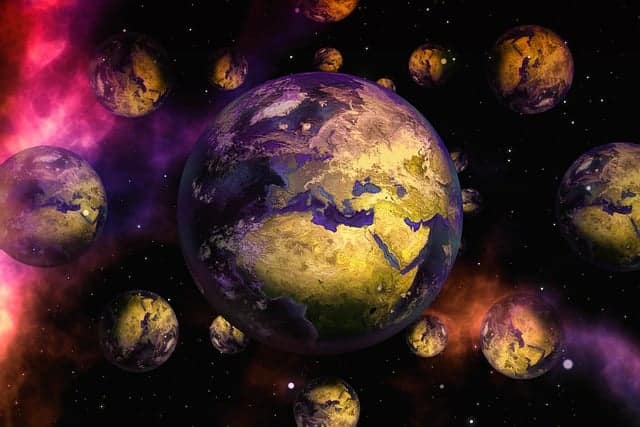
Since Everett, other scientists have turned to the multiverse theory to advance their own ideas. It's certainly not the realm of superheroes and science fiction, but the theory is certainly controversial. Like any good scientific theory explaining something esoteric, it's based on our current scientific knowledge, along with a fair amount of guesswork and speculation. There's no evidence to support its reality. But there's also little evidence to refute it.
In a sense, the multiverse can be compared to a tiger in the bathtub. If a guest in your house tells you there's a tiger in your bathtub, your natural instinct is to immediately respond, "Of course there isn't one." But you don't know for sure, right? Not with 100% certainty. You'll never know for sure unless you check. And if for some reason you can't get to the bathtub to check, you'll never, ever know for sure, no matter how improbable it may seem.
There are several different approaches to the idea of a multiverse. The cosmological multiverse theory proposes that immediately after the Big Bang, when the universe came into being, it created many such bubbles. Each one represents a separate universe, slightly separated from the main universe that gave rise to it. Over billions of years, this potentially infinite number of bubbles evolved in their own ways, so that some could be almost exactly like our own, while others could be unimaginably different and completely uninhabitable. Our universe would be just one of these bubbles.
String theory also allows for the idea of a nearly infinite number of parallel universes, each evolving in almost any conceivable way, with only slightly different parameters each time.
Returning to Everett and his many-worlds theory, he believed in a quantum multiverse. Simply put, the universe is constantly dividing. This means that when you go to breakfast and choose between pancakes and waffles, and you choose pancakes, that universe continues to exist, while a new universe divides, and you choose waffles.
One of the key features of the multiverse theory is that we can't see or understand these other realities. They are completely separate from our own. This, of course, makes proving their existence difficult. As for why anyone would believe in their existence if there's no way to observe them, that's a little easier to explain.
The concept of a multiverse can explain a lot. Science doesn't know what it doesn't know. What caused the Big Bang? Why does time flow the way it does? Why do all the scientific constants we consider essential to reality exist in the way they do?
If a multiverse exists, it might help us understand why things work the way they do in our universe. It's entirely possible that we were simply lucky, and all these factors are just minor variations that came together to create a functional universe, while another universe is a chaotic place because we were unlucky there.
Arguments for a Multiverse

The idea of a multiverse is certainly a good one, but what evidence is there? What science can support this idea? There's far more evidence than you think, especially if the Avengers and Spider-Man are the only things you connect with.
One argument for a multiverse is based on our understanding of space itself. If space is infinite, then the multiverse must be real. There are only a limited number of ways matter can be arranged, and in an infinite space, at some point, matter will be arranged identically more than once. Therefore, our world, our reality, must have repeated itself almost exactly over and over again, and also in completely different ways over and over again. After all, infinite space is very large.
For clarity, a deck of cards is used. A deck of 52 cards can be shuffled only a limited number of ways. At some point, patterns begin to emerge. Will you eventually land exactly the same 52 cards in the correct order? Yes, of course, but shorter chains will also occur. You'll land the same three, four, or five cards in a row over and over again.
Along with the Big Bang theory, which explains the beginning of our Universe, there is the theory of inflation, which states that the Universe has expanded, increasing in size by 90 times in the smallest fraction of a second imaginable.
Inflation is one of the most widely accepted theories of the origin of the universe, explaining much, but it brings us back to the bubbles we discussed earlier. Some parts of the universe would expand faster than others, and where the expansion slowed, these bubbles would form. These would be tiny pocket universes, and an infinite number of them could exist.
There is even potentially visible evidence for the existence of multiverses, but this remains theoretical for now. Physicists in Europe studying the cosmic microwave background radiation, left over from the formation of the universe itself, discovered something unusual in 2010. Circular patterns are visible in this background radiation. It has been theorized that these patterns represent what might be called "bruises" from collisions between other universes and our own.
One of the most compelling arguments for the multiverse theory suggests that our universe isn't even real, but merely a simulation. Based on our knowledge of computers, it has been proposed that an advanced race, whether aliens or humans in the future, could create a computer so powerful that it could simulate every human mind that has ever existed. In fact, it could simulate far more than has ever existed, and do so with remarkable ease.
What's strangely disturbing is that this theory, if logically sound, is itself confirmed by reality. The likelihood that it's true is high, and we'll never know because we're programmed not to know. The upside is that it will essentially never affect our daily lives.
Another argument for the existence of a multiverse lies in the sheer complexity of our own. Consider how many things must come together for our universe to function the way it does. Not just what must have happened for life to emerge on Earth, but also how gravity must work to keep the sun burning so brightly, so warmly, and for so long. How subatomic forces must work to hold atoms together. How molecules must interact to enable the complex chemical reactions that create a habitable environment, an atmosphere, and so much more. It's an infinite number of things that must work together perfectly. This is sometimes called the "fine-tuning" argument.
Given all this complexity, the multiverse theory offers a new answer. Most universes don't work. Life can't arise, planets can't form, and nothing can function as we know it. But since there are an infinite number of potential universes, some of them must work, and our universe is an example.
In fact, there are many other arguments for the existence of a multiverse. Some are extremely complex, while others are undoubtedly more philosophical. Some may even contradict each other, but all of them demonstrate the willingness of physicists and other scientists to try to explain what we experience every day by looking far beyond the visible.
Arguments against the multiverse
Let's start with the last argument: our universe is so complex and unlikely to exist that there's a good chance it's simply a lucky roll in a multiverse of failed attempts. While the logic is understandable, others argue that it's an example of the gambler's fallacy. The idea is that a gambler, losing all night, believes their next dice roll will definitely be a winner because they've already lost so many times. But there's nothing in probabilities to support this idea.
By the same logic, an infinite number of other failed or smaller universes isn't required to explain why our universe works the way it does. Whether they all exist or none exist is irrelevant to our universe, so the argument is meaningless. Based on this logic, one cannot conclude that a multiverse exists.
A similar argument against this version of the multiverse theory can be boiled down to comparing it to faith. If the fundamental principles of our universe are so complex and seemingly impossible that we must propose an infinite number of other, less perfect universes to explain our own, doesn't that sound a lot like theology? None of this can be proven, so we have to take it at face value that the multiverse has blessed us with our more or less perfect universe.
The biggest problem with any of these theories is their inability to derive or prove the existence of a multiverse. Take, for example, inflation, which creates these tiny bubble universes. Every time inflation slows, a Big Bang occurs, creating a new universe within that bubble. Big Bangs can happen again and again. But we know from our own universe that we know nothing about anything before the Big Bang or beyond our own. We can't test these ideas. They go beyond the laws of physics as we know them in our own universe.
The multiverse theory, while helping to explain many problems in quantum physics, also creates entirely new ones of absurd proportions. If an infinite number of realities exist, then anything absurd could happen in any one of them at any moment.
It's entirely possible that there's a universe where the sun explodes for no apparent reason. It's entirely possible that dinosaurs survived and became our masters. It's entirely possible that you're pondering this question right now, and you're a very smart penguin. Stupid? Perhaps, but the multiverse should support it.
Ultimately, however, one of the main arguments against the multiverse theory today remains largely the same as when it was first proposed. For any theory to be proven, it must be tested. With the multiverse theory, this is completely impossible.
Ultimately, we've reached a dead end. There are numerous arguments supporting the existence of the multiverse. But there are also numerous arguments against it. We have no evidence to support the reality of the multiverse, and nothing to definitively deny its existence.
We only have one reality, the one we currently exist in. We have ample practical evidence of our existence, the existence of our universe, and that's all we have to deal with. Until scientific breakthroughs occur that challenge the laws of physics, this is all we have.
Other articles that may interest you