








Pin4RedditShareTweetEmailWhatsApp4 Shares
Measuring intelligence is a difficult task. IQ tests exist, but they are generally considered partially or completely incapable of assessing a person's intelligence. Your IQ says little about your intelligence, and tests are often highly biased.
Now, given the challenges associated with human intelligence testing, which relies on mutual understanding between the tester and the person being tested, imagine how difficult it is to measure the intelligence of a non-human being. Most of us know, albeit from personal experience, that some animals are considered smarter than others.
People constantly post videos online of their pets doing amazing things, like opening doors or fetching unusual objects. Does this indicate intelligence? If so, how much? Similarly, it's common knowledge that animals like dolphins and chimpanzees are considered smarter than most other members of the animal kingdom, but the scientific research and testing underlying these findings is so richly entrenched that the average person takes it at face value.
What makes an animal smart?

There are many types of intelligence. You could call this basic theoretical knowledge, but that's just one of them. Logic and reasoning, emotional intelligence, and even musical intelligence are different types, with different applications and developed in different ways. And that's just for humans. For animals, however, it's necessary to go beyond human-centered definitions and concepts.
For some, this means things like learning ability and how an organism applies what it learns. So, when you teach a dog a trick, it's a form of intelligence. But animals obviously learn on their own, too. They can also learn in a group, which isn't the case with humans. By this, we mean collective intelligence, something you might observe in a beehive.
Some researchers compare animals to humans to give us at least a rough idea of what intelligence means in animals. Your dog might be as smart as a small child. A chimpanzee can be smarter than a four-year-old. And crows are like seven-year-olds.
Many of these studies are limited and biased. For example, the dog study relied on the number of words the dog could learn and the feedback from dog training judges. It's like a baker teaching you to bake, making you bake a cake, and then judging your intelligence based on that cake. There are many missing pieces to this equation.
More advanced studies of animal cognitive abilities involve direct examination of their brains. Dogs undergo MRI scans to see how their brains function.
The easiest way to understand animal intelligence is through observation. Animal behavior may seem insignificant or random, but patterns and repetitions are what you notice over time. Any pet owner knows exactly how smart their pet is. They can solve problems, they have emotions, maybe even a sense of humor. But if that's not enough science for you, we have something better to offer.
Chimpanzee
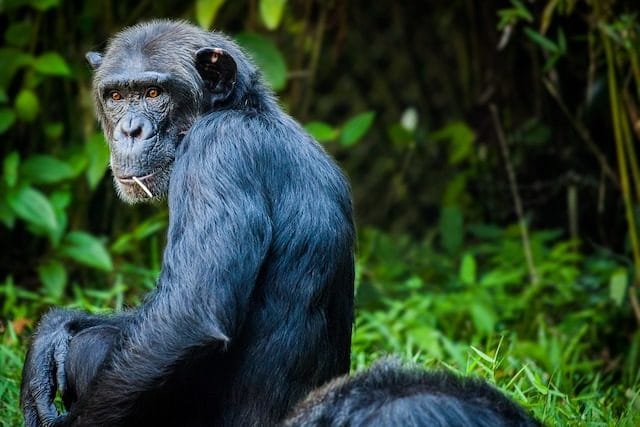
Chimpanzees are often considered the epitome of animal intelligence. Our closest relatives, they rank at the highest level. And it's a well-deserved title. In many ways, though not all, as we'll see later, chimpanzees are incredibly intelligent.
There's still debate about the reliability or difficulty of chimpanzees' understanding of human language, but some individuals have demonstrated the ability to communicate using sign language in the past. Like humans, chimpanzees work in groups, exhibit self-awareness, kindness, empathy, and many other seemingly human-like traits.
When it comes to tool use, it's not just monkeys cracking nuts with stones. Chimpanzees in Gabon use entire tool kits consisting of five different sticks, each with a different size and purpose, to break open hives and extract honey. They make these tools in advance and then head to the hives. Chimpanzee communities use up to 25 different tools, and older apes teach younger ones how to make them.
A 2013 study conducted in Japan shocked internet users when a video accompanying the test showed a chimpanzee performing a task of memorizing the numbers one through nine, randomly displayed on a screen for a fraction of a second (actually 210 milliseconds). The chimpanzee performed this task with incredible accuracy, surpassing that of adult humans attempting the same task. Even humans who had undergone extensive training were unable to outperform the chimpanzee.
The memory test was conducted on only one chimpanzee, and the results are not typical for all chimpanzees. Nevertheless, the fact that an ape can easily outperform a human in such a task is remarkable.
Some researchers have suggested that the idea of what distinguishes humans from other animals in terms of intelligence needs to be reconsidered. Most of the things we thought made us unique are no longer relevant and are observed in chimpanzees. Language, particularly symbolic language, appears to be our greatest achievement.
Dolphins

Dolphins are known to learn very quickly and demonstrate a wide range of intelligence. This includes not only logical thinking and problem-solving skills, but also emotional intelligence. They exhibit empathy and compassion for both grief and joy. The part of their brain responsible for processing emotions is even more complex than that of humans.
Dolphins have the ability to communicate with each other, and this ability is extremely complex. They can also understand human language in the form of gestures, including combining them to form symbols.
They possess a complex social structure. They exist in communities and thrive as social beings, much like humanity. Like us, they possess self-awareness, social norms, and even basic functions such as toolmaking and use.
Dolphins possess an understanding of relative abundance and mathematical abilities. They were the first non-primate animals shown to grasp the basic numerical concepts of "smaller" and "larger." Later studies showed that they understand and utilize nonlinear mathematics in their hunting using echolocation. The way they blow bubbles and use sonar pulses suggests that they calculate fish positions in their heads.
Biologically, dolphins are second only to humans in brain-to-body ratio—the size of their brain relative to their body size. Their cerebral cortex is similar in structure and complexity to that of humans. They also possess unique spindle neurons, which assist in complex cognitive functions such as reasoning, recognition, problem-solving, and more. A 2014 study found that one species of pilot whale, a type of dolphin, has more neocortical neurons than any other mammal, including humans. And of course, brain size isn't the only indicator of intelligence, which we'll discuss later, but it's worth considering.
Crows and ravens
Research on bird intelligence is relatively new compared to, for example, research on chimpanzees. For a long time, birds weren't considered particularly intelligent because they have relatively small brains. But not all birds are the same, and some have proven to be exceptionally intelligent.
In an experiment designed to determine whether crows are capable of conscious thought, electrodes were implanted in their brains to observe how they responded to trained stimuli. The birds responded to signals on monitors due to neuronal activation, which did not occur without a visual cue, indicating conscious awareness of what was happening. Although the crow's brain is structurally distinct, its functioning is not significantly different from that of mammals.
In numerous experiments, crows have demonstrated the ability to use tools to solve puzzles and obtain food. They have been shown to recognize and even remember human faces for many years. They can also warn others about people they dislike, and these crows will display aggression toward humans even if they have never interacted with them before.
Their puzzle-solving skills have been compared to those of monkeys, and in some cases even said to surpass them. They can be shown a puzzle, and they will solve it without training on the first try, something few other animals can do. For example, crows are able to recognize recursive patterns, something previously only accomplished by primates and humans, and they do it better than monkeys.
In the wild, crows have been observed calling to attract larger predators, such as wolves and foxes, to carrion. They wait for larger predators to tear apart the carcass to access the meat they otherwise wouldn't be able to obtain on their own.
From a human perspective, crows have demonstrated an understanding of zero. At first glance, this may seem unimpressive, until you consider that even humans have struggled for quite some time to master the abstract concept of zero—that is, a number, not nothing. In experiments where crows were trained to match numbers, they were able to identify zero as a number and also understand its order in sequence, meaning they know that it comes before one. They possess a true numerical understanding of the difference between zero and one.
In one experiment, crows demonstrated their ability to think ahead and plan for the future by returning tokens for various rewards, choosing lower-quality items plus an extra token, based on the assumption that a more valuable reward could be obtained in the future by turning in the token.
A similar result was obtained in a completely different experiment, when crows selected a specific tool from a variety of objects that they couldn't use at the time, but which had previously allowed them to obtain their favorite food. They chose it in the hopes of using it again in the future. They were able to remember how to use this tool even 17 hours later. A similar experiment with four-year-old children showed that they are not as capable of understanding the problem and its solution as birds.
Octopus
In 2008, the Starfish Aquarium in Coburg, Germany, developed a problem. Their electrical system kept shorting out. They'd fix it, only to have it short out again. And so it did. It soon became clear that the cause wasn't technological, but biological. They had an octopus named Otto who would splash water onto the lights, causing short circuits.
The octopus had been trained to spray water at people, but it decided to climb out of its tank and knock out the light. It only did this when the light was on, and the staff believed the hassle this caused to people trying to fix the lamp amused the octopus, who was known to enjoy games, including playing chess for a while.
In Cornwall, an octopus named Louis spends hours playing with a Mr. Potato Head toy. Other octopuses regularly escape from their tanks, sometimes moving to other tanks to feed on fish. One octopus in the tank was able to recognize a specific employee and sprayed water only on that person when they approached. Other experiments have confirmed that octopuses can differentiate between different people they encounter, recognizing and favoring some over others.
Aristotle once called octopuses stupid because they approached a person's hand when immersed in water. His notion of intelligence seemed based more on fear of the animals than curiosity. But this curiosity proved beneficial to the species. They learned to hunt alongside fish, using landmarks as a guide.
Researchers tested octopuses in real-life situations and discovered some surprising things. These creatures are capable of solving puzzles, opening containers, and escaping from areas considered safe for children.
The octopus brain and the human brain are very different, and perhaps that's why we're only just beginning to appreciate their intelligence. Two-thirds of an octopus's neurons are located in its arms, not its brain. In other words, they think with their whole body. Octopus intelligence evolved completely differently than ours. But not on 100%.
Some octopus species have genes called transposons. Humans also have many such genes, and they are associated with learning and memory formation.
Octopuses, even in the wild, demonstrate tool use. They use rocks and shells to defend their ocean lairs. Smaller species have been observed with the venomous tentacles of the Portuguese man-of-war, which they use as weapons.
In 2009, octopuses were observed carrying coconut shell halves underwater. The researchers noted that the octopuses had to exert effort to carry them, moving more slowly and in a more exposed manner. However, they later used the shells as shelter, reassembling both halves while the octopus hid inside. This was repeated multiple times, indicating that the octopus understood the potential benefit of the shells and was willing to risk short-term danger for the long-term gain once it reached its destination.
Octopuses and other cephalopods seem even more impressive and tragic because their lifespans are astonishingly short compared to humans. Everything they seem capable of learning and understanding happens in just a couple of years. Most live only a year or two.
Other articles that may interest you